
Executive summary
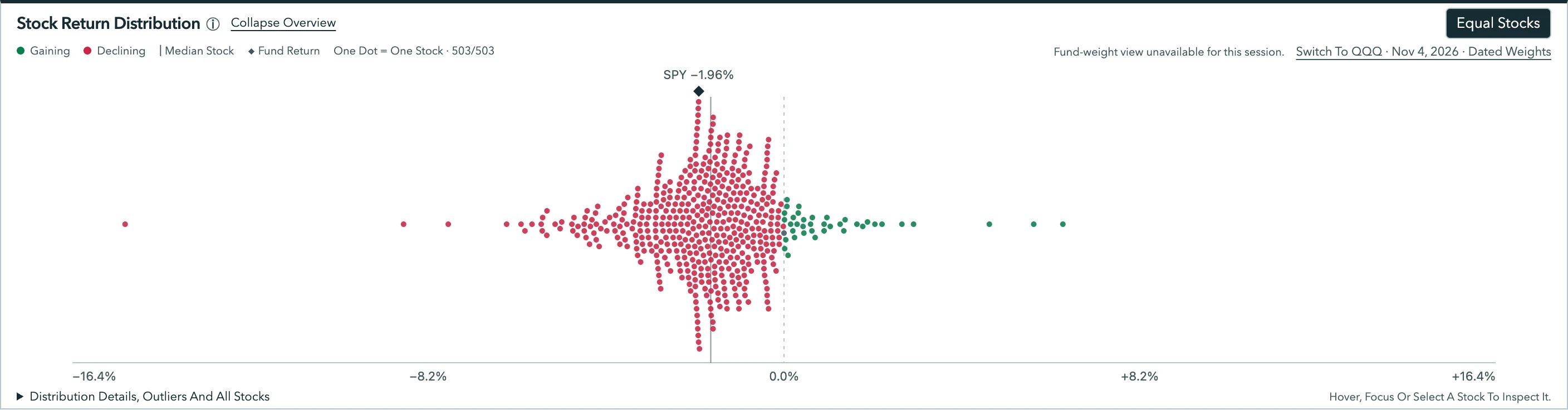
SPY and QQQ opened higher on Thursday and closed near their lows. SPY fell 1.96% to $715.87, a sixth straight decline, and QQQ fell 2.19% to $645.04, its lowest close since the October 6 high. Both closes were under the bear lines we set a day earlier, $726.80 and $656.10. The selling was broad: 38 of 503 S&P 500 members rose, the median stock lost 1.69%, and no sector had a majority advancing. CNBC reported the Dow's first close below 50,000 since June.
Anthropic began trading at about 11:48 a.m. ET at $111.50, 34% above its $83 offer, and closed at $97.17. Stocks reached their session lows soon after that first trade by CNBC's account, which is timing and not a cause. Anthropic's strategic investors fell: Amazon 3.87%, Alphabet 3.46%, Nvidia 3.30%. AMD lost 7.72% on the day Hunterbrook Media, whose affiliated fund is short the stock, published allegations about its China ties; AMD says the claims misrepresent its business. In the evening California Attorney General Rob Bonta's office said it had served an investigative subpoena on Nvidia. A subpoena asks questions and is not a finding.
No sustained rebound came after the close. CNBC had futures flat at 6:00 p.m. and, by 7:50 p.m., Nasdaq-100 futures down 0.5% and S&P 500 futures down 0.2%. QQQ finished the evening 0.47% lower, and SPY ended at $714.99, down 0.12%, per 5-minute bars. Anthropic lost a further 4.70%, AMD 3.41% and Nvidia 0.91%. Intuit, which reported once the market had closed, was about 10% lower. In Asia on Friday morning the Kospi opened about 4% lower and the Nikkei fell as much as 4.5%.
Our stance stays cautious on SPY and QQQ, and on concentrated AI. For the three closes through Tuesday we put 60% on a further decline, 25% on a hold and 15% on a recovery of the lines broken on Thursday. The bear trigger is a close under Thursday's low for either fund. The evening's last prices already sat under both lows, and regular-session closes decide.
Since the close
Clock times are Eastern; Central follows in parentheses. Each after-hours percentage compares a final evening trade, at or before 8:00 p.m., with the 4:00 p.m. close. SPY is the exception: its numbers are read from 5-minute bars. Futures readings are CNBC's. Several funds, among them the Dow, small-cap, Japan and Korea funds, showed only their closing price in the evening, and for those we print nothing.
- 4:02 p.m. filing; quotes at 5:36 and 7:59 p.m. (3:02, 4:36 and 6:59 p.m. CT) — Ross Stores. Third-quarter sales rose 12% to $6.3 billion and earnings were $1.91 a share (company filing). The fourth-quarter earnings guide of $2.16 to $2.25 compared with a $2.28 estimate cited by CNBC. The stock, down 3.41% in the regular session, was 7% to 9% lower in the first minutes and about 5% lower by 7:59 p.m.
- About 4:05 p.m.; filings at 4:08 and 5:26 p.m. (3:05, 3:08 and 4:26 p.m. CT) — Intuit. Fiscal first-quarter revenue rose 12% to $4.4 billion, and the second-quarter earnings guide of $3.17 to $3.22 a share compared with a $3.73 estimate cited by CNBC. Intuit also agreed to sell Mailchimp to Bending Spoons. Its filing describes an all-cash base price of $3.68 billion with a separate investment of about $368 million in the buyer; its release describes $3.31 billion in cash plus $368 million in stock. The shares were 13% to 15% lower early and ended the evening at $279.74, down 9.77%. A call write-up from a trading-news outlet reported that CFO Sandeep Aujla guided second-quarter revenue growth to 6% to 7% and said Credit Karma ran below plan, and that CEO Sasan Goodarzi attributed the shortfall to higher interest rates. These are company statements, with the speakers as the write-up named them.
- 4:09 p.m. filing; 4:30 p.m. call; quotes at 5:36 and 7:58 p.m. (3:09, 3:30, 4:36 and 6:58 p.m. CT) — Keysight. Fiscal fourth-quarter revenue was a record $1.99 billion, non-GAAP earnings were $3.61 a share, and the first-quarter revenue guide is $2.04 billion to $2.06 billion (company filing). A gain of about 1.5% at 5:36 p.m. faded to roughly flat by 7:58 p.m. CEO Satish Dhanasekaran said AI bookings ran about 2.5 times the prior year's, as reported in a call write-up.
- 4:15 p.m.; quote at 7:59 p.m. (3:15 and 6:59 p.m. CT) — Gap. CNBC reported adjusted earnings of 82 cents a share and a full-year outlook cut to about flat sales, with the company citing warmer weather. CEO Richard Dickson told CNBC that Gap is "really in turnaround mode". The stock, which is outside the dashboard's four groups, rose 3.61% after hours.
- 5:36 and 7:59 p.m. (4:36 and 6:59 p.m. CT) — Anthropic. The shares were 0.8% under their first-day close at 5:36 p.m. and ended the evening at $92.60, down 4.70% and still about 11.6% above the offer price. We found no company statement. Among its strategic investors, Amazon ended 0.39% lower, Microsoft 0.68% and Broadcom 0.82%, and Alphabet 0.24% higher.
- 10:27 a.m. report; final evening trade by 8:00 p.m. (9:27 a.m. and 7:00 p.m. CT) — AMD and the Hunterbrook allegations. Hunterbrook Media's report alleges, among other things, that AMD firmware appeared in software updates from a Chinese server maker after that company was added to the U.S. Entity List. Hunterbrook disclosed that its affiliated fund was short AMD and long a basket of comparable securities when the report was published, and the report says its records do not by themselves establish a violation of export law. AMD told CNBC that the claims misrepresent its business practices and that it complies with U.S. export controls. CNBC said it had not verified the findings. These are allegations and not findings. AMD closed the regular session down 7.72% and ended the evening at $472.51, down a further 3.41%. The names to read it against are Nvidia and the chip funds SMH and SOXX, whose evening figures are in the next entry. For the Outlook, AMD was a named leader in Wednesday's bull case, and its losses are part of why the bull weight is lower.
- 5:49 p.m. CNBC; 8:05 p.m. The Hill (4:49 and 7:05 p.m. CT) — the Nvidia subpoena. California Attorney General Rob Bonta's office said it served an investigative subpoena on Nvidia. It is asking whether Nvidia's advanced chips or confidential information may have gone to China, and whether the company misled investors and the public about that risk (the office's release). Those are questions and not findings. CNBC said Nvidia did not immediately respond. Nvidia was 0.2% lower around 5:50 p.m. by CNBC's reading and ended at $144.65, down 0.91%. The chip funds SMH and SOXX ended 1.45% and 1.30% lower, and AMD ended at $472.51, down 3.41%.
- 6:00 p.m. open; 7:50 p.m. update (5:00 and 6:50 p.m. CT) — futures and the two funds. CNBC had futures opening flat, with S&P 500 futures down 0.1% and Nasdaq-100 futures down 0.2%. By 7:50 p.m. it had Nasdaq-100 futures down 0.5%, S&P 500 futures down 0.2% and Dow futures down 56 points. QQQ ended at $642.03, down 0.47%, after a low of $640.02. SPY's 5-minute path ended at $714.99 after ranging from $713.29 to $716.49. The median AI 30 name was 0.32% lower at 4:30 p.m., 0.88% lower at 7:00 p.m. and 1.29% lower at 8:00 p.m.; by final trades the median loss was 1.32%, with 1 of the 29 quoted names higher. We found no reported cause for the drift.
- 7:00 p.m. Tokyo and Seoul open; reports to about 7:52 p.m. (6:00 and 6:52 p.m. CT) — Asia, Friday local time. The Kospi opened about 4% lower and fell below 5,000, and the Nikkei 225 fell as much as 4.5%; the readings differ by the minute they were taken. CNBC had SoftBank Group down 16%, SK Hynix about 6%, Tokyo Electron about 7% and Advantest more than 9%; a trading-news outlet had SoftBank down about 14% earlier. These are chip and AI-financing companies, which is the read-through to SMH, Micron and Nvidia.
- As of about 8:25 p.m. (7:25 p.m. CT) — Thanksgiving week. The NYSE calendar lists its markets as closed on Thursday, November 26, with a 1:00 p.m. ET close on Friday, November 27.
- What it means for the Outlook. The evening extended the day's direction. SPY's 5-minute path finished below the fund's regular-session low and QQQ ended below its own, and those two lows are the new bear lines described later. The high of SPY's path, $716.49, was more than $10 under the $726.80 line the fund broke on Thursday, which is its bull level in the new set. For QQQ we go by the final trade. Only regular-session closes count.
Section by section
The pulse: 38 of 503 S&P members rose
SPY: −1.96%, 7.6% of 503 members advancing (38 up, 464 down, 1 unchanged), 23.5% / 49.2% / 48.9% above the 20-, 50- and 200-day averages. QQQ: −2.19%, 10.9% advancing (11 of 101), 19.8% / 39.6% / 39.4%. AI 30: 0 of 30 up, 6.7% / 6.7% / 20.0%. Crypto-related equities: 1 of 7 up. The S&P count fell from 237 on Wednesday, and 7.6% is the lowest share advancing in the 20 sessions the tab's Dated Readings table shows.


How the day traded: above Wednesday's bull levels intraday, under its bear lines at the close
SPY opened at $737.46, 0.99% above the prior close and above its 200-day average of $732.69. It traded as high as $739.90, which was over the $738.07 bull level we had set, and closed 22 cents above its low of $715.65, at 0.9% of the day's range. The close was 2.30% under the 200-day average, and the dashboard's strip reads "2 sessions below 200-day". QQQ opened 1.76% higher at $671.09, reached $676.49, above its $671.68 bull level, and closed at 2.2% of its range, 5.56% under its 200-day average for a fifth session.
By CNBC's account the S&P 500 was up about 1% just after the open and the Nasdaq as much as 2% early. Gains faded before Anthropic's first trade and stocks reached session lows soon after it. Reuters described the day as Anthropic's debut failing to revive enthusiasm for AI stocks, which is the outlet's framing. Measured against the lines from Wednesday, SPY closed 10.93 points, or 1.50%, under its bear line and QQQ 11.06 points, or 1.69%, under its own. We leave the grading to Friday's look back on the week.
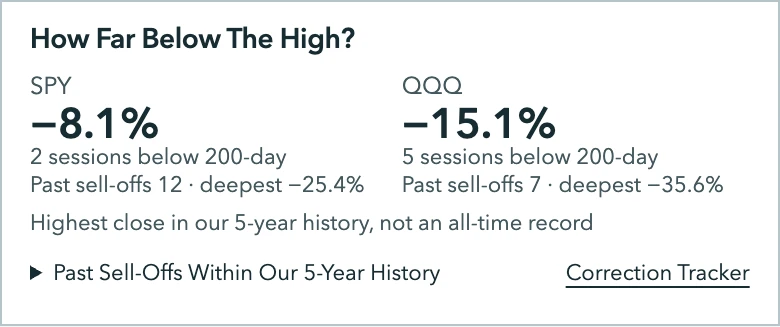
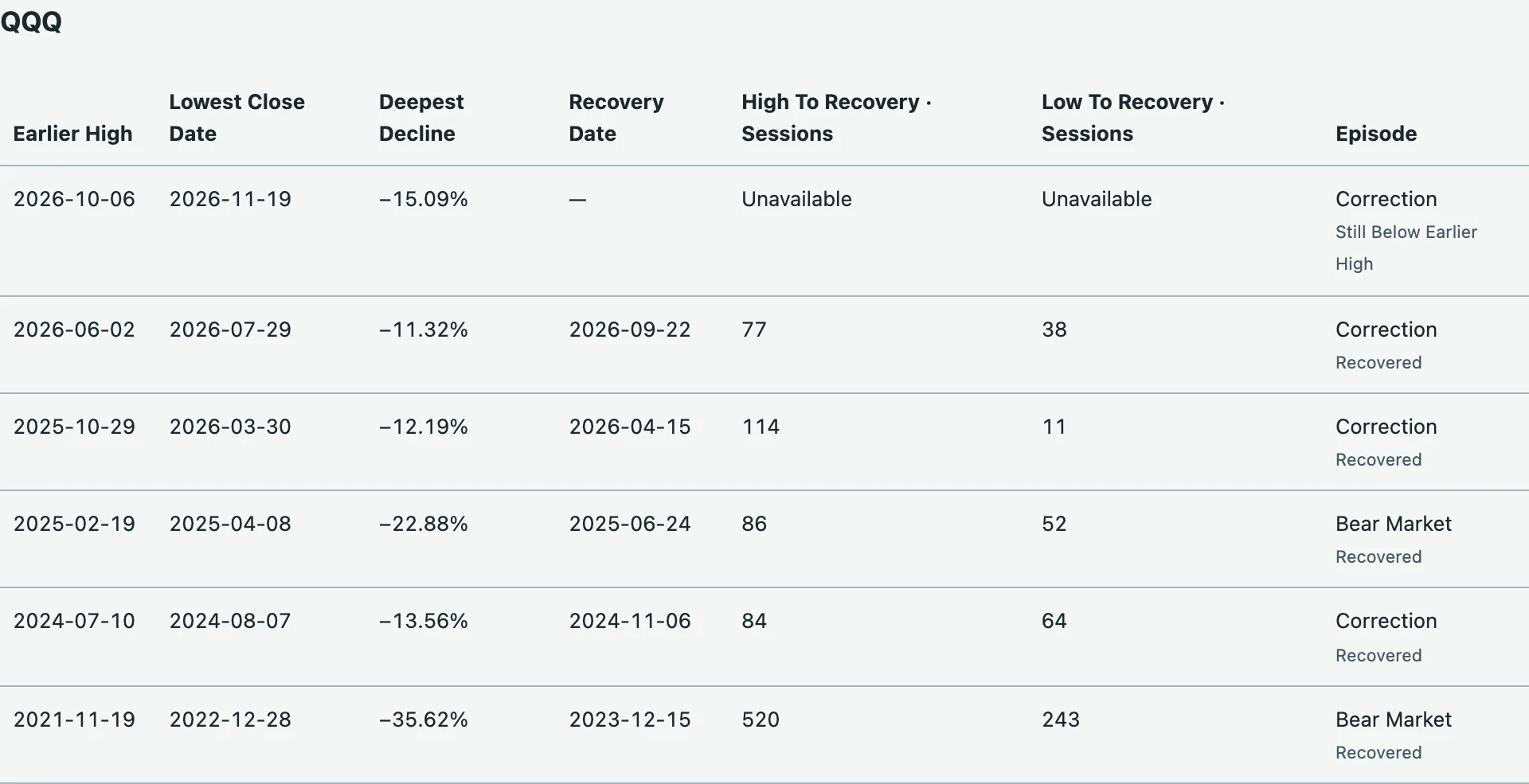
Distance from the highs: QQQ is past all three of its completed corrections
SPY closed 8.11% below its October 6 closing high of $779.09, from 6.28%. A close 10% below that high would be $701.18, which is 2.05% under where SPY finished. QQQ closed 15.09% below its own high, from 13.18%, and under the November 5 close of $647.05 that had been this decline's lowest. On the Correction Tracker the QQQ row now carries November 19 as its lowest close. That depth is past all three of QQQ's completed corrections in the table (11.32%, 12.19% and 13.56%) and short of its two bear markets (22.88% and 35.62%). The tracker lists no SPY decline of 10% or more as open. History, not a forecast.

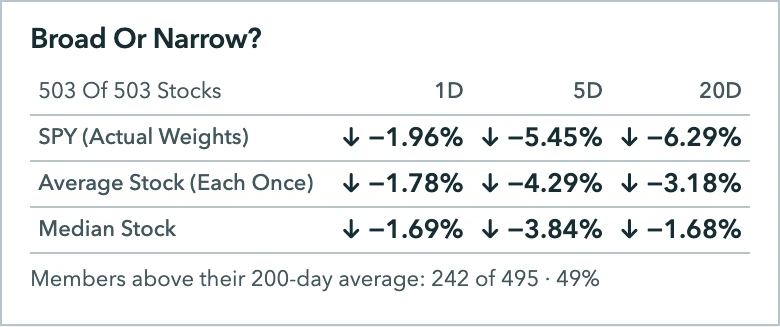
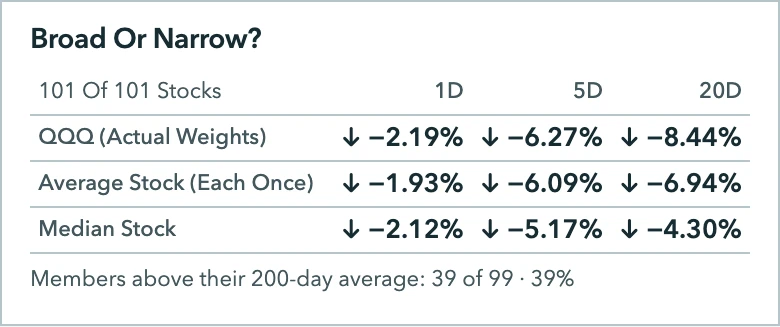
Broad or narrow? Broad, in both funds
SPY's −1.96% compares with −1.78% for the average member and −1.69% for the median. QQQ's −2.19% compares with −1.93% and −2.12%. On Wednesday the median S&P member fell 0.09% while the fund fell 0.31%, and we read that decline as sitting in a few heavy names. On Thursday it was nearly everyone: the fund fell 0.27 points more than its median stock, and the median's loss was the largest of the last ten sessions.
Dispersion supports the reading. S&P member dispersion fell to 1.67 percentage points, the 15th percentile of the past year, from 2.31 (60th). Low dispersion on a day 464 members fell means most stocks moved down together by similar amounts. The Nasdaq-100's was 2.48 points, the 40th percentile. The counterevidence: SPY still fell further than its median, and Alphabet (−3.46%), Amazon (−3.87%), Meta (−3.27%) and Nvidia are large companies that lost more than the fund. Naming them as the source of that difference is a view of ours, because contributions are unavailable.
Breadth: the share above the 200-day average went through 55% and 50% in one session
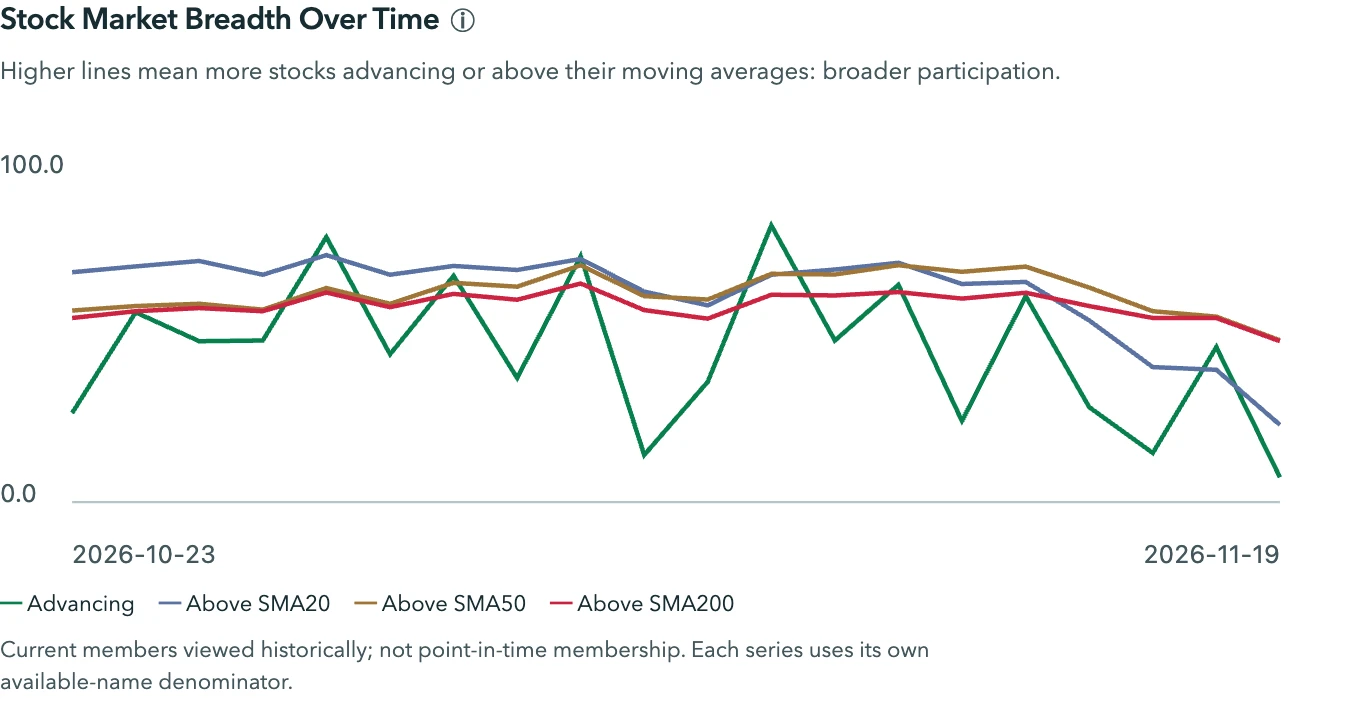
The share of S&P members above their 200-day average fell to 48.9% (242 of 495) from 56.0%, a net decline of 35 members. That is below the 55% line we have watched, below half, and the lowest of the 20 sessions in the Dated Readings table. The share above the 20-day average fell to 23.5% from 40.2%. In the Nasdaq-100 the 200-day share fell to 39.4% (39 of 99) from 45.5%, also the lowest in its table.
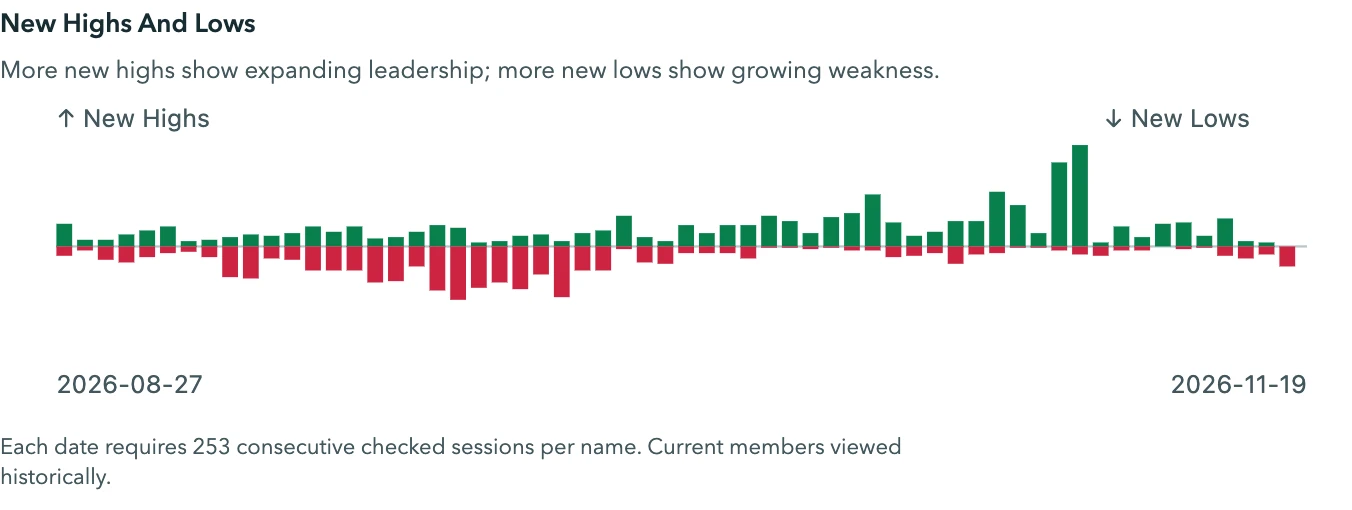
New 52-week lows exceeded new highs 15 to 0 among S&P members, against 6 to 3 on Wednesday, and 5 to 0 in the Nasdaq-100, against 2 to 0. The S&P list includes Nvidia, Alphabet's class C shares, Netflix, Boeing, Caterpillar and Ford.
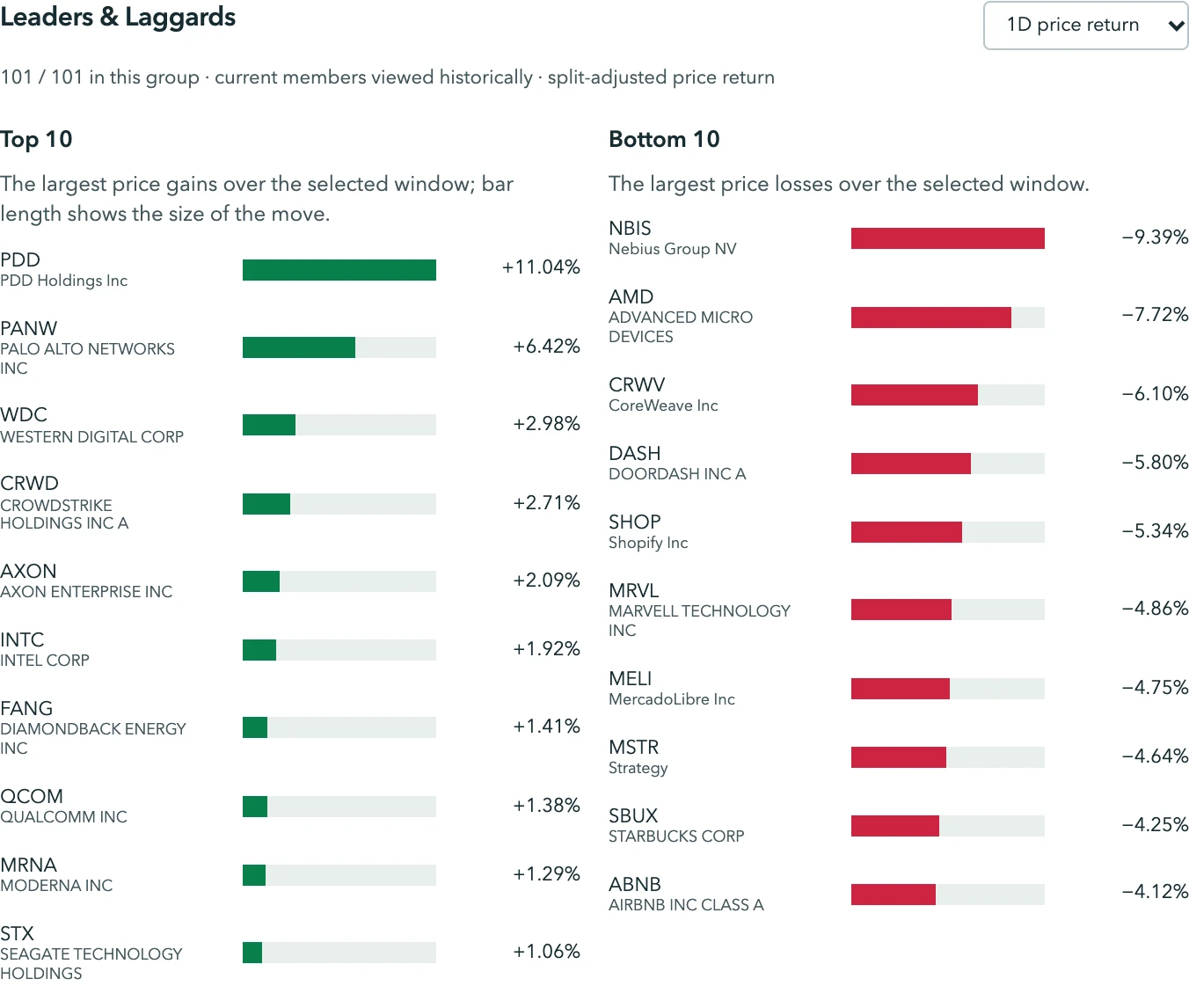
Leaders and laggards: Palo Alto up 6.42%, Williams-Sonoma down 15.16%
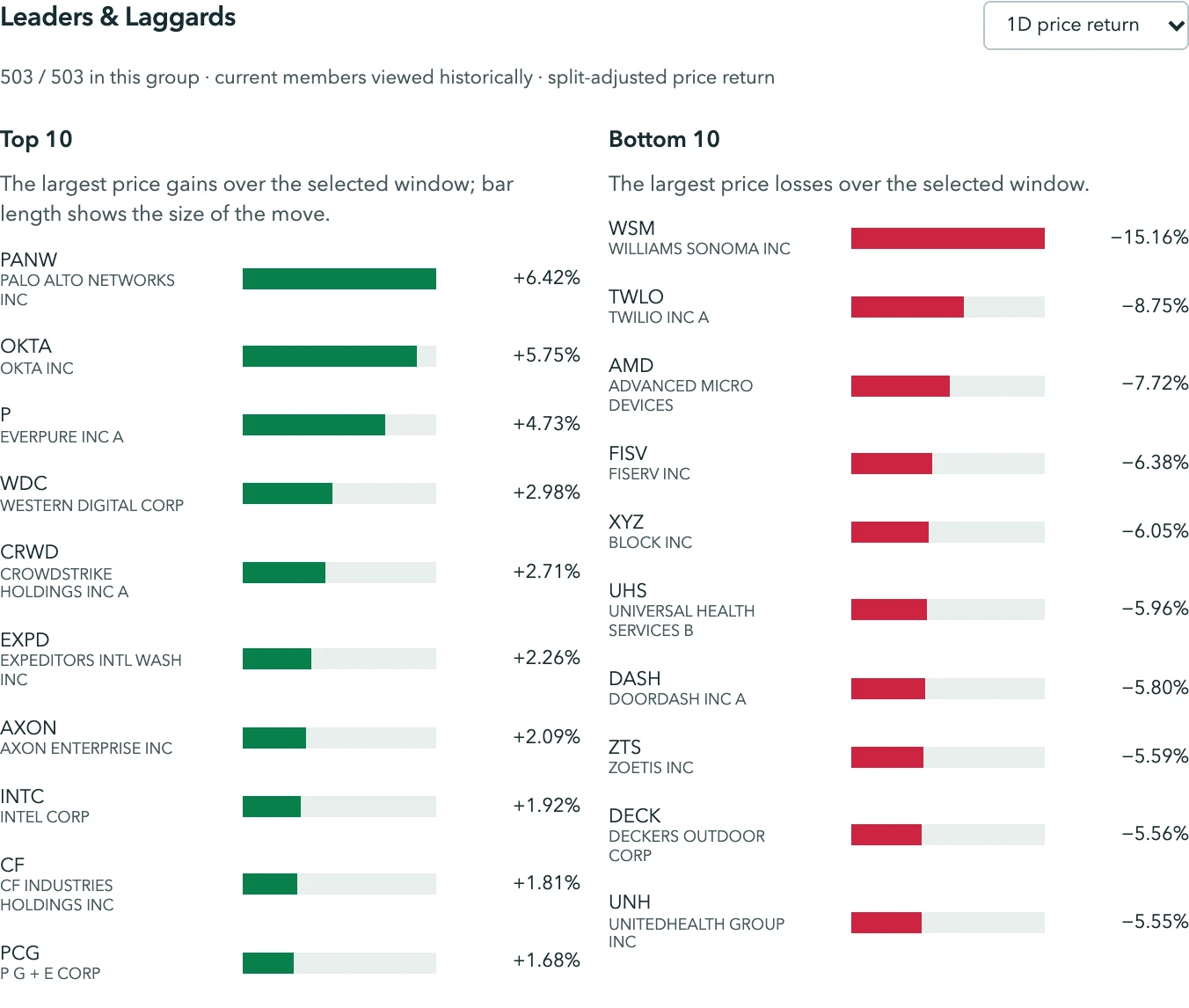
S&P leaders: Palo Alto Networks +6.42%, Okta +5.75%, Everpure +4.73%, Western Digital +2.98%, CrowdStrike +2.71%, with Expeditors +2.26% sixth. Laggards: Williams-Sonoma −15.16%, Twilio −8.75%, AMD −7.72%, Fiserv −6.38%, Block −6.05%. In the Nasdaq-100, PDD (+11.04%), Palo Alto and Western Digital led, and Nebius (−9.39%), AMD and CoreWeave (−6.10%) were weakest. What Moved The Market Today lists the same names for the two funds and says contributions are unavailable.
The news around these moves is reported context and does not establish causes. Palo Alto and Everpure were in their first full session since raising guidance. Williams-Sonoma reported third-quarter comparable revenue up 5.1% and repeated its full-year outlook (company filing). PDD reported results before the open. Walmart raised its outlook and closed down 1.04%. UnitedHealth fell 5.55%, a third day of declines that a market newsletter tied to the proposed Medicare audit rule. The dashboard marks three large moves, those of PDD, Veeva and Williams-Sonoma, as not yet checked against an ex-dividend calendar.
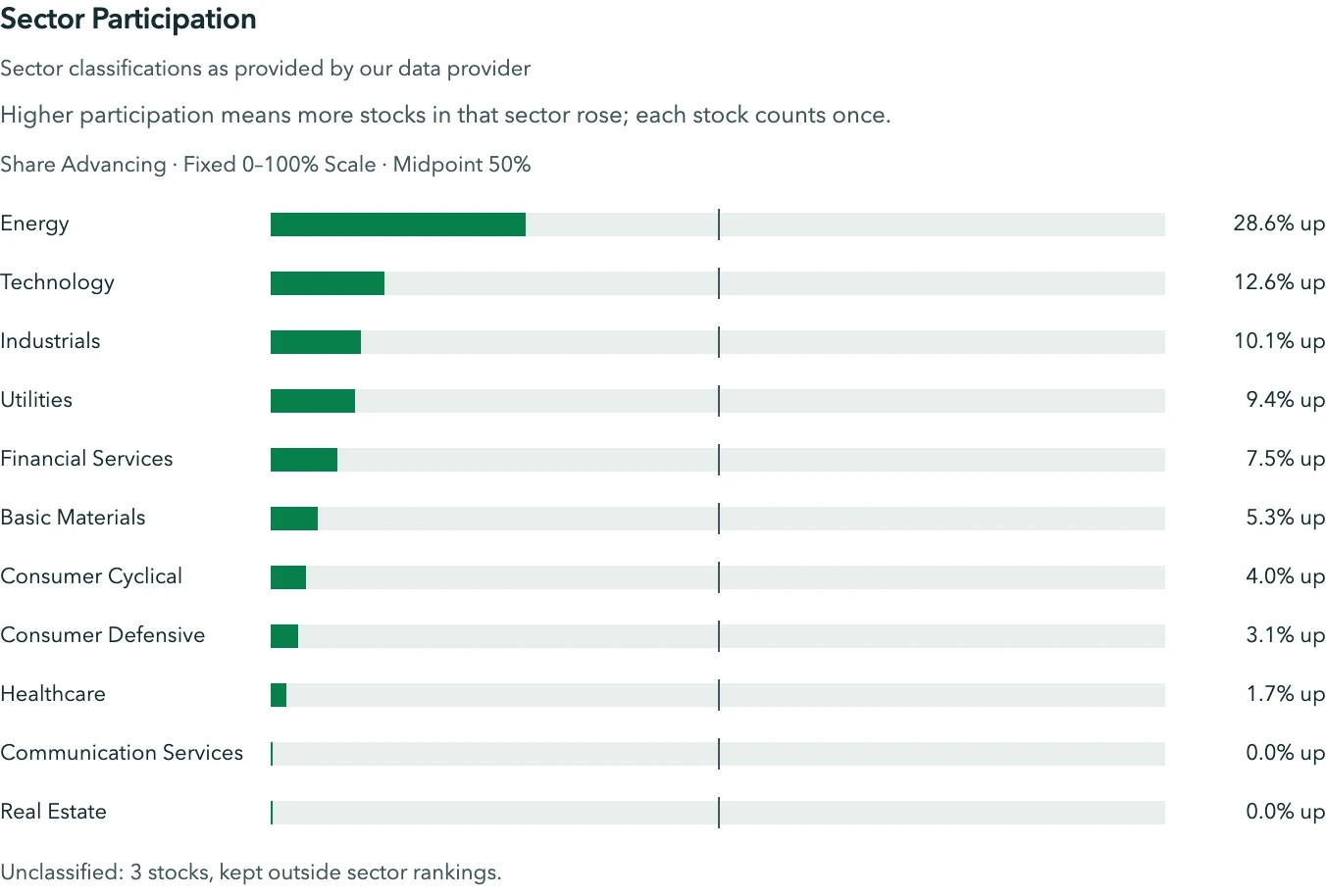
Sectors: none of eleven had a majority advancing
No S&P sector had a majority of its members higher, against four on Wednesday. Energy had the largest share advancing, 6 of 21, which is a rank among weak readings: its median stock still fell 1.05%, the smallest sector loss. Real Estate (0 of 30) and Communication Services (0 of 23) had no gainer, and Communication Services had the largest median loss, 3.14%. The two sectors we named on Wednesday as likely relative leaders in a decline split: Utilities had the second-smallest median loss (1.15%), and Consumer Cyclical went from 39 of 50 advancing to 2 of 50.
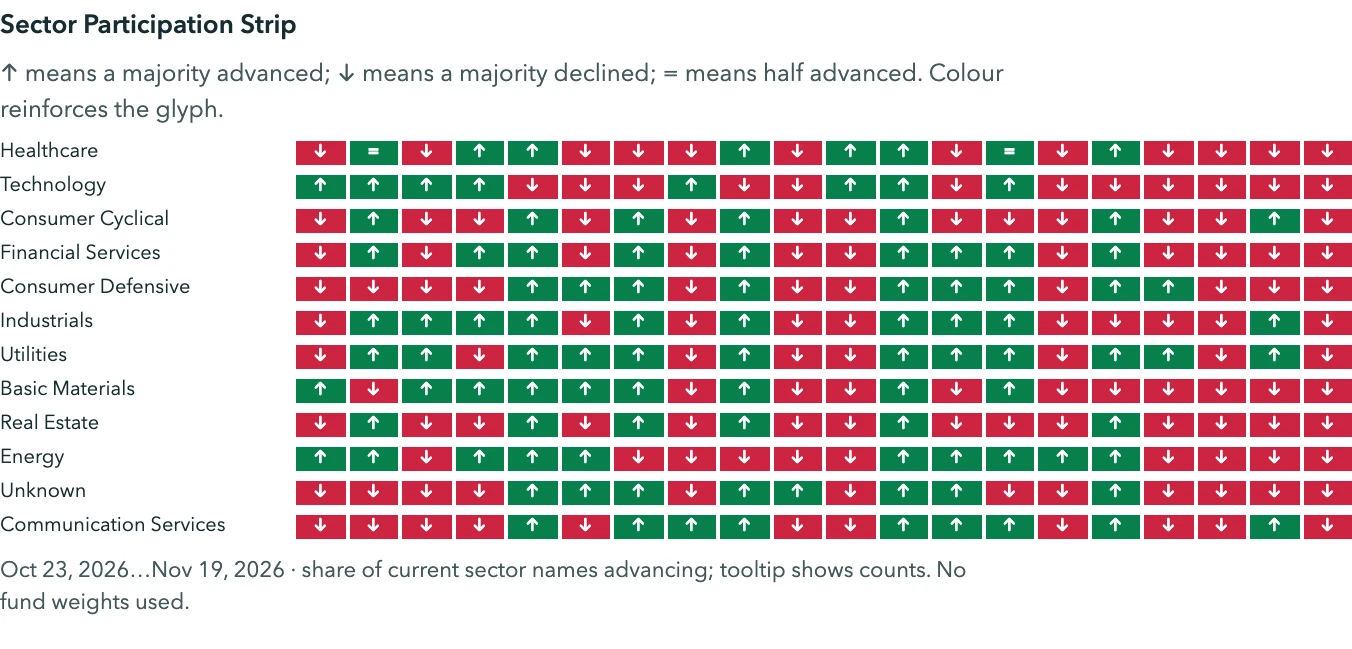
On the Participation Strip, the newest column shows a down arrow in every row, and Technology's row has six in a row. Among Nasdaq-100 sectors, Energy split 1 of 2 and every other sector had a majority declining.
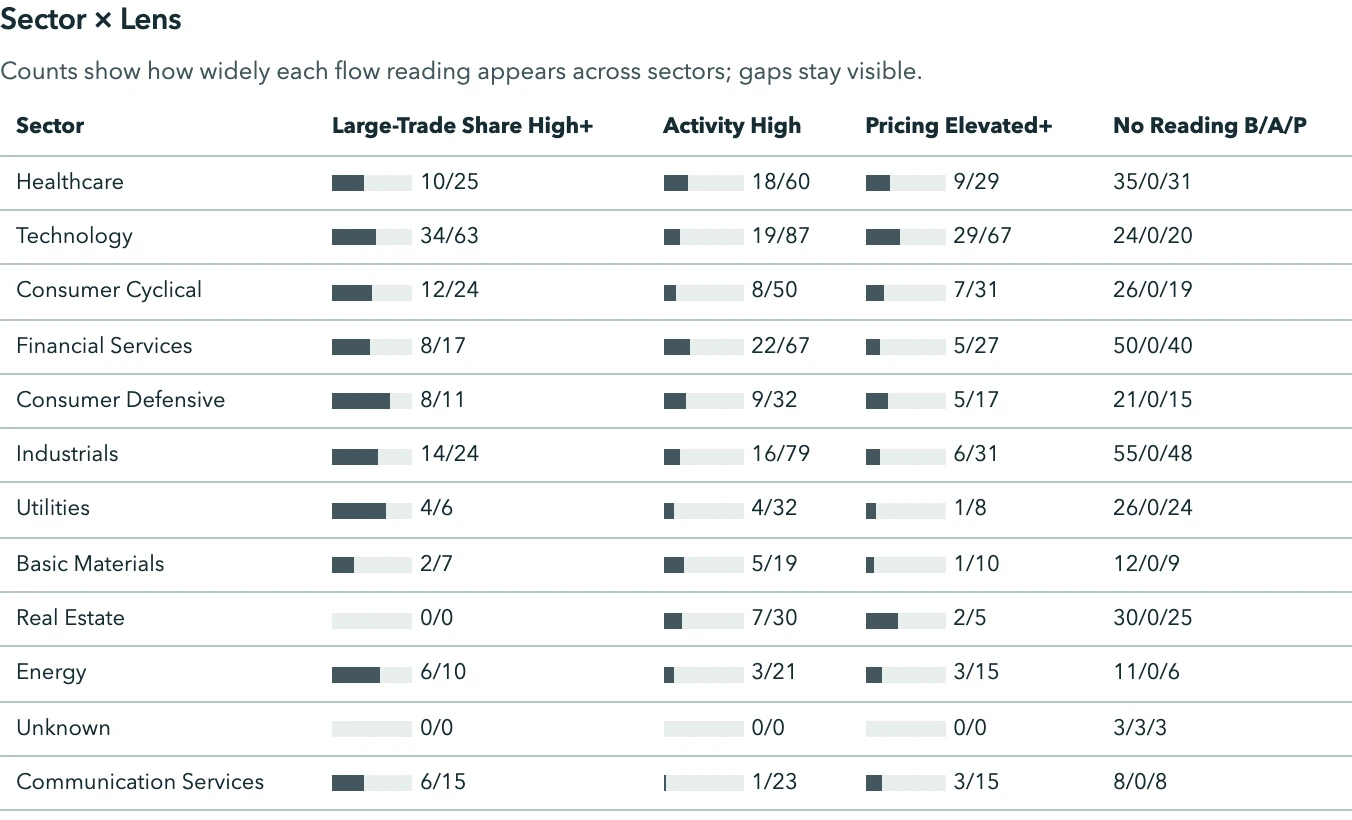
Large-trade share compares how much of a stock's options premium came in large prints with that stock's own history; it says size, not direction. On the Sector × Lens grid, readings of High or above rose to 104 of 202 S&P members that have a reading, from 72, and Very high readings to 58 from 27. For the Nasdaq-100 the count is 42 of 75, from 23 of 72. The Flows section explains why size rose: much of the day's large premium had a shape that fits financing.
AI 30: no gainer, and two names above the 50-day average
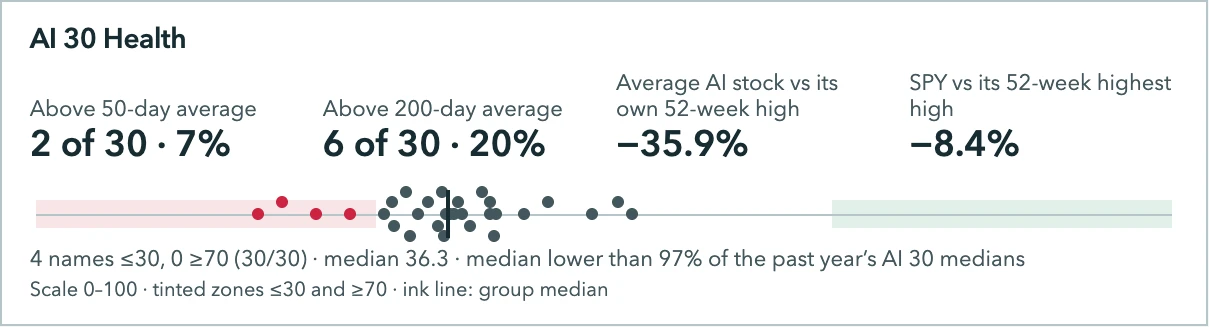
The count we follow, AI 30 names above their 50-day average, fell to 2 from 3: Amazon and Broadcom remain, and Arista dropped out. Six are above the 200-day average, from seven, with Palantir leaving. Measured against its own 52-week high the average AI stock is 35.9% lower, from 34.1%; that is an average of distances, not a basket return. The group's median RSI of 36.3 is lower than 97% of the past year's medians, a rank and not a probability.
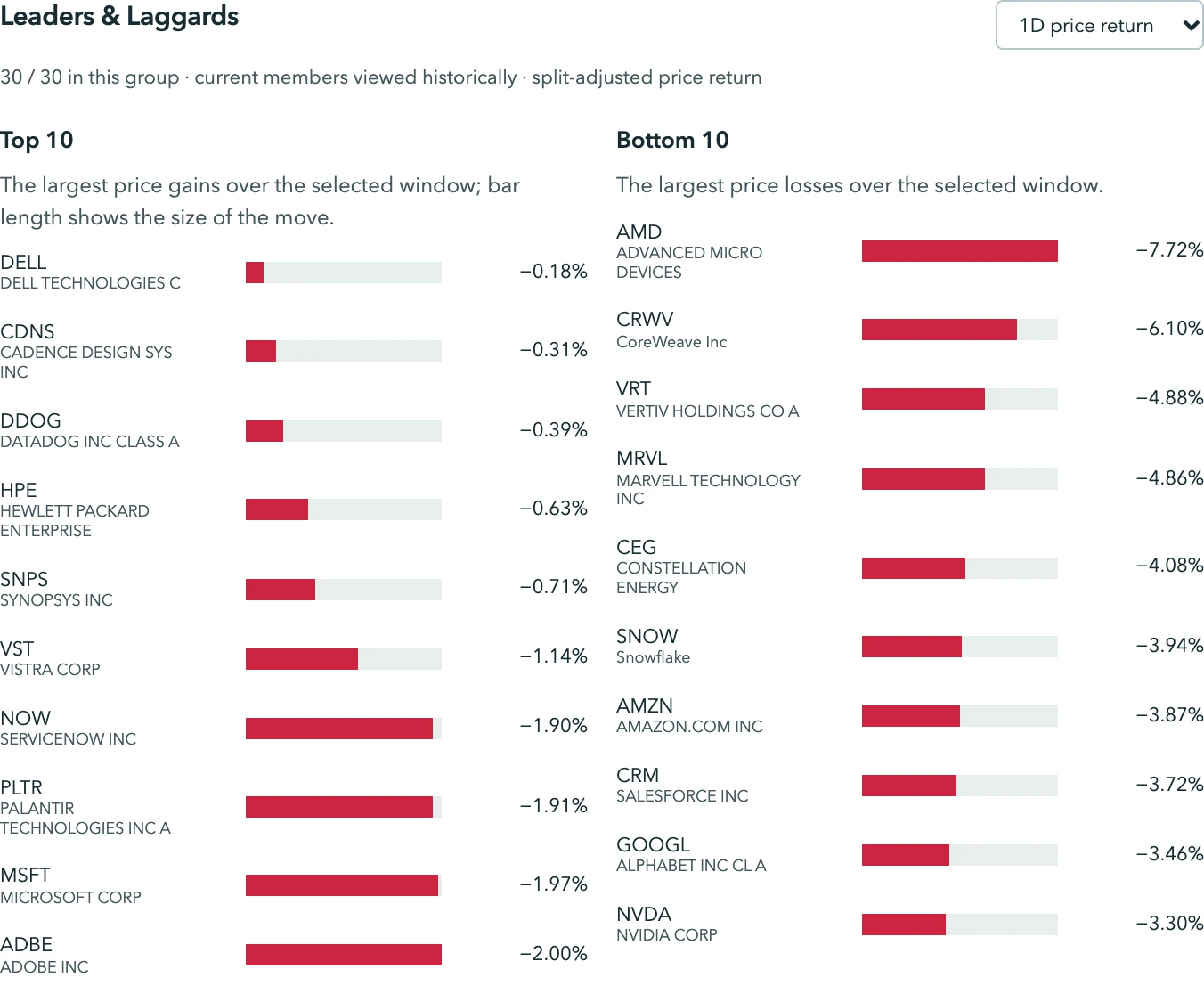
None of the 30 rose, the first such session since November 5 in the tab's Dated Readings table, and the median fell 2.55%. Dell (−0.18%) lost least. AMD, CoreWeave, Vertiv (−4.88%) and Marvell (−4.86%) lost most. Of the names we listed as bull-case leaders on Wednesday, the three cybersecurity stocks rose and AMD, Broadcom, Amazon, Arm and Vertiv fell.
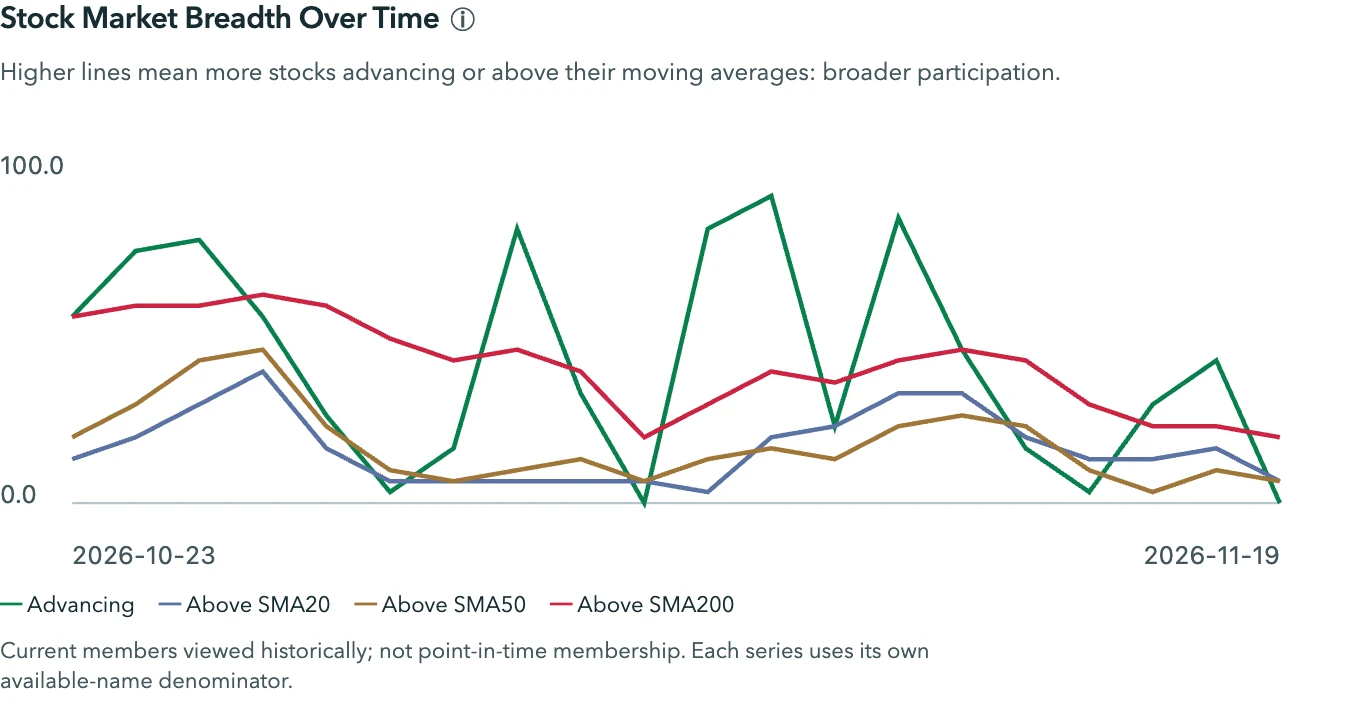
The tab's remaining panels agree. Its distribution has no dot above zero, each of its five sectors shows 0% advancing, Technology's strip row matches the S&P tab's, and its new-lows chart adds Nvidia. On its Sector × Lens grid, large-trade share reads High or above for 22 of the 30, from 14, and options pricing reads Extreme for 9, from 6. Four names sit at an RSI of 30 or below, unchanged in number and membership, and 14 are in the bottom 10% of their own year's range, a position and not a direction; the 70-or-above and top-10% filters list nothing. Median relative volume for the 9 names with baselines was 0.86x, up from about 0.75x. Nvidia ranks 21st of 30 for the session in Selected Stock Context.
The AI Ecosystem tab: no group had a gainer
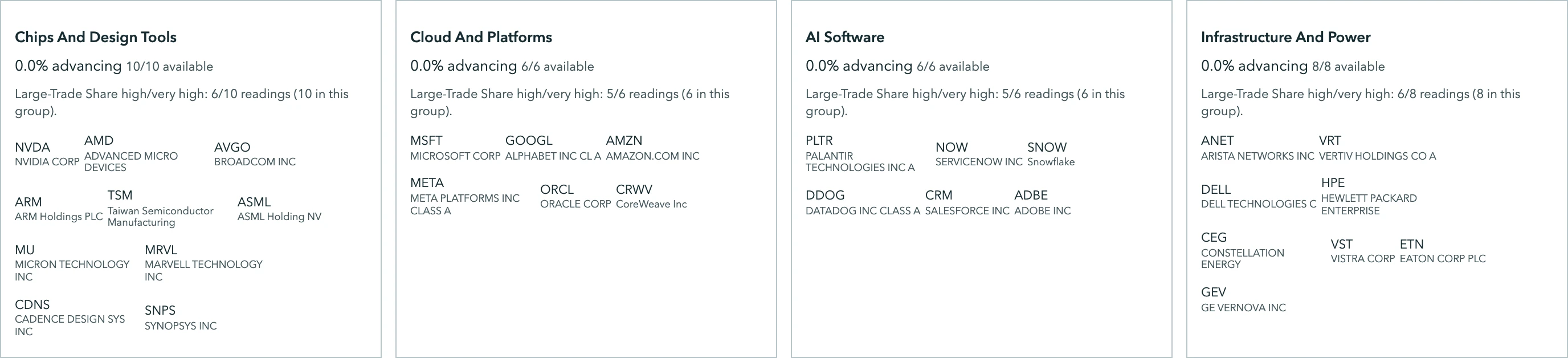
Chips And Design Tools: 0 of 10 advancing. Cloud And Platforms: 0 of 6. AI Software: 0 of 6. Infrastructure And Power: 0 of 8. On Wednesday 13 of the 30 names rose. The groups are not portfolios. With no gainer anywhere, the session drew no line between chip designers, their cloud customers, software and power suppliers.
Nvidia and AMD
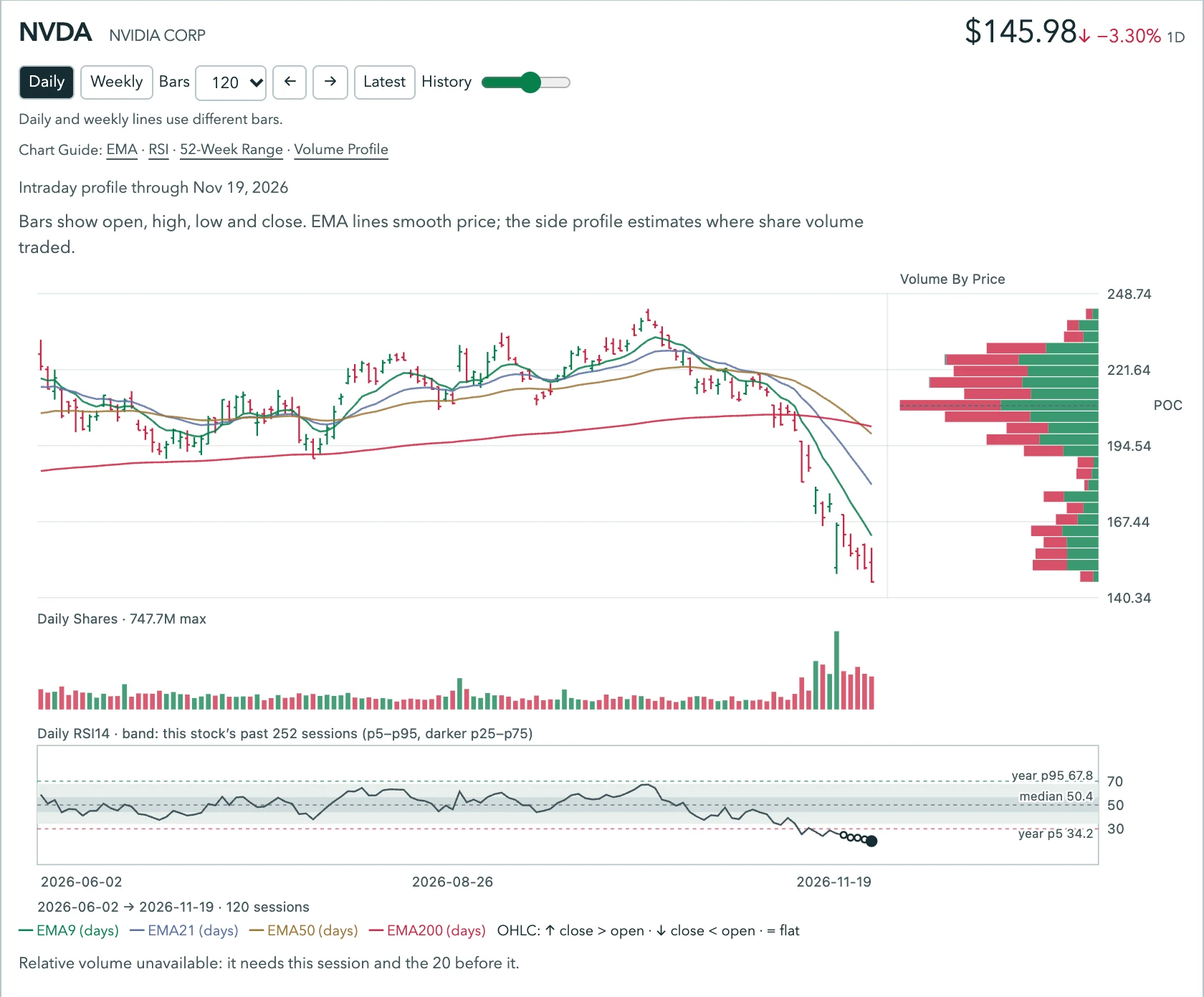
Nvidia traded as high as $158.13, above the $156.20 level it lost on Monday, and closed at $145.98, down 3.30% and 4.02 under $150, the round level on Wednesday's warning list. It is a new 52-week low. The 14-day RSI of 19.6 is the lowest in the chart's past year, and the stock is 40.02% below its 52-week high. The fund and AI 30 tabs show Nvidia's chart and lenses by default, and its large-trade share label is now Very high, from High. Earlier in the day Rep. Brian Mast, chairman of the House Foreign Affairs Committee, released export-license records for AI chips bound for China. By Reuters' count the Commerce Department approved more than 879,000 of 3.4 million chips requested from December 2025 to May 2026; how many shipped is not clear.
AMD opened at $542.17, reached $555.01, fell to $470.56 and closed at $489.19, below its 9- and 21-day exponential averages and last of the 30 AI names for the session. Hunterbrook Media published its report at 10:27 a.m. ET. Among other things it alleges that AMD firmware appeared in software updates from a Chinese server maker after that company was added to the U.S. Entity List. The report says the records it found do not by themselves establish a violation of export law, and Hunterbrook disclosed that its affiliated fund was short AMD. AMD told CNBC that the claims misrepresent its business practices and that it complies with U.S. export controls. CNBC said it had not verified the findings. These are allegations.
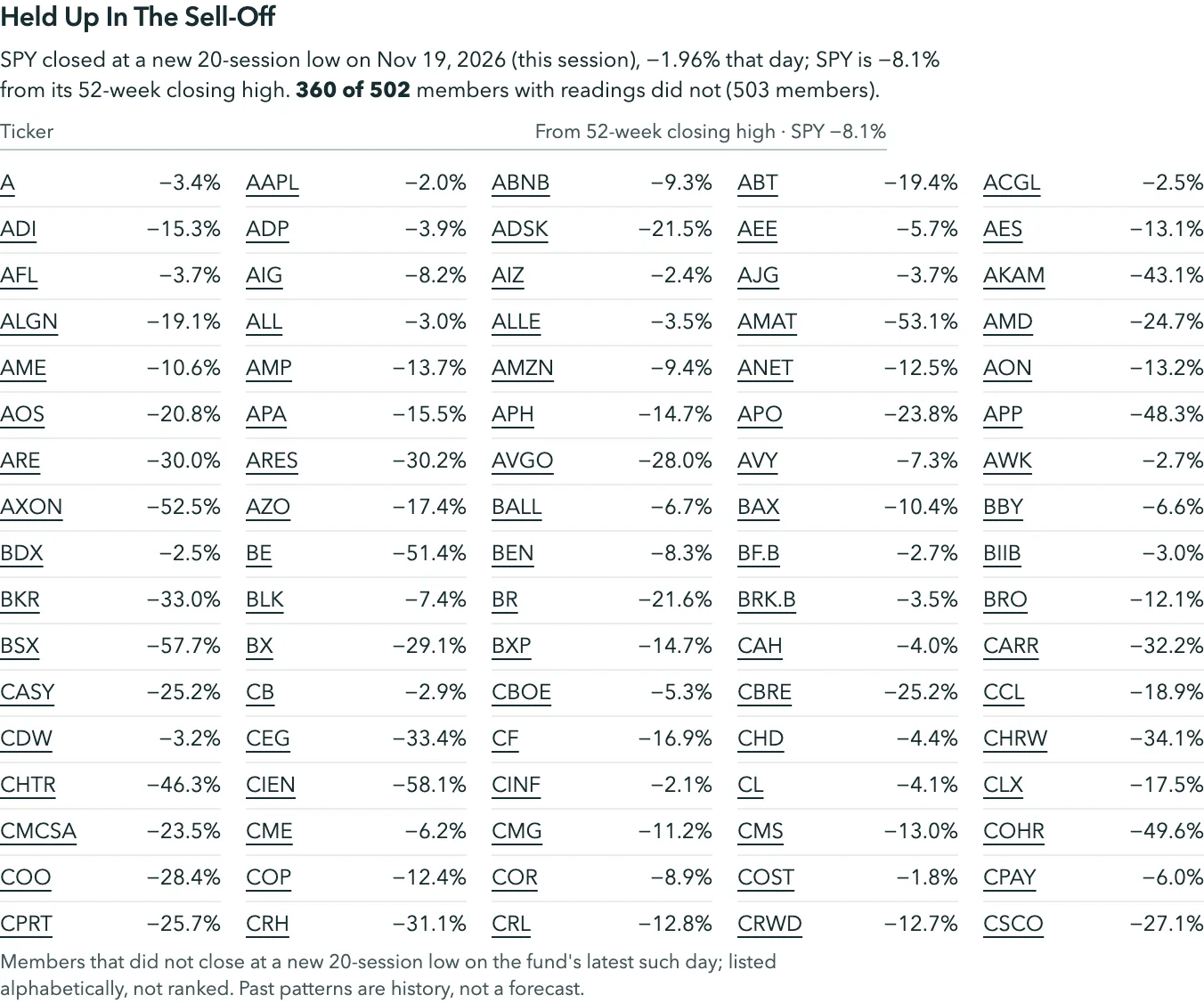
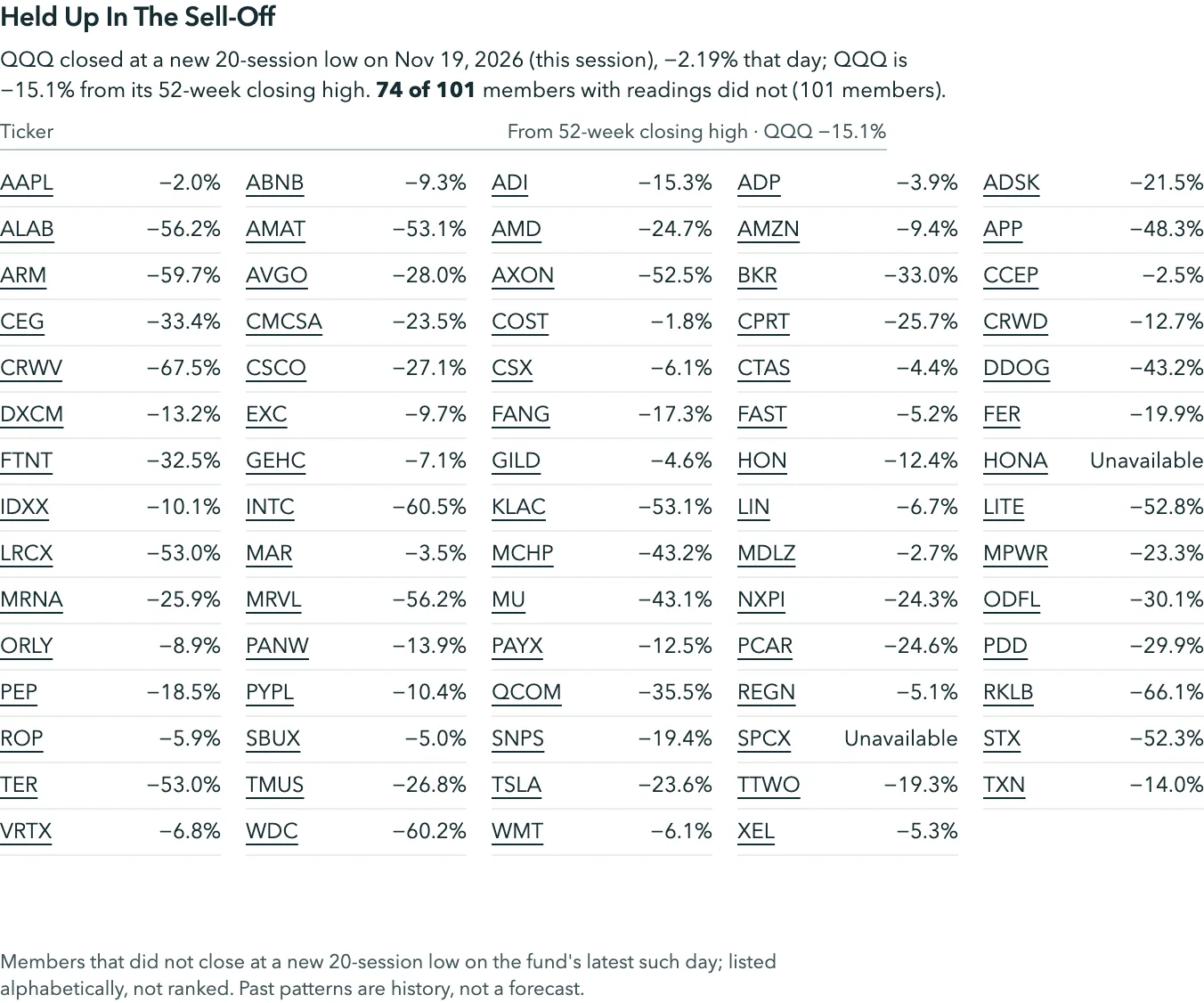
Held up in the sell-off: both anchors moved to Thursday
Each fund closed at a new 20-session low, so the panel now measures from November 19 on both tabs. Of the 502 S&P members that have readings, 360 stayed above a 20-session closing low of their own, down from 420 on Wednesday's anchor. For QQQ the anchor moved for the first time since November 5: 74 of 101 members held above their own lows, against 59 on the old anchor. The lists are alphabetical and are not rankings.
Volume: SPY at 1.50 times its average, the typical member below 1x
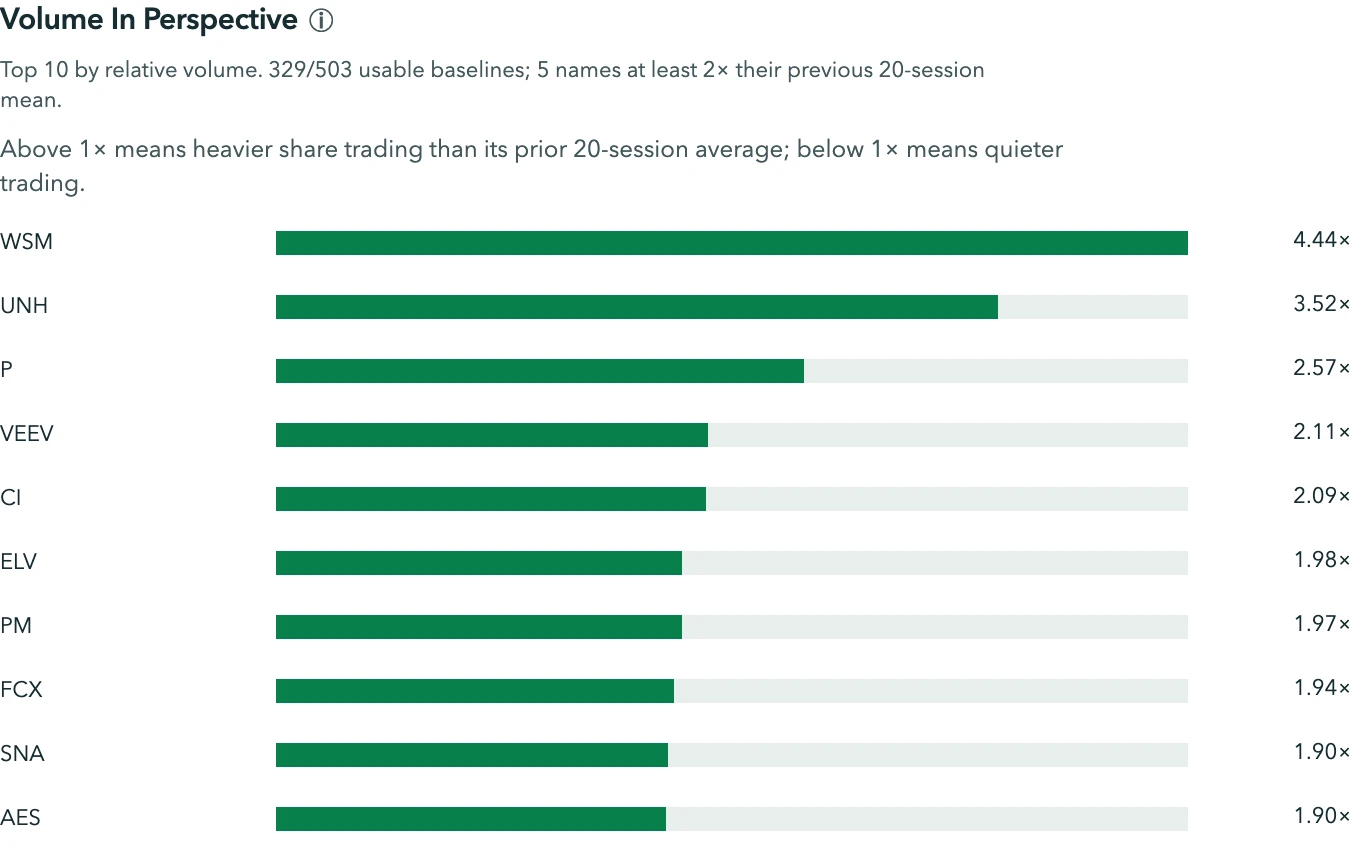
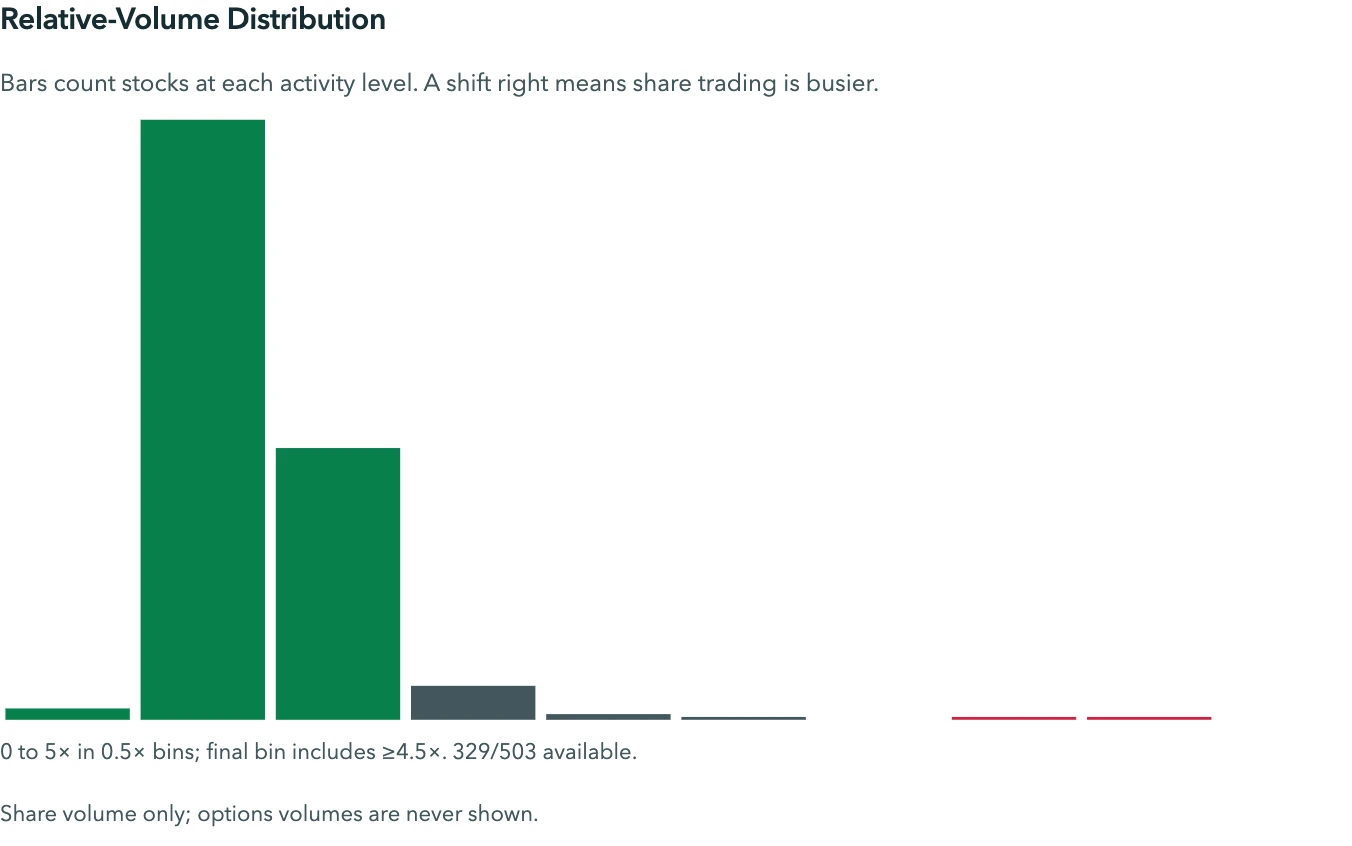
SPY's share volume was 1.50 times its 20-session average, against 1.00 on Wednesday. The typical member was quieter: median relative volume was 0.89x across the 329 of 503 S&P members that have baselines, from 0.84x, and 216 of those traded under 1x. Five names reached twice their usual volume: Williams-Sonoma (4.44x), UnitedHealth (3.52x), Everpure (2.57x), Veeva (2.11x) and Cigna (2.09x). Our reading is that activity went through the index fund more than through the typical stock, which fits a decline broad in count without being heavy in most members' own volume. The Nasdaq-100 tab has no member volume, so both of its volume charts are empty, and neither fund tab shows the rebound volume check on a day both fell.
Momentum: nineteen S&P names at an RSI of 30 or below, three at 70 or above
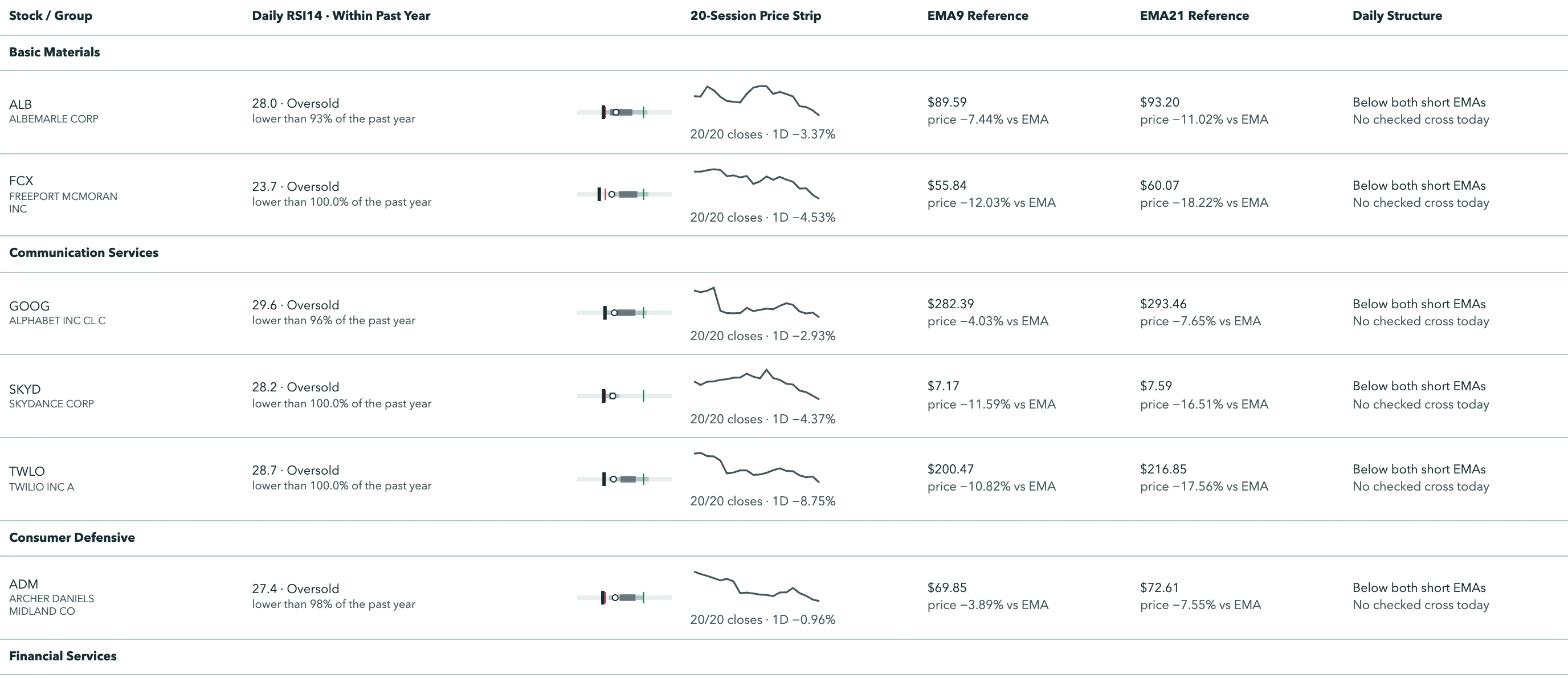
The 14-day RSI fell to 31.6 from 36.6 for SPY and to 33.9 from 37.7 for QQQ. Nineteen S&P members read 30 or below, from fifteen. Seven joined, among them Alphabet's class C shares, Sandisk, Twilio and Capital One, and Axon, First Solar and Intel left. Three read 70 or above, from eleven. A reading of 30 or below marks strong recent losses and is not a forecast of a turn.
Ninety-seven S&P members sit in the bottom 10% of their own year's RSI range and nine in the top 10%; that is position within each stock's year. Among the day's moving-average crosses we note AMD's and Amazon's: each closed below its 9- and 21-day exponential averages. In the Nasdaq-100 seven names remain at 30 or below, with Alphabet's class C shares and Sandisk replacing Axon and Intel, and none is at 70 or above.
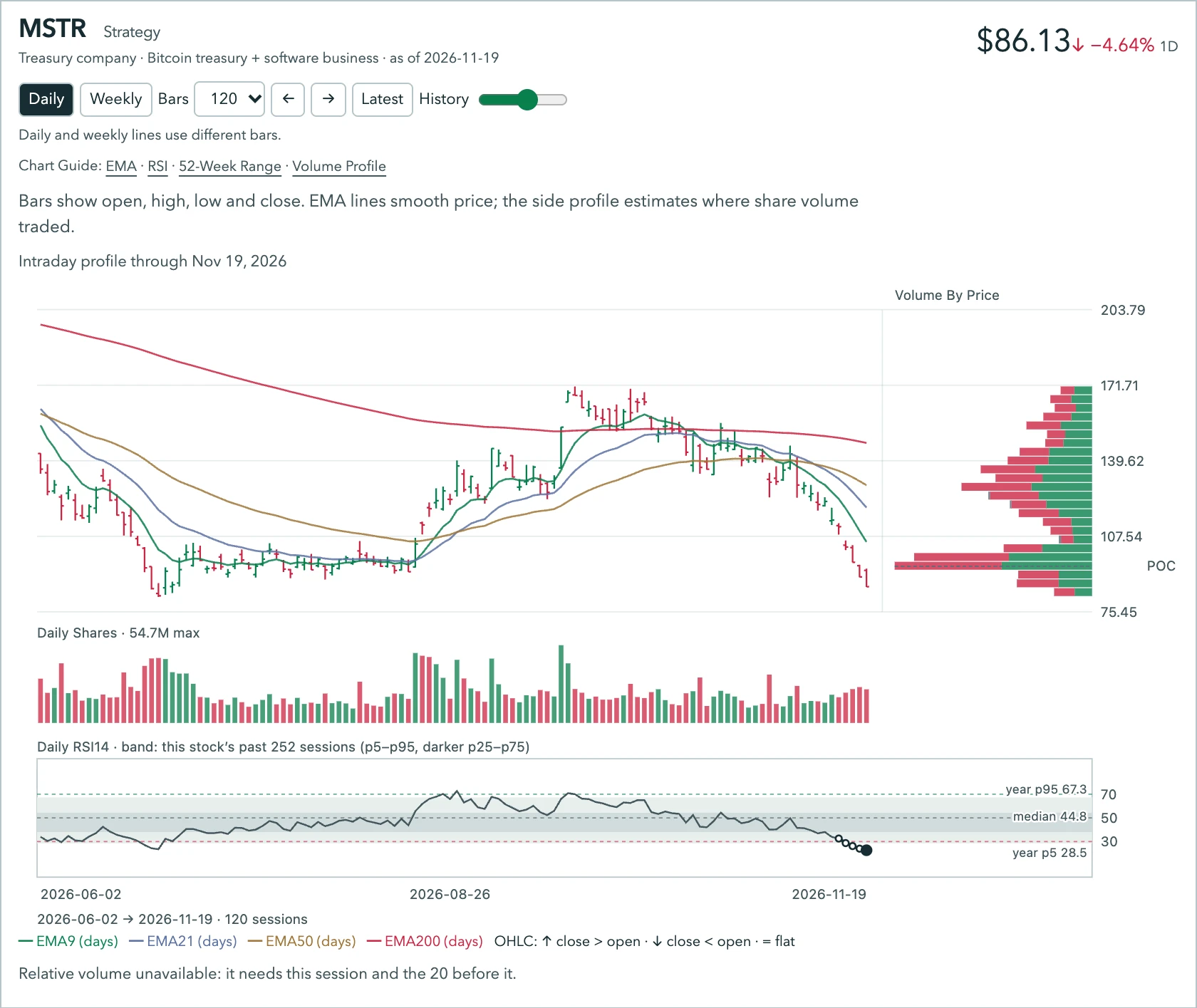
Crypto-related equities: one of seven rose
The Ethereum trust gained 0.40%, the Solana staking fund did not move, and the other five fell, for a median of −2.59%. Strategy lost most, 4.64% to $86.13, and is last of 7 in Selected Stock Context. No name is above its 20-, 50- or 200-day average; one was above its 200-day average on Wednesday. Six have an RSI of 30 or below, as on Wednesday. Strategy's chart and lenses show an RSI of 22.7, the lowest of its past year, options pricing Extreme, and large-trade share Very high, from Low. Deep-in-the-money puts of the financing shape described under Flows totalled $615.3 million in Strategy, so that label is about size.
Elsewhere on the tab, one dot in the distribution sits above zero, the gainer is unclassified so both classified sectors show 0% advancing, and every strip row has six down sessions in a row. The Sector × Lens grid is blank for five of the seven. Bitmine's 1.07x is the highest of three relative-volume readings. All seven are in the bottom 10% of their year's RSI range, the filters for 70 or above, the top 10% and moving-average crosses list nothing, and no name made a new high or low.

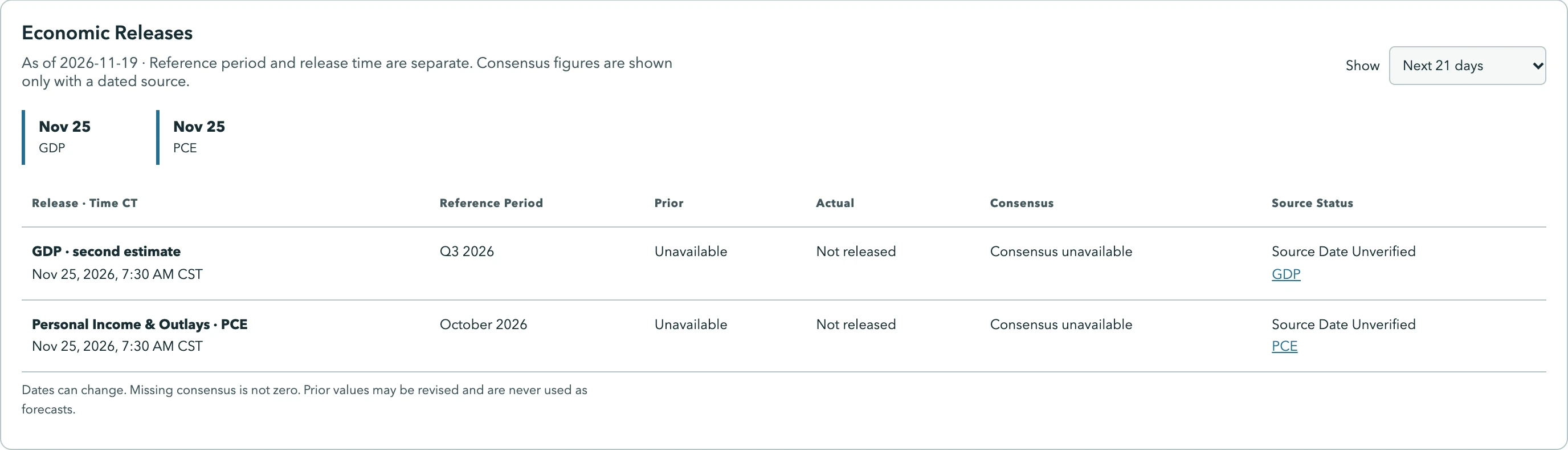
Macro panel and the Economic Releases table
Nothing new on the Macro tab: its six views and the strip above the fold are still unavailable, and the yield chart's data stops at November 5, so we do not picture it. Treasury figures are under Economy. Ahead, the Economic Releases table shows only the two November 25 reports, GDP (second estimate) and personal income and outlays, and it has no row for the Philadelphia Fed survey.
Market History, Performance & DCA, Stock History
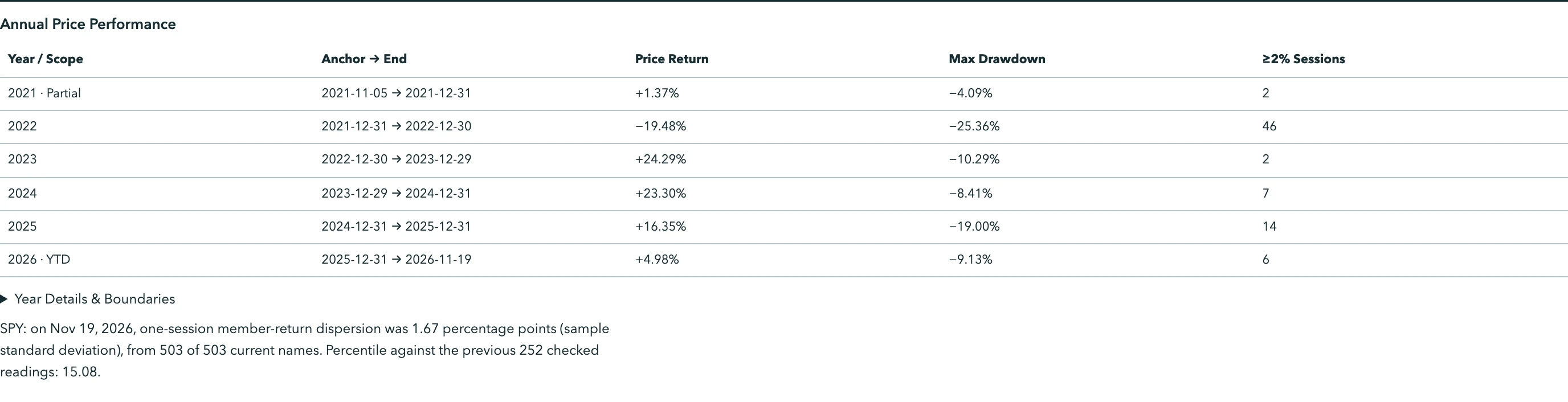
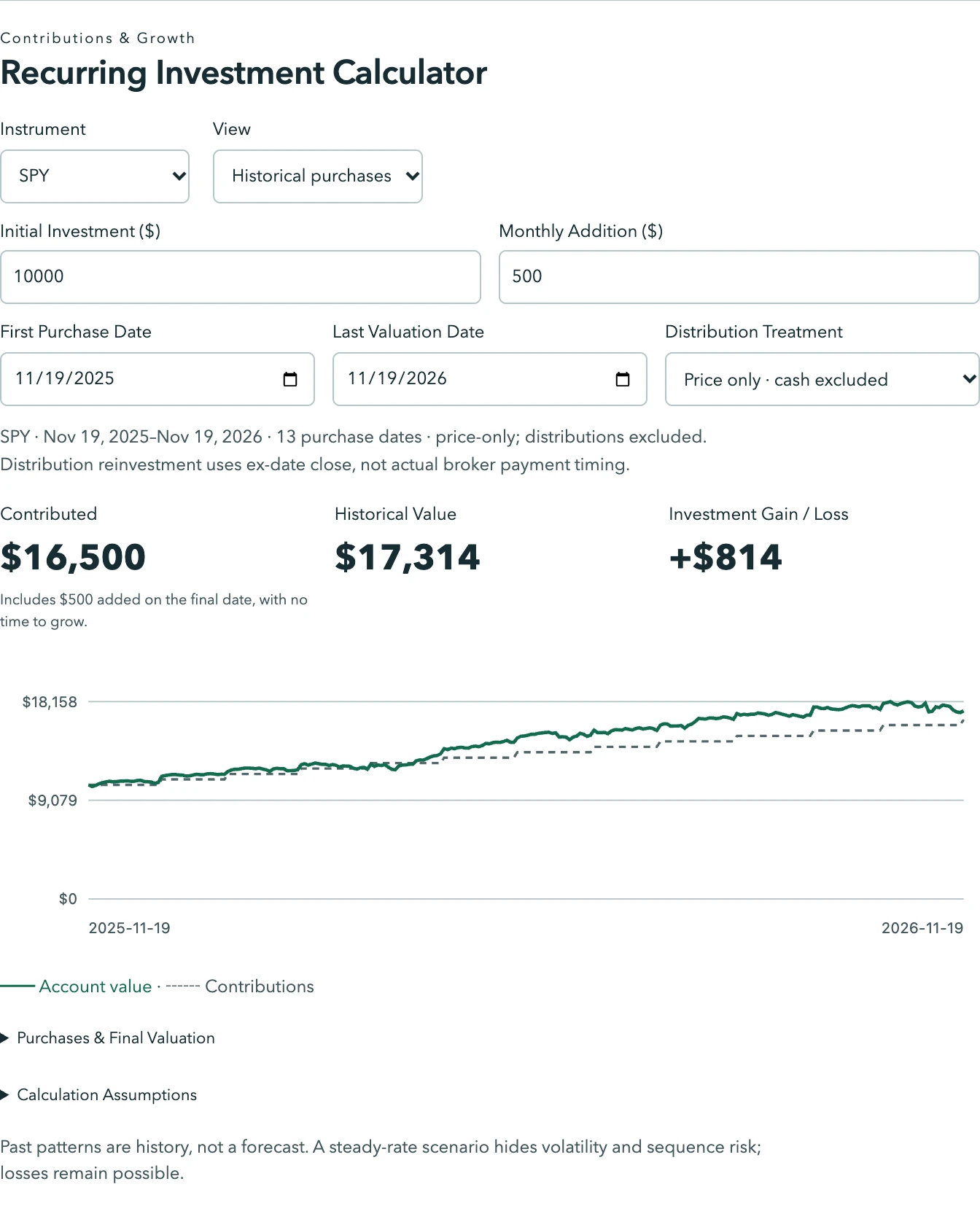
SPY has lost 5.78% over its six declining sessions. In Market History's fixed seven-session windows, a decline of at least 5% occurred in 5 of 180 (2.78%), a frequency and not a probability. Over twelve months SPY's price return is 8.03% against 17.32% for an equal-name basket of its members rebalanced daily, which is not an equal-weight ETF. The annual table shows SPY 4.98% higher for 2026 so far; the year's deepest drawdown, 9.13%, is 1.02 points beyond the current 8.11%. Stock History counts 32 sessions since each fund's October 6 closing high. Performance & DCA plots growth of 100 for SPY, QQQ and Nvidia over the trailing twelve months. Its default case puts $10,000 into SPY on November 19, 2025 and $500 a month after that: $16,500 contributed, worth $17,314 on price alone, an illustration.
Quiet and unavailable panels, in one line
Still hidden or unavailable on every tab: Fund Bridge and its holding contributions, Rotation, Big Moves, Flow Grid, Dividends, the macro strip and the six macro views. Read and not pictured, because they are text: the Metric Guide, The Session In One Paragraph, What Moved The Market Today, Today's News (3 lead items and 24 more stories), Share Previews and Find A Stock. The AI 30 and crypto tabs show the same How Far, AI 30 Health, Broad Or Narrow, AI Ecosystem, Macro, Performance, Market History and Stock History modules as the fund tabs; what is specific to each tab is in its section above. The Economy page keeps its November 9 date, and nothing changed on the Journal index, the News page, the About page or the footer dialogs.
Flows
Everything here is drawn from Thursday's options tape and the dashboard's flow labels. Three cautions apply throughout. A side is how the tape classifies a print against the quote and does not show that anyone bought or sold. Size does not prove intent. Flow is context, not a forecast. Market totals include every print; sector ratios and large-print figures include prints of $25,000 or more, about $170.6 million of which traded outside regular hours. Prints given a clock time below are regular-session prints. Anthropic had no option prints on its first day.
Market level: the highest premium and put share of eight sessions, much of it in a financing shape
Total options premium was $81.34 billion, 1.84 times the median of the seven sessions before it and the highest of the eight sessions from November 10. Puts took 70.0% of premium against a 53.8% median, also the highest of the eight. That figure is a share of premium and not a count of put purchases. Deep-in-the-money puts with almost no time value, a shape that matches stock-financing arbitrage and carries no market direction, made up $25.35 billion of the large prints, against a $5.16 billion median. With those prints and deep-in-the-money calls removed, the put share was 59.0% against a 49.6% median, still the highest of the eight, on premium 1.51 times its median. The adjustment is an estimate.
SPY's premium was $5.75 billion, 2.27 times its recent median, with puts at 63.2% against 52.7%. QQQ drew $5.48 billion, 2.07 times, with 66.1% in puts (median 59.1%). SPY's 30-day implied volatility rose to 23.1% from 20.3%. The dashboard now labels SPY's large-trade share High, from Very high, and its options pricing Extreme, from Elevated; QQQ's labels are unchanged at High and Extreme.
Sectors: Communication Services and Healthcare furthest above their medians, mostly through one shape
Communication Services' large-print premium was 5.39 times its prior-seven median with 86.9% in puts. With the deep-in-the-money pattern removed the ratio falls to 1.15, and Alphabet was the largest contributor. Healthcare's was 3.48 times and 1.11 on the same adjustment, led by UnitedHealth and by $165.1 million of deep-in-the-money calls in Amgen one session ahead of its listed November 20 dividend date, which fits dividend arbitrage.
Single names: UnitedHealth, AMD, Palo Alto, Intel and Nvidia
UnitedHealth drew $474.9 million of premium, 14.19 times its prior-seven median, with puts at 84.2% against 36.1%; $315.6 million of its $352.1 million in large put prints had the deep-in-the-money shape. AMD drew $1.85 billion, 1.36 times its median, with puts at 49.9% against 41.2%. Its single-leg large prints outside that shape were close to even, $270.2 million in puts and $259.8 million in calls, and its 30-day implied volatility rose to 77.1% from 72.0%. The tape does not say who traded or why.
Palo Alto drew $306.6 million, 4.65 times its median, with puts at 12.4% against 34.3%, and seven cybersecurity names together drew 3.15 times their median with 18.7% in puts (median 38.3%). Intel rose 1.92% while its premium reached $872.1 million, 4.20 times its median, with 91.7% in puts; $742.4 million of its $771.2 million in large put prints had the financing shape, so the put share there says nothing about direction. The 30 AI names together drew $15.75 billion, 1.62 times their median, with 70.8% in puts against 47.4%, and $7.50 billion of their $11.50 billion in large prints matched the same pattern. For Nvidia it was $2.63 billion of $3.04 billion in large put prints.
Large and unusual prints: an afternoon of deep-in-the-money puts
Single-stock deep-in-the-money puts totalled $16.11 billion for the day, $10.49 billion of it between 2:00 and 3:00 p.m. ET and most of it in contracts expiring Friday. The largest single print of the day was 46,640 Nvidia November 20 200-strike puts for $238.8 million at 2:27 p.m., with the stock near $148.88, part of a $610.3 million same-second group. Similar groups printed in Sandisk, Micron, the chip fund SMH, Arm, Intel and UnitedHealth. Separately, 74 box-shaped S&P 500 index packages carried $3.67 billion of gross premium. Both shapes fit financing and neither reads as a view on the market.
Outside those shapes, the largest structure was a December 2027 S&P 500 put spread at the 5,850 and 5,700 strikes, about 19% to 21% below the index, carrying $384.6 million of gross premium with both legs classified at the bid. Netting its legs would invent a position, so we infer no direction. One contract stood out for size against its base: a single cross of 10,000 SPCX August 2027 205-strike calls at 3:55 p.m., against prior open interest of 101. A cross carries no side. The next open-interest update will show the net change in outstanding contracts for this series; that count alone cannot tell us whether these trades opened or closed positions.
Tying it in
The tape was the busiest and most put-heavy of the eight sessions on a day 464 S&P members fell, and the adjusted put share was still the highest of the eight. The largest single source of that put premium, though, was a financing shape concentrated in one afternoon hour ahead of a monthly expiration. Where prices rose most, in cybersecurity, premium was about three times its median with a low put share. AMD's flow was close to even outside the financing shape. None of this forecasts Friday.
Economy
Released or reported for Thursday, November 19:
- Manufacturing survey, November (Federal Reserve Bank of Philadelphia, 08:30 ET): the current activity index fell to 6.3 from 20.9, its lowest since May and still positive. New orders fell to −0.4 from 4.3. Shipments rose to 25.7 from 15.3 and employment to 11.6 from 9.1. Prices paid rose to 58.2 from 43.2 and prices received to 47.0 from 40.1. The six-month outlook was 33.6, from 33.0.
- Treasury par yields (Treasury Department): 2-year 4.76% (from 4.80%), 10-year 5.04% (from 5.07%), 30-year 5.40% (from 5.41%). The 1-month bill rose to 4.20% from 4.10%.
- Fed speakers: Vice Chair Philip Jefferson said, "Currently, the AI buildout is exerting upward pressure on demand and inflation", and that productivity gains could ease inflation later (speech text). Chicago Fed President Austan Goolsbee said "the Fed's job is to prevent this thing from overheating the economy", as Reuters reported. Neither gave a rate path.
- Rate pricing: futures put the chance of a quarter-point increase in December at 96.4%, as Reuters reported, from about 92.7% a day earlier.
Improved since the previous release: the 10-year par yield eased to 5.04% from 5.07% and the 2-year to 4.76% from 4.80%; Philadelphia Fed shipments rose to 25.7 from 15.3 and employment to 11.6 from 9.1.
Deteriorated: Philadelphia Fed current activity fell to 6.3 from 20.9 and new orders to −0.4 from 4.3; prices paid rose to 58.2 from 43.2; the reported pricing of a December increase rose to 96.4% from about 92.7%.
What it means for SPY and QQQ (our view): on the bear side, a factory survey showed slower activity and faster input prices, a mix that complicates a rate decision, and two officials named AI demand as a source of inflation. On the bull side, longer yields fell while stocks lost about 2%, and the 10-year stays under the 5.15% we use as our measure. We do not read the session's decline as a rates story.
Next release that could change this: the final University of Michigan sentiment reading, due by schedule on Friday, November 20 at 10:00 ET. On Wednesday, November 25 at 08:30 ET the Bureau of Economic Analysis is due to publish its second estimate of third-quarter GDP together with October personal income, outlays and PCE prices, as listed in the dashboard's Economic Releases table.
Outlook
These are scenarios with conditions and not forecasts; the weights are our subjective leanings, and they sum to 100. They cover three closes: Friday, November 20, Monday, November 23 and Tuesday, November 24. Exactly one will have happened; bear is evaluated first, then bull, and base is what remains. Wednesday's set ran through Monday, and Thursday's close met its bear condition for both funds, so we start again from new lines.
The prior weights were 40% for bear, 35% for base and 25% for bull. How each of the day's main items moves them:
- The sixth decline, with 464 S&P members lower. Wednesday's break was narrow and this one was not, which removes the reason we gave for holding the bear weight at 40%. It rises to 60%. Both funds closed within a point of their lows, so the new bear line, the session's low, sits close under each close.
- Anthropic's debut. We made no call on it. What happened: a first trade 34% above the offer, a close about 13% under that first trade, and no gainer among 30 AI names. A second session that holds above the first-day close would fit the base case; a further slide alongside AI hardware and software would fit bear.
- AMD and the Hunterbrook allegations. AMD was a named leader in Wednesday's bull case and fell 7.72%, then 3.41% more after hours. The allegations are unproven and AMD denies them. For the scenarios it means the bull path has no AI leader at present, and the bull weight falls to 15%.
- The Nvidia subpoena. A question from a state attorney general, with a small after-hours move. It adds no level. Nvidia under its round level was already on the warning list, and it stays there.
- Futures and the after-hours session. Wednesday evening's prices recovered that day's break; this evening's extended it. SPY's 5-minute path ended 66 cents under its regular-session low and QQQ ended $2.31 under its own, so both sat beyond the bear trigger. That supports the higher bear weight and decides nothing.
- Asia on Friday morning. Chip and AI-financing names led the declines in Tokyo and Seoul. Our view is that, if the evening's readings hold, this points to a weak open for U.S. chip stocks; it is not a level.
The bull and base cases carry 40% of our weight, short of the 65% that would support a bullish lean, and the base case leaves at least one fund short of its bull level on Tuesday. The lean on SPY and QQQ therefore stays cautious. We are waiting for SPY to close a regular session above its 200-day average with at least half of S&P members higher. Our caution on concentrated AI also stands: Nvidia closed at a 52-week low, and only Amazon and Broadcom are above their 50-day averages.
Bear — "a close under Thursday's low for either fund" (about 60%, from 40%).
- Trigger: SPY closing below $715.65, or QQQ closing below $644.34, on any of Friday, Monday or Tuesday.
- Path: SPY extends its streak toward the level 10% under its October high, 2.05% below where it finished; a close beneath that level would make this a correction by the tracker's definition. Each lower QQQ close would be a new low for its decline; the table's next comparison is the 22.88% bear market of 2025, far from here. Nvidia staying under $150 and a 10-year par yield above 5.15% would be the accompanying signs.
- Leaders and laggards: Energy and Utilities, the sectors with the smallest median losses on Thursday, would be the relative leaders, with cybersecurity. Laggards: Nvidia, AMD, the cloud names tied to Anthropic, Communication Services, Consumer Cyclical and the crypto-related equities.
- Window: any of the three closes.
- Invalidation: Tuesday's close arrives with no close under either low.
Bull — "both funds back above the lines they broke, at Tuesday's close" (about 15%, from 25%).
- Trigger: no bear trigger, and Tuesday's closes above $726.80 for SPY and above $656.10 for QQQ, the two lines broken on Thursday. SPY's level is 1.53% above its latest close and QQQ's 1.71%.
- Path: neither fund closes under its low, SPY retakes its bull level and then tests its 200-day average, and QQQ retakes its own and moves toward its 9-day exponential average ($666.15). The conditions would be a majority of S&P members advancing on at least one of the days, an AI 30 count above 2, and Anthropic holding above its first-day close.
- Leaders and laggards: the largest AI names that fell hardest on Thursday (Amazon, Alphabet, Meta, Nvidia) would have to lead, with cybersecurity keeping its gains. Managed care can lag.
- Window: Tuesday's close.
- Invalidation: a bear trigger on any day, or either fund at or under its bull level on Tuesday.
Base — "no close under Thursday's lows, and at least one fund short of its bull level on Tuesday" (about 25%, from 35%).
- Trigger: no bear trigger, and on Tuesday one fund or both close at or under the bull level.
- Path: both funds hold their lows at every close and trade under the lines they broke. SPY stays below its 200-day average and above the 10% level. Nvidia closes between its latest close and its round level, and the AI 30 count ends at 5 or fewer.
- Leaders and laggards: cybersecurity and Energy lead; AMD and Nvidia lag.
- Window: through Tuesday's close.
- Invalidation: a bear trigger on any day, or both funds over their bull levels on Tuesday.
Event previews: what to watch, not forecasts. Anthropic, Friday: the second session; we will note its close against $97.17 alongside the AI 30's breadth. Monthly options expiration, Friday: much of the financing-shaped put premium was in contracts expiring that day, and we offer no call on its effect. Fed speakers, Friday: Governor Christopher Waller at 8:25 a.m. ET and Governor Lisa Cook at 12:15 p.m.
Before turning constructive we would want: for the broad market, a SPY close above its 200-day average ($732.69 on Thursday) with at least half of S&P members higher that day, the 200-day share back over 55%, and a session in which new highs at least match new lows. For concentrated AI: Nvidia closing over $150 and then $156.20, seven AI 30 names above their 50-day average, and QQQ over its bull level.
Warning signs that would strengthen the case for caution: SPY closing 10% or more below its October high (off, by 2.05%); the 10-year par yield over 5.15% (off: 5.04%); a further fall in the share of S&P members above the 200-day average (on watch: 48.9%); new lows outnumbering new highs (on: 15 lows, no highs); one or no AI 30 name above its 50-day average (off: 2); Anthropic closing under its $83 offer (off: $97.17).
Dip, wait, or trim? All five warning signs on Wednesday's list are now on, and the lean was already cautious. SPY's RSI of 31.6 and the 7.6% of members advancing describe a washed-out condition and do not mark a turn. Adding to broad exposure has support, in our view, only once SPY closes back over the 200-day average with at least half of S&P members higher. Carrying less risk has more support on each close under Thursday's lows.
Key dates (all times ET). Fri Nov 20 — Waller 08:25; Michigan sentiment 10:00; Cook 12:15; Anthropic's second session; monthly options expiration. Mon Nov 23 — Wednesday's scenario window ends. Tue Nov 24 — this window closes; Dell, HP and Workday report after the close, as reported. Wed Nov 25 — 08:30 GDP and PCE; 14:00 Beige Book. Thu Nov 26 — NYSE closed. Fri Nov 27 — NYSE closes at 1:00 p.m. (NYSE calendar). Dec 8–9 — FOMC.
Final summary
- Friday's close against Thursday's lows. SPY closed 22 cents above its low and the evening's prices were under it. A close under either fund's low is the bear trigger, and the level 10% below SPY's October high is the next reference.
- Whether anything leads. No AI name rose and no sector had a majority advancing. A session with at least half of S&P members higher would be the first evidence of repair; Anthropic's second session and Nvidia against its round level are the AI checks.
- Expiration on Friday, then a short week. Options expire Friday, GDP and PCE arrive Wednesday, and the NYSE is closed the following Thursday.