
Executive summary
SPY closed below its 200-day average on Wednesday for the first time since April: $730.20, down 0.31%, against an average of $732.55. That met the bear trigger we named on Tuesday. It was the fund's fifth straight decline, and CNBC reported the same streak for the S&P 500 index, which fell 0.23% while the Dow lost 1.11%. QQQ rose 0.39% to $659.51. The median S&P 500 member fell 0.09% and 237 of 503 rose. The large declines sat in managed care (UnitedHealth −10.21%), in Energy, where 1 of 21 members rose, and in Nvidia.
Nvidia gave back its post-results gain. CNBC had the shares up almost 4% before the open; they closed down 2.89% at $150.96, short of the $156.20 we wanted regained, while AMD rose 5.31% and Broadcom 3.64%. The reasons reported, leadership uncertainty and a delayed quarterly filing, are not established causes. At 2:00 p.m. ET the Fed's minutes said almost all officials judged that further rate increases would likely be appropriate, and many called the AI buildout a material inflation risk. The 10-year Treasury par yield still eased, to 5.07% from 5.10%.
After the close Anthropic said it priced its IPO at $83 a share, above the $70 to $78 range; trading as ANT is due Thursday. CNBC called it the largest IPO on record. Palo Alto Networks reported results, and its last after-hours trade was up 9.08%. From about 6:00 p.m. ET prices climbed: CNBC had S&P 500 futures up 0.5% and Nasdaq-100 futures up 1%, QQQ's last after-hours trade was up 1.39%, and SPY was about +0.7% ($735.57) by 8:00 p.m. per 5-minute bars. No cause for the timing was reported.
We move our stance on SPY and QQQ to cautious, from wait-and-see, through Monday's close; the weights are 40% bear, 35% base and 25% bull. A SPY close under Wednesday's low, or a QQQ close under $656.10, is the new bear trigger. SPY's evening path ended back above its 200-day average, and neither fund's after-hours range reached a new trigger; regular-session closes decide. On concentrated AI we remain cautious.
Since the close
All times are Eastern, and Central follows in parentheses. An after-hours figure is the last after-hours trade measured against Wednesday's regular close; that session ended at 8:00 p.m., and pre-market trading has not begun. SPY's after-hours quote was unavailable, so its figures come from 5-minute bars and are labelled that way. Futures figures are outlet readings; where no outlet reading exists, the funds' last trades stand in for futures. No after-hours figure is available for the Dow or small-cap funds, the energy, health-care and financial sector funds, the gold fund or the Japan, Korea and Taiwan country funds.
- After 4:00 p.m.; webcast 4:30 p.m. (3:30 p.m. CT) — Palo Alto Networks' results. Fiscal first-quarter revenue rose 39% to $3.44 billion, and the company said it intends to buy Applied Compute for $4.5 billion in stock (company release and filing). After a 9.90% gain in the regular session, the stock's last after-hours trade, at 7:59 p.m., stood 9.08% higher, inside a range of −4.68% to +12.29%. The read-through is to cybersecurity: CrowdStrike +6.01%, Okta +3.88%, Fortinet +2.47%. None of these is an AI 30 member.
- 4:06 p.m. (3:06 p.m. CT) — Everpure. The storage company, formerly Pure Storage, said fiscal third-quarter revenue rose 51% to $1.5 billion and raised its full-year revenue guidance (company filing). Its final after-hours trade was up 4.30%.
- 4:07 to 5:55 p.m. (3:07 to 4:55 p.m. CT) — two reporters outside our universe. Universal Technical Institute was down 8.12% at 5:29 p.m. and Magnera up 13.73% at 5:55 p.m., both per a trading-news outlet.
- About 6:00 to 8:00 p.m. (5:00 to 7:00 p.m. CT) — futures and the funds. CNBC had futures opening flat at about 6:00 p.m., with S&P 500 and Nasdaq-100 futures each up 0.1%; its later entry had them up 0.5% and 1%. SPY's 5-minute path sat near its $730.20 close until 5:55 p.m., began rising with the 6:00 p.m. bar, peaked at $735.91 at 7:40 p.m. and ended at $735.57. QQQ's final trade was $668.65, between $658.25 and $668.91. The chip fund SMH rose 1.68%. The median AI 30 name was down 0.32% at 6:00 p.m. and up 1.34% at 8:00 p.m.; Nvidia's final trade was up 0.65%. No report we read named a cause for the 6:00 p.m. turn. CNBC described futures as rising as investors looked ahead to Anthropic's debut, which is its framing of the evening and does not explain the timing.
- About 6:29 p.m. company release; 6:42 p.m. SEC filing (5:29 and 5:42 p.m. CT) — Anthropic prices at $83. The company said it priced 980,000,000 Class A shares at $83.00 and granted underwriters an option on 147,000,000 more; trading is expected to begin Thursday on Nasdaq as ANT (company release). At that price the shares come to about $81.3 billion, a product of the two figures and not a company total. Final after-hours trades: Alphabet +1.51%, Amazon +1.34%, Microsoft +1.12%, Broadcom +1.58%.
- 7:00 p.m. Tokyo open; 8:00 p.m. Seoul open (6:00 and 7:00 p.m. CT) — Asia, Thursday local time. A trading-news outlet had the Nikkei opening up 0.36%, and CNBC had Australia's ASX 200 down about 1.1%. Korea's market opened an hour late for the national college entrance exam, and readings conflict: one outlet had the Kospi up 0.45% at the open, CNBC had it down 1.16%.
- 8:13 and 8:29 p.m. (7:13 and 7:29 p.m. CT) — Palo Alto call write-ups. CEO Nikesh Arora said of the Applied Compute deal, "If it works, I think this will dwarf the ability that we have in cybersecurity" (CNBC). CFO Dipak Golechha said operating margin could fall by up to 1 point in fiscal 2027 and 2 points in fiscal 2028. Both are company statements relayed by secondary write-ups, the margin figures by one of them; we have yet to read an official transcript.
- Earlier, 1:35 p.m. (12:35 p.m. CT) — Fed Governor Michael Barr. Governor Barr spoke before the close; his remark is listed here with the evening's items. He said, "If the economy evolves as I currently forecast, I expect it will be appropriate to raise rates further to achieve that goal" (speech text). He gave no size or timing.
- Tie to the Outlook. SPY's 5-minute path ended above its 200-day average and above the $732.34 line it closed under. That does not undo the close, because triggers are decided by regular-session closes. Against the new triggers set out below, neither fund's after-hours range reached a level: SPY's path stayed between $729.52 and its peak, and QQQ's last trade was 0.45% short of its $671.68 bull level. Nvidia's after-hours range dipped to $149.88 before the last trade.
Section by section
The pulse: SPY down, QQQ up, and no majority advancing in either
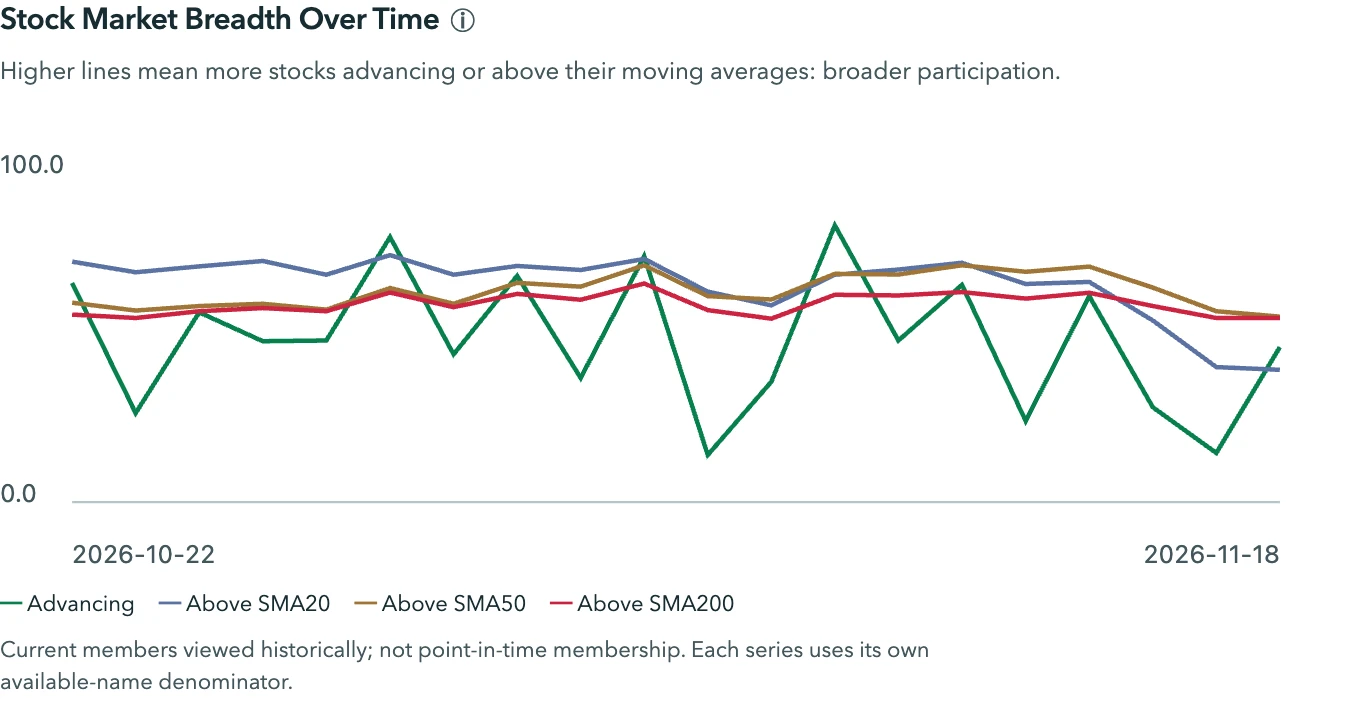
SPY: −0.31%, 47.1% of 503 members advancing (237 up, 265 down, 1 unchanged), 40.2% / 56.4% / 56.0% above the 20-, 50- and 200-day averages. QQQ: +0.39%, 47.5% advancing (48 of 101), 32.7% / 42.6% / 45.5%. AI 30: 13 of 30 up, 16.7% / 10.0% / 23.3%. Crypto-related equities: 0 of 7 up. The number of S&P members advancing rose to 237 from 75 on Tuesday, on a day the fund still fell.


The key level: SPY's first close under its 200-day average since April
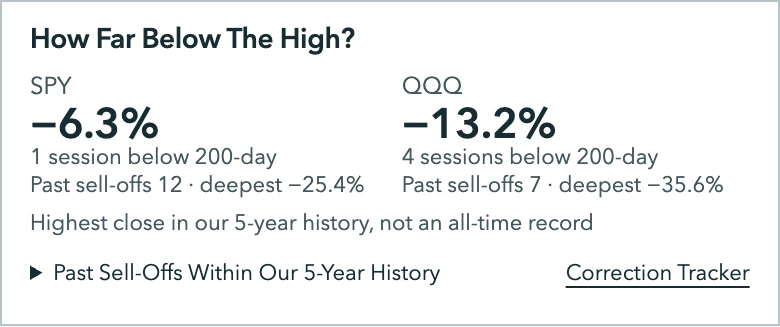
SPY opened at $733.37, above the average, traded as high as $735.06 and closed 2.35 points, or 0.32%, under it. The dashboard's strip now reads "1 session below 200-day". The previous stretch below the average lasted 13 sessions, from March 19 to April 7.
Yesterday we named any close below $732.34, Tuesday's value of the average, as the bear trigger for the three closes through Friday. Wednesday's close was 2.14 points under that line, so the bear condition was met on the first of the three. QQQ closed 3.41% below its own 200-day average, a fourth session under it.
Our reading: one close below a long average is a condition and not a verdict. The next closes matter more. Either they return above the average, as the evening's prices did, or rallies begin to stop at it.
How the day traded
SPY's low of $726.80 was about 20 cents under Tuesday's low, and the close was 41.2% of the way up the day's range. It was also the lowest close since the decline began on October 6. QQQ traded between $662.80 and $653.05 and closed 66.3% of the way up its range. Its low was $3.05 under the $656.10 line we have used since Monday, and its close $3.41 above it.
Distance from the highs
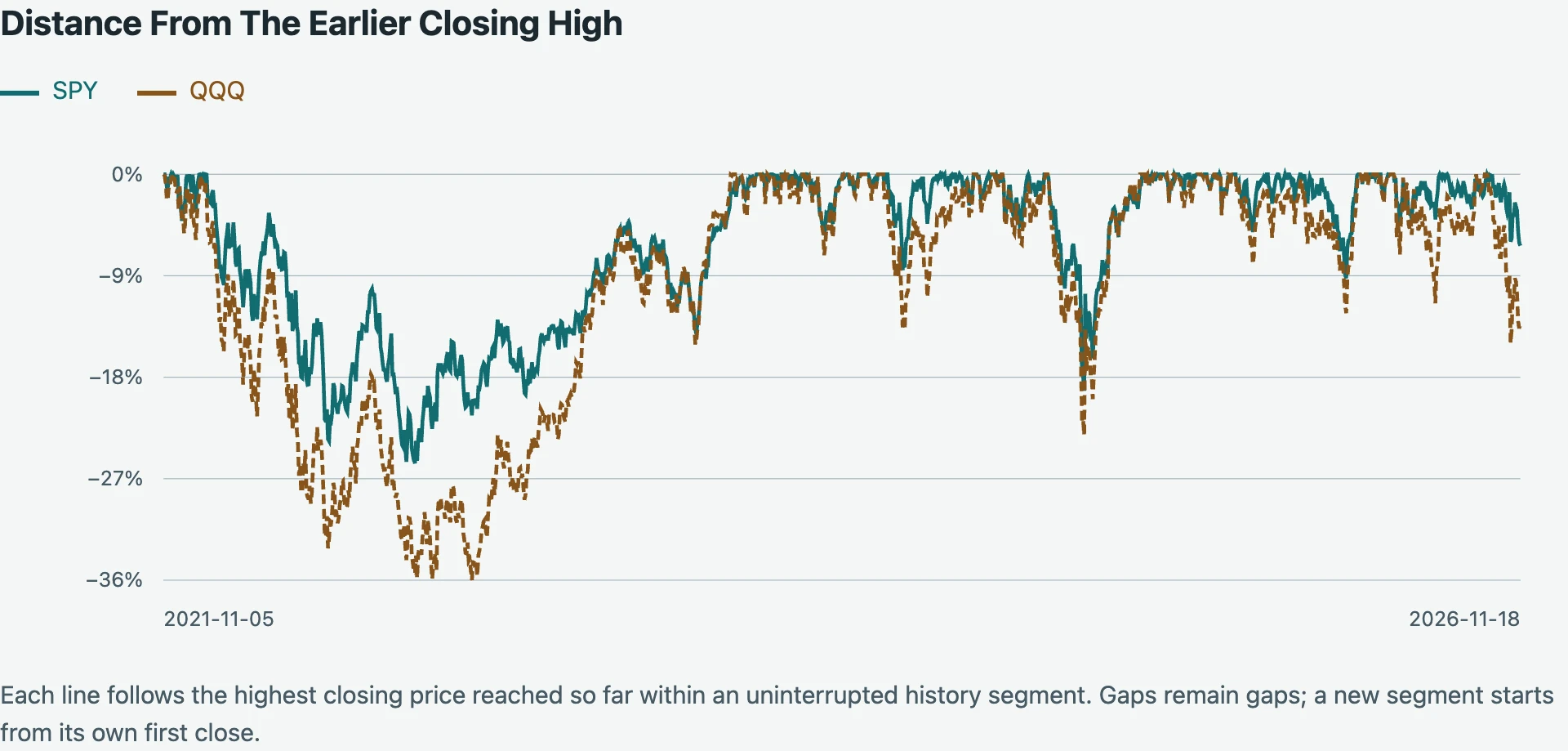
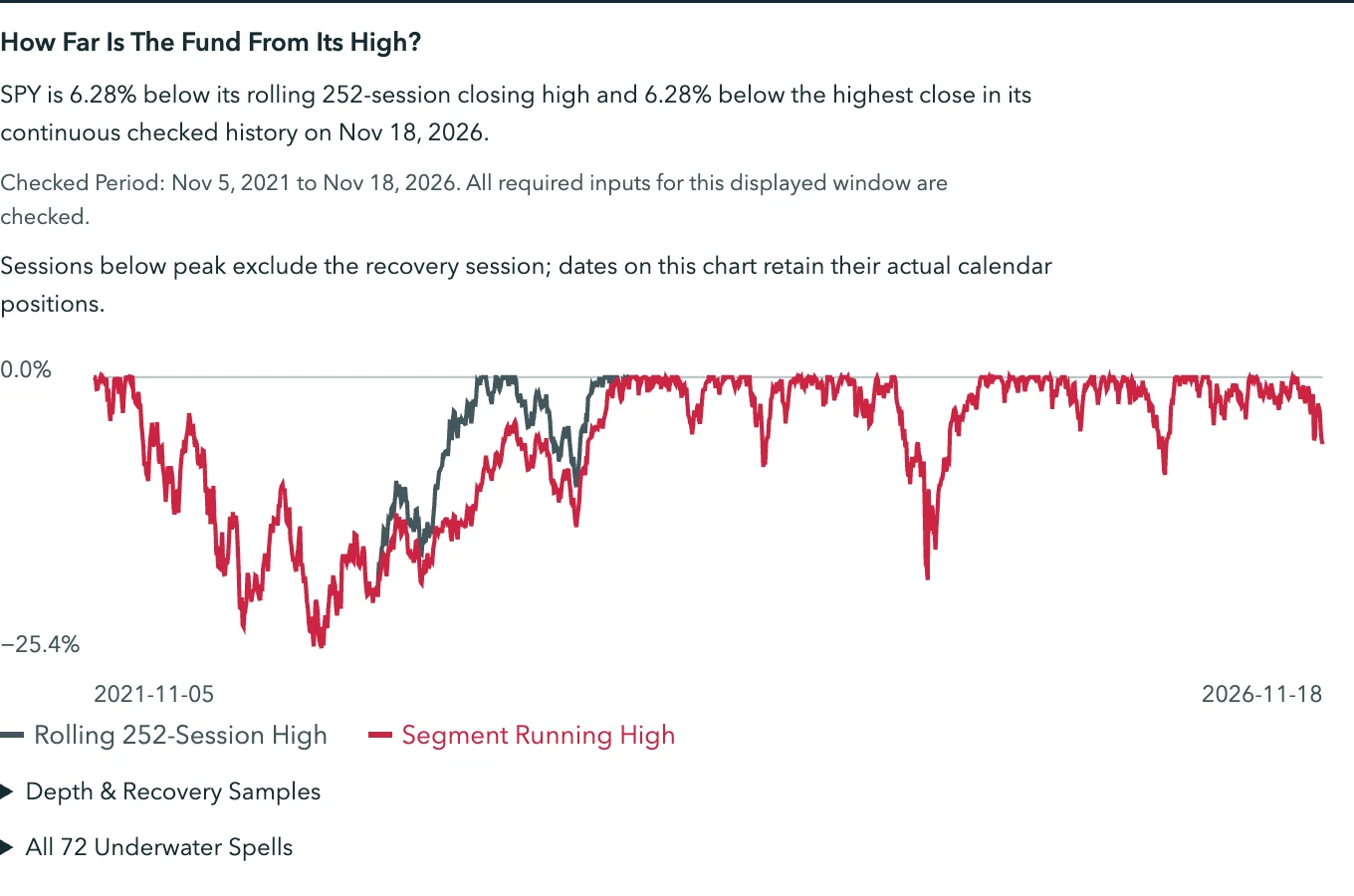
SPY closed 6.28% below its October 6 closing high, from 5.99% on Tuesday; a 10% decline would be a close at $701.18. QQQ closed 13.18% below its own, from 13.52%. On the Correction Tracker that is past two of QQQ's three completed corrections and short of the third (13.56%). History, not a forecast.

Broad or narrow? The gap was in the largest names, in both funds
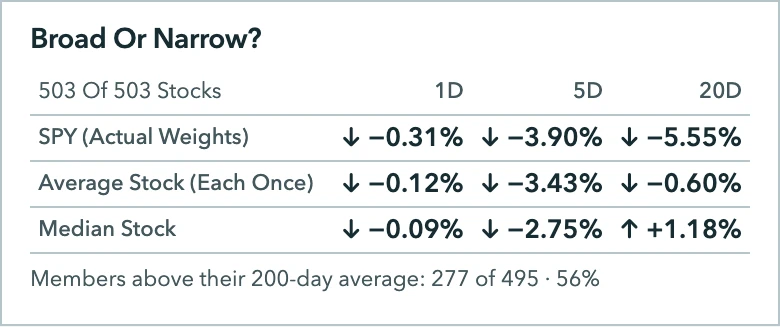
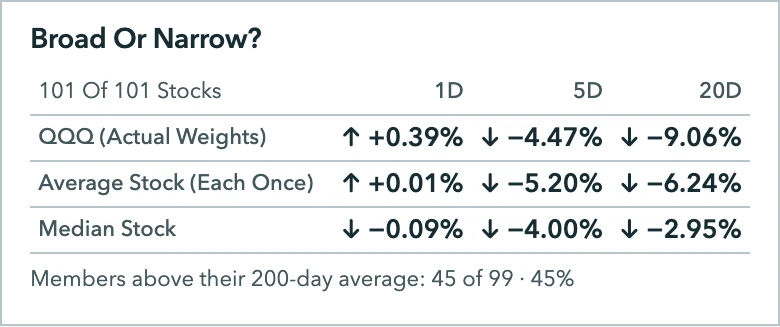
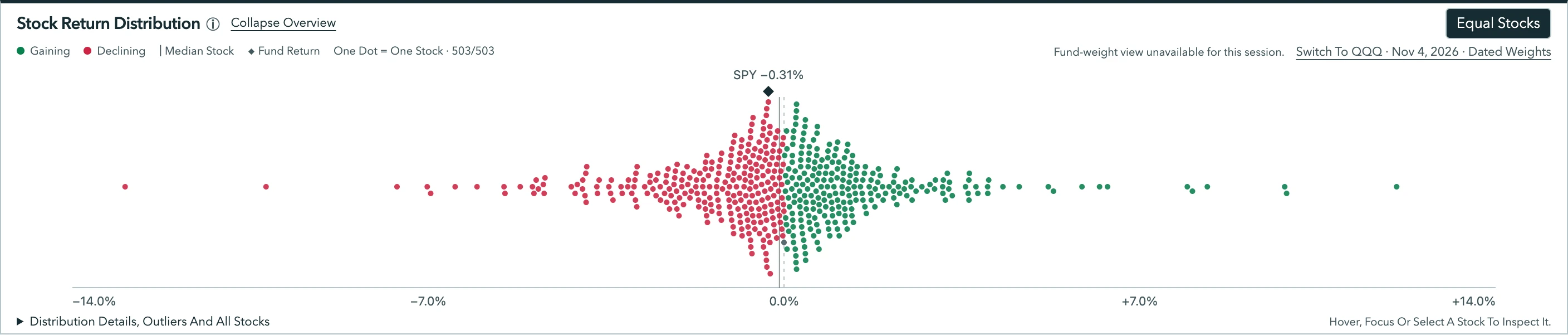
SPY's −0.31% compares with −0.12% for its average stock and −0.09% for its median. A fund that falls further than both its average and its median member is one whose largest names lost more than the rest. QQQ was the mirror image: +0.39% for the fund, +0.01% for its average stock and −0.09% for its median, so its largest names did more than their share. On Tuesday the median S&P stock fell further than the fund. On Wednesday the order flipped back.
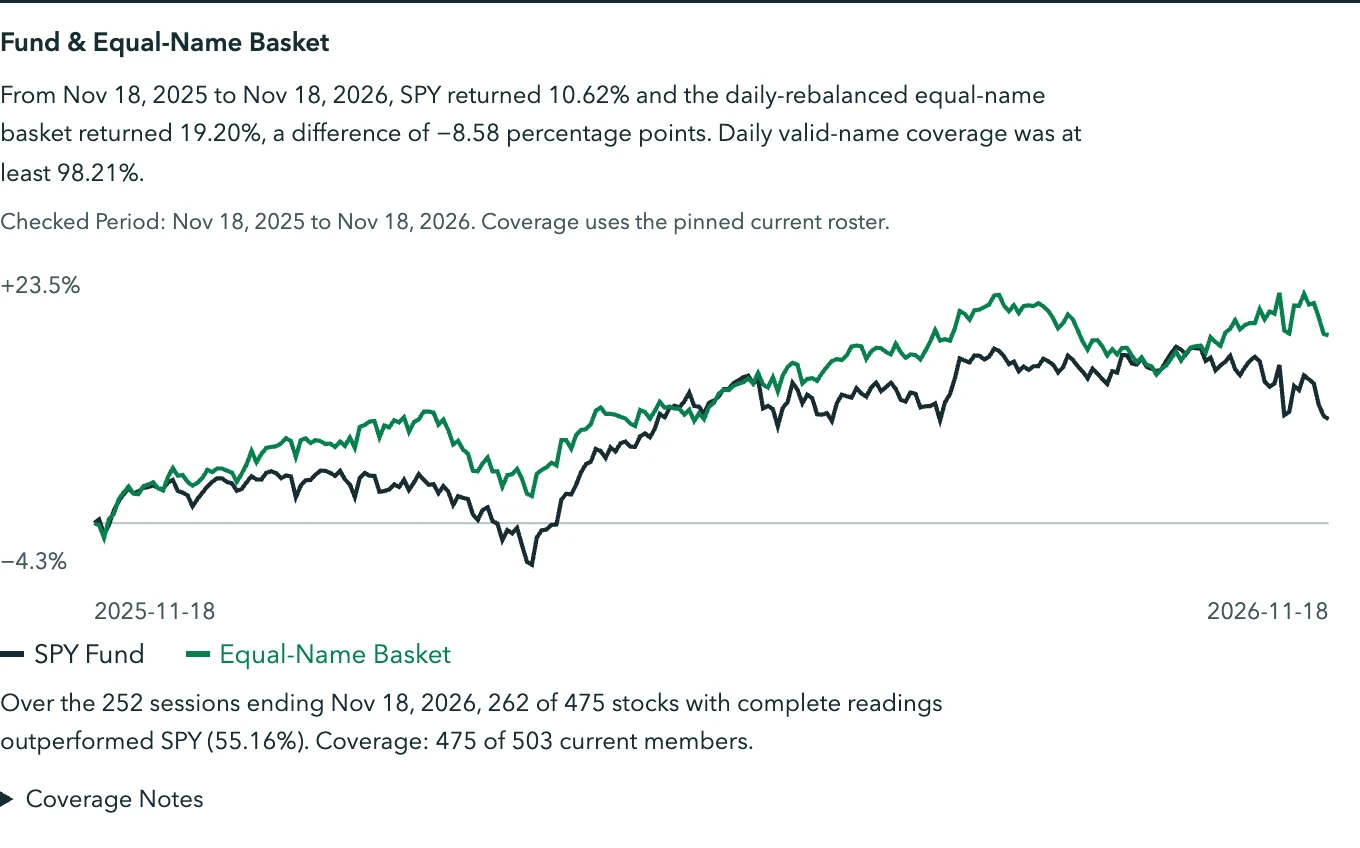
The counterevidence, before calling the S&P's decline narrow: 265 members still fell, and this is one session. Which large names made the gap is our view and not a measurement, because contributions are unavailable; Nvidia, UnitedHealth, Exxon Mobil (−3.97%) and Chevron (−4.74%) are large companies that fell far more than the fund. Over twelve months the same order holds: Market History puts SPY's price return at 10.62% against 19.20% for a daily-rebalanced equal-name basket of its members, which is not an equal-weight ETF. S&P member dispersion rose to 2.31 percentage points, the 60th percentile of the past year, from 1.57 (11th); the Nasdaq-100's was 2.41 points, the 36th percentile.
Breadth, new highs and new lows
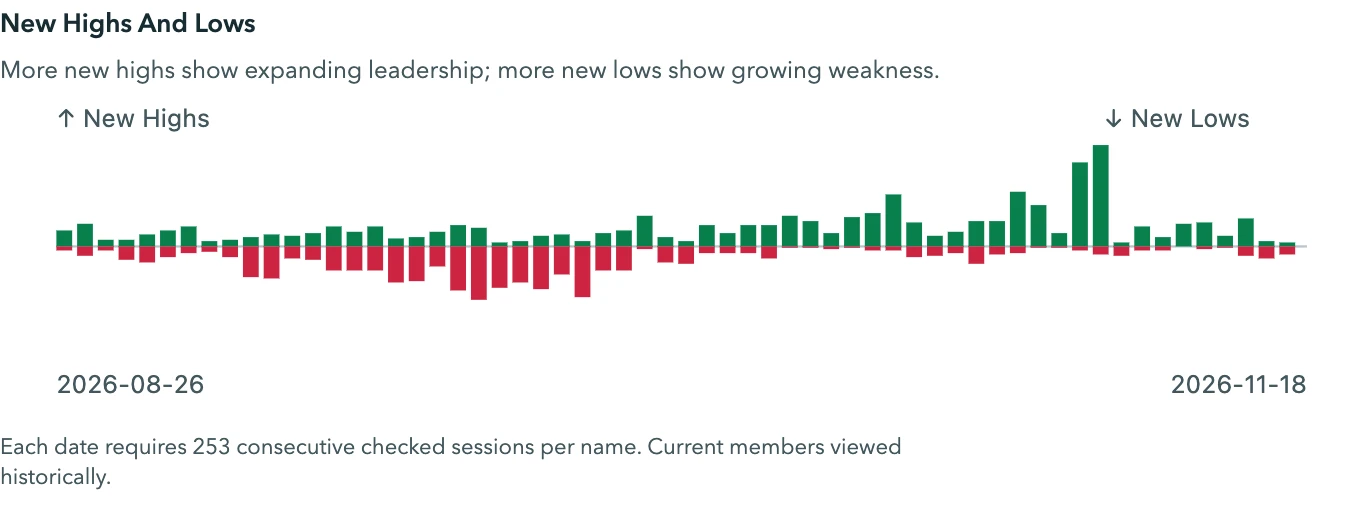
The S&P tab's Dated Readings table shows the share of members above their 200-day average unchanged at 56.0% (277 of 495). The 55% line we watch sits 0.96 points lower, and it would take five more members slipping below their averages to breach it. On the Nasdaq-100 tab the same table has the share up to 45.5% (45 of 99) from 43.4%. New 52-week lows again exceeded new highs, 6 to 3 among S&P 500 members and 2 to 0 in the Nasdaq-100, after 9 to 4 and 3 to 1 on Tuesday, so that item on Tuesday's warning list stayed on.
Leaders and laggards: Okta up 12.07%, Humana down 12.98%
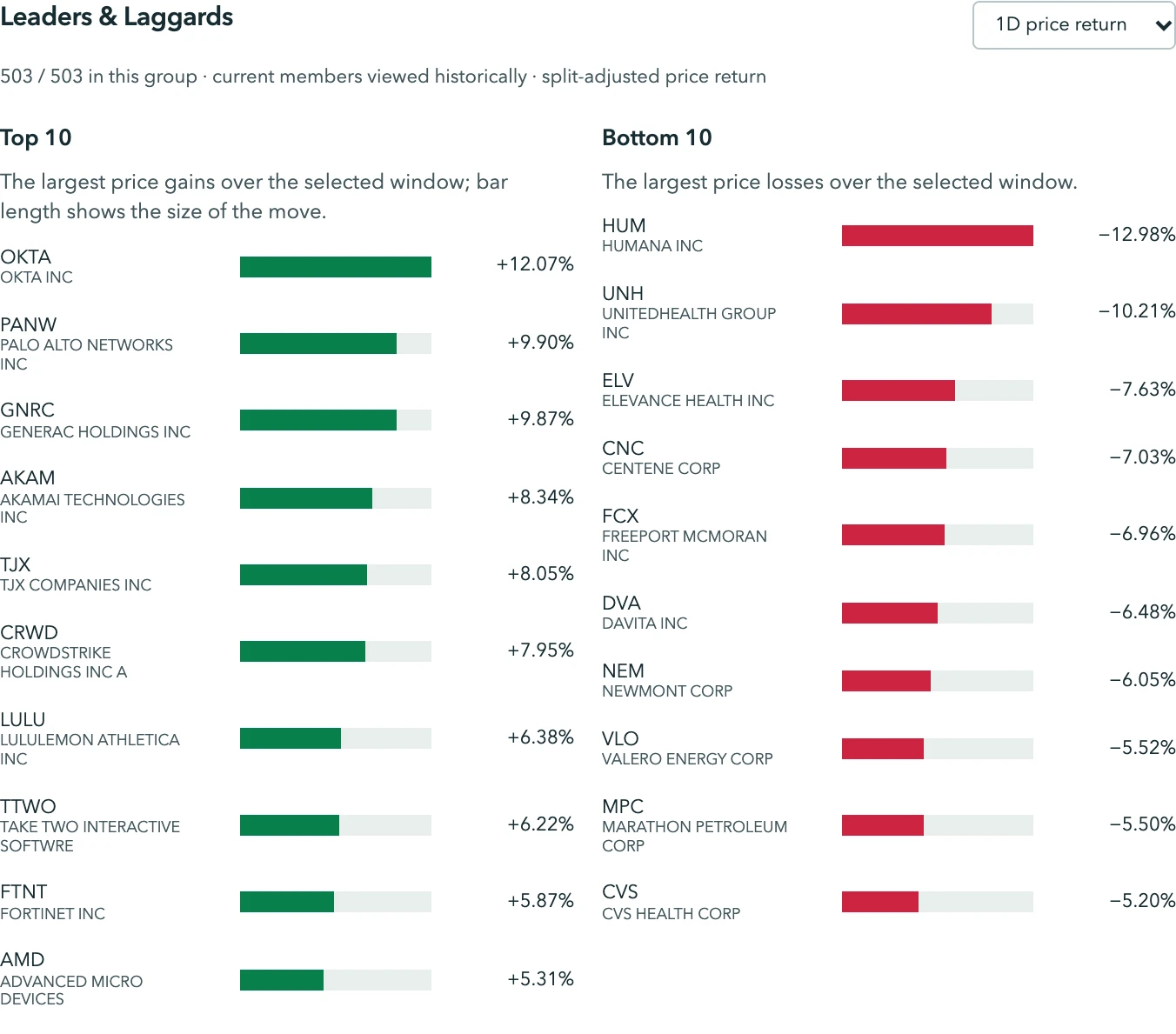
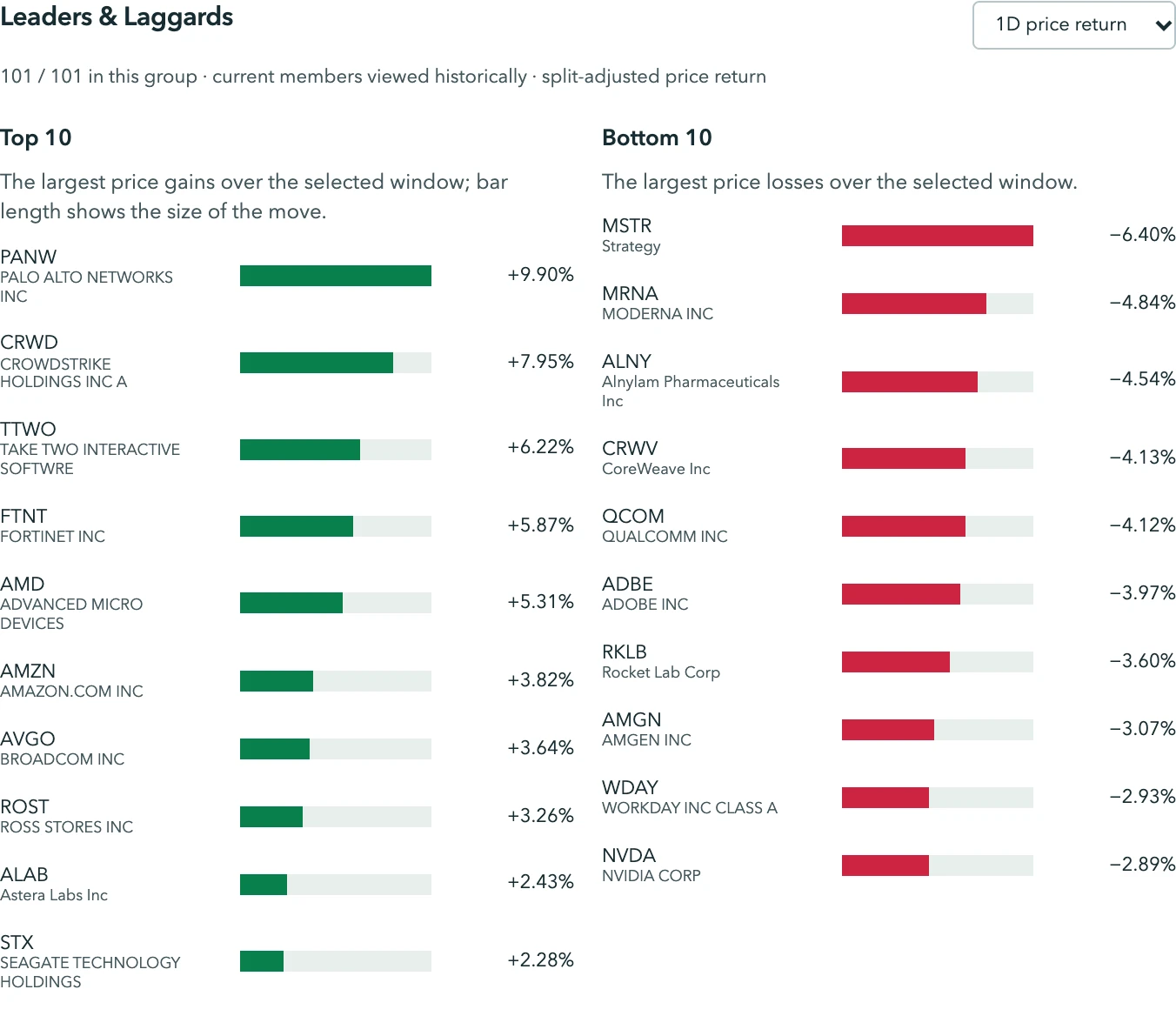
S&P leaders: Okta +12.07%, Palo Alto Networks +9.90%, Generac +9.87%, Akamai +8.34%, TJX +8.05%, with CrowdStrike +7.95% sixth. Laggards: Humana −12.98%, UnitedHealth −10.21%, Elevance −7.63%, Centene −7.03%, Freeport-McMoRan −6.96%. In the Nasdaq-100, Palo Alto, CrowdStrike and Take-Two (+6.22%) led, and Strategy (−6.40%), Moderna (−4.84%) and Alnylam (−4.54%) were weakest.
Reported alongside these moves, and not established as causes. Cybersecurity shares rose on the day Homeland Security Secretary Markwayne Mullin warned Congress about AI-powered attacks on U.S. infrastructure. Health insurers fell for a second session, which reports tied to a proposed Medicare anti-fraud audit rule that we have not read. TJX and Target (+4.01%, a 52-week high) reported before the open. December WTI crude settled down 3.2% at $83.26, as reported. We found no same-day report behind Generac's gain. The dashboard flags eight of the day's large moves, including those of Humana, UnitedHealth, Palo Alto, TJX and Chevron, as unverified against an ex-dividend calendar.
Sectors: four of eleven had a majority advancing, and Energy had 1 of 21 rising
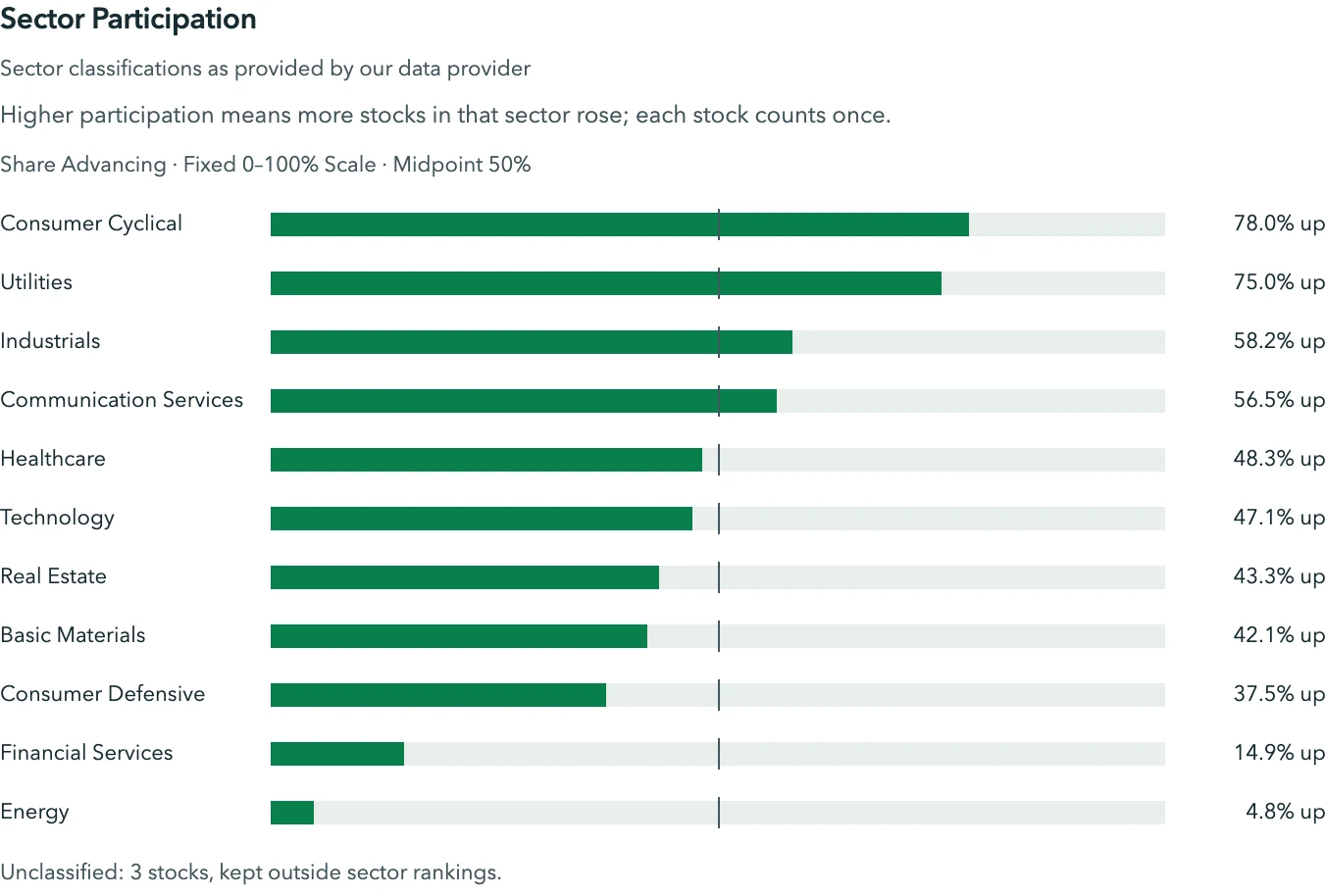
Four S&P sectors had more gainers than losers, against none on Tuesday: Consumer Cyclical (39 of 50), Utilities (24 of 32), Industrials (46 of 79) and Communication Services (13 of 23). Energy had 1 of 21 rising and Financial Services 10 of 67. Healthcare was nearly even at 29 of 60, so the managed-care losses were a pocket inside it. Technology split 41 of 87; the cybersecurity gainers and Nvidia sit in the same sector.
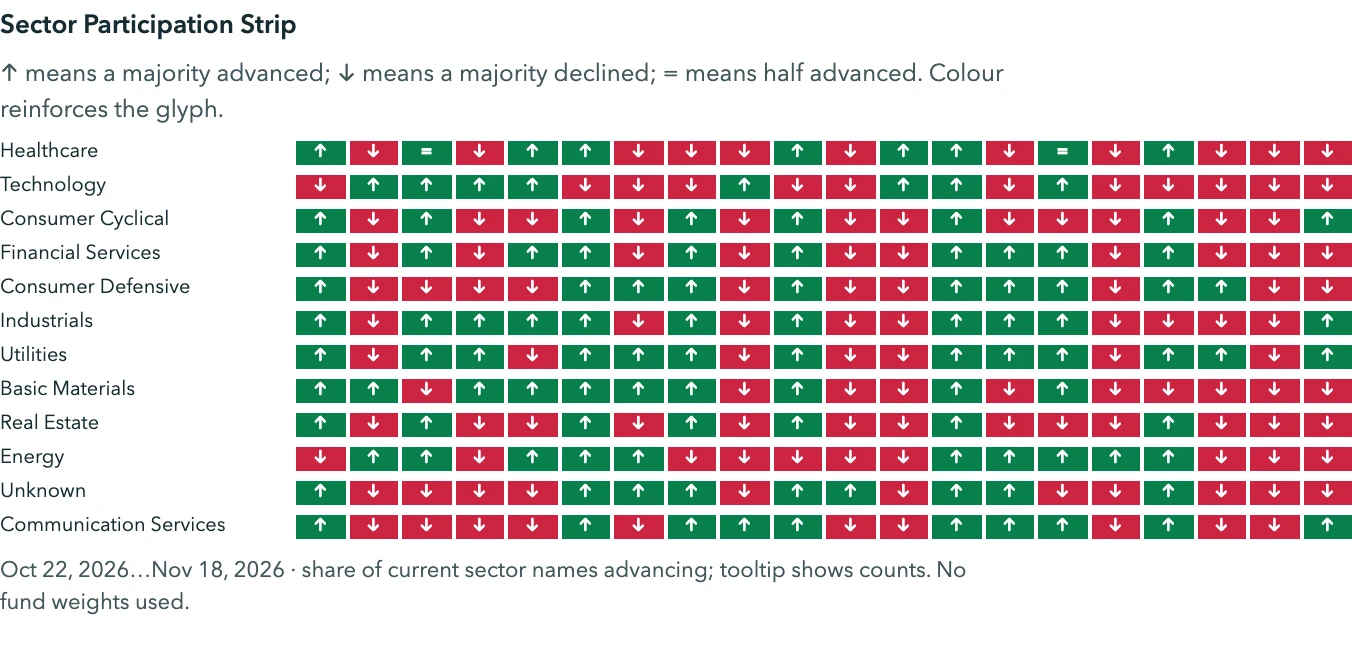
The Participation Strip gives each sector an up arrow on days a majority advanced. Wednesday's column has four, and Technology's row has now printed a down arrow five sessions running. Among Nasdaq-100 sectors, Consumer Cyclical (7 of 10) and Communication Services (6 of 9) had majorities.
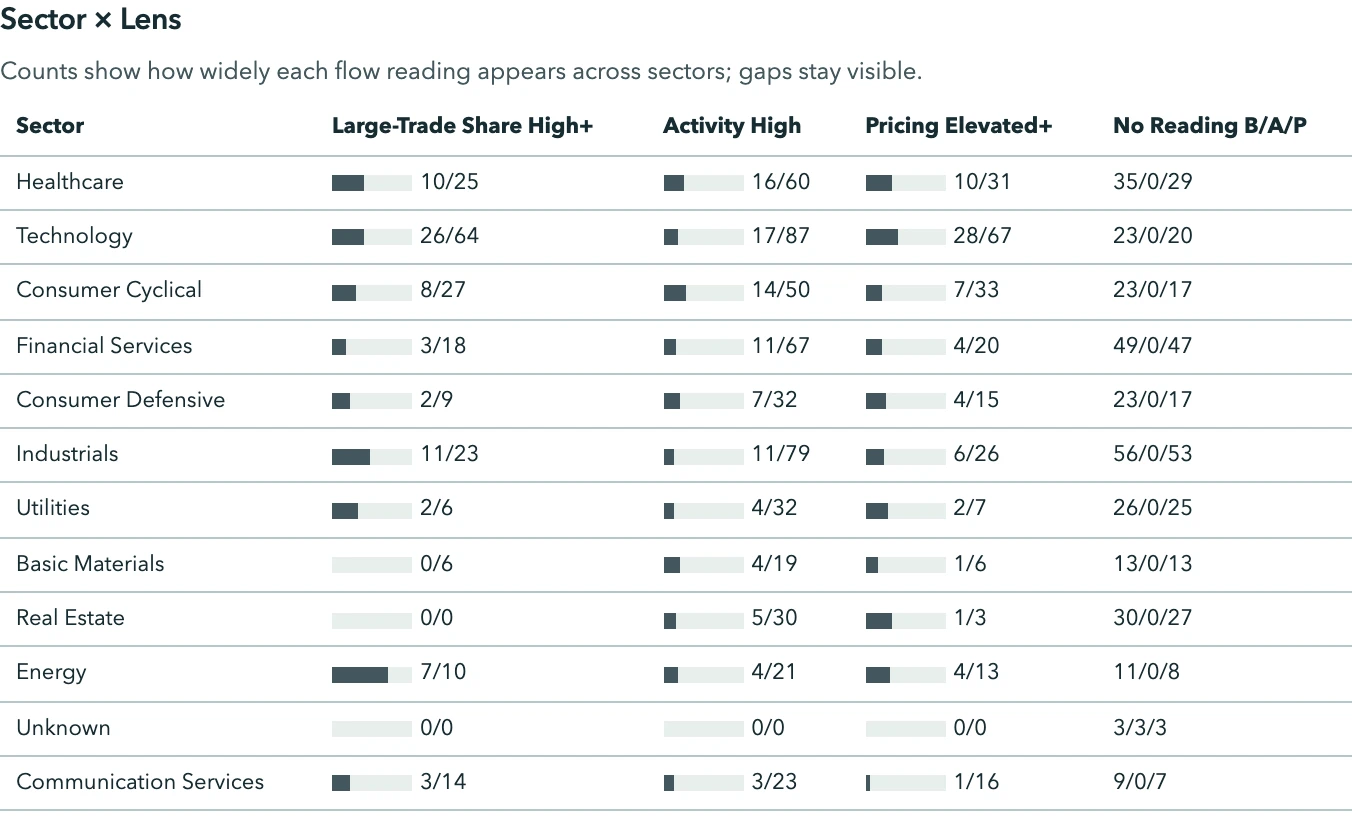
Large-trade share is a measure of size with no direction: it sets the portion of a stock's options premium that arrived in large prints against the same stock's past. In the Sector × Lens table, 72 of the 202 S&P members with readings and 23 of 72 Nasdaq-100 members are labelled High or above. Within the S&P count, Very high readings rose to 27 from 14 on Tuesday. Energy had the highest share of any sector, 7 of 10.
AI 30: the count is back to three
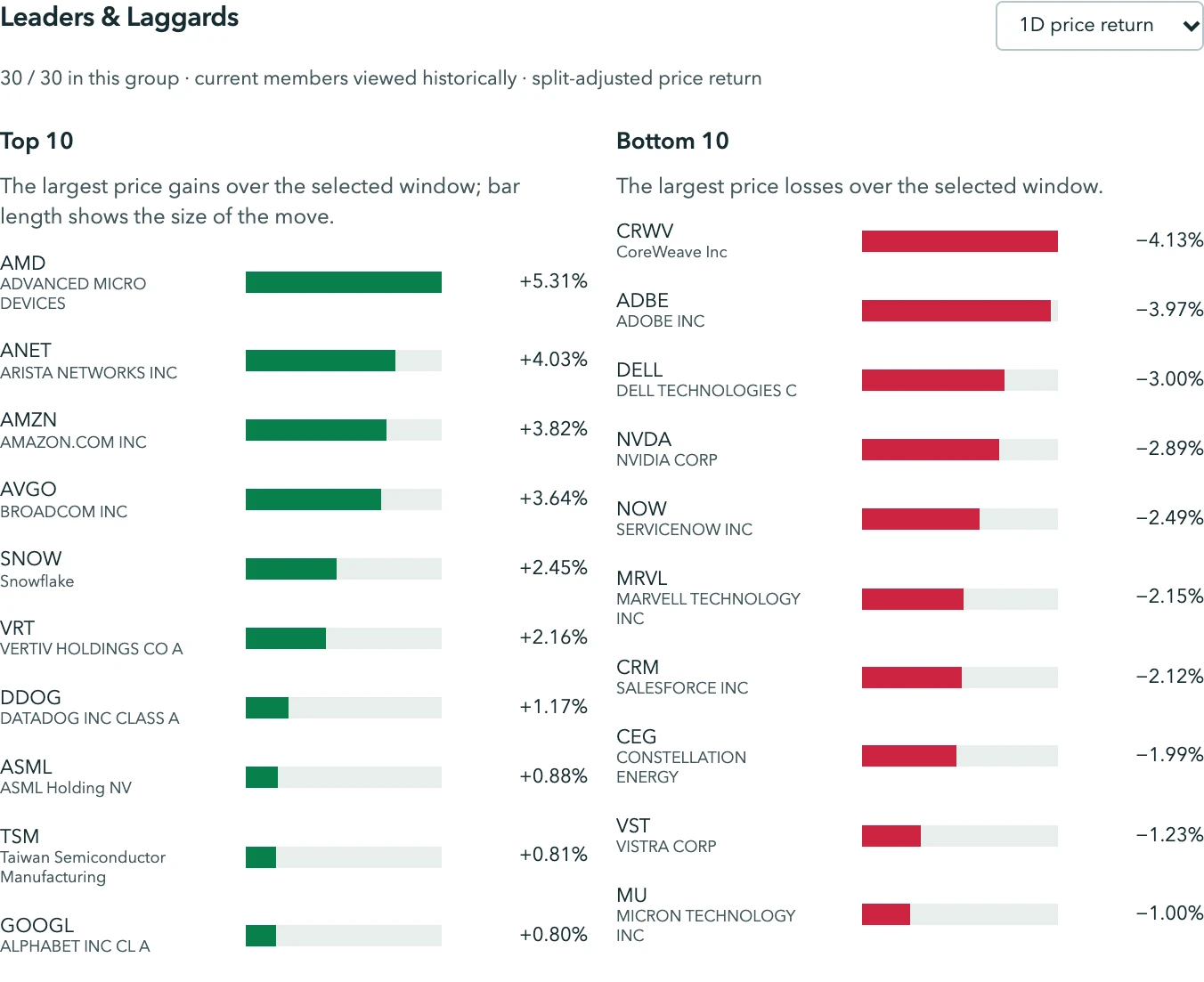
The AI 30 count we follow is the number of names above their 50-day average. It rose to 3 from 1, as Arista and Broadcom joined Amazon. Above the 200-day average there are seven, unchanged. Measured against its own 52-week high, the average AI stock is 34.1% lower, an average of distances and not a basket return. Tuesday's list of what we wanted to see had the count back at 3 and then 7. The first step is done.
Thirteen of the 30 rose, from 9, and the median fell 0.36%. AMD, Arista (+4.03%), Amazon (+3.82%) and Broadcom led. CoreWeave (−4.13%), Adobe (−3.97%), Dell (−3.00%) and Nvidia lost most. In the Selected Stock Context table Nvidia ranks 27th of 30 for the session.
The tab's other panels, briefly. Seventeen names sit below zero in its distribution, and none made a new high or low. Among its 22 Technology names nine rose, and the sector strip marks a majority of them declining for a fifth session. Options pricing is labelled Elevated or above for 12 of those 22 in its Sector × Lens table, and across the tab the Extreme label fell to 6 names from 8. The RSI filter for 30 or below holds four names, the same four as Tuesday, and two of its momentum filters are empty (an RSI of 70 or above, and the top 10% of a stock's year). For the 9 names that have baselines, median relative volume was 0.76x, from 0.93x.

The AI Ecosystem tab: software went from 0 of 6 advancing to 3 of 6
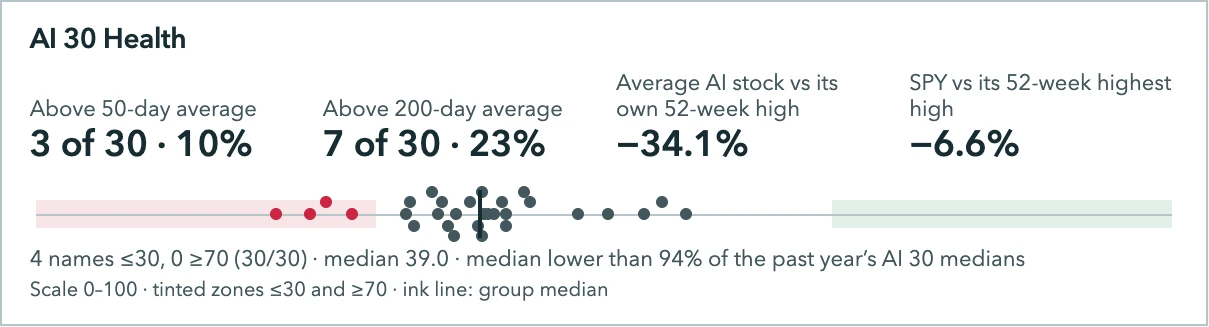
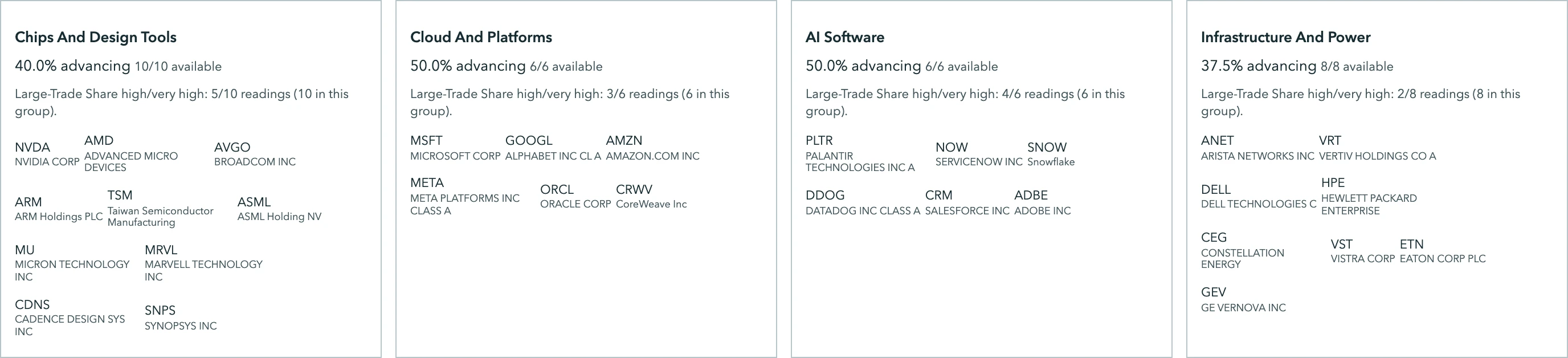
Chips And Design Tools: 4 of 10 advancing, or 40.0%. AI Software: 3 of 6. Cloud And Platforms: 3 of 6. Infrastructure And Power: 3 of 8. None of the four groups is a portfolio. No software name rose on Tuesday; on Wednesday Snowflake, Datadog and Palantir did. Inside chips, AMD, Broadcom, Taiwan Semiconductor and ASML rose, and Nvidia, Micron, Marvell and three others fell.
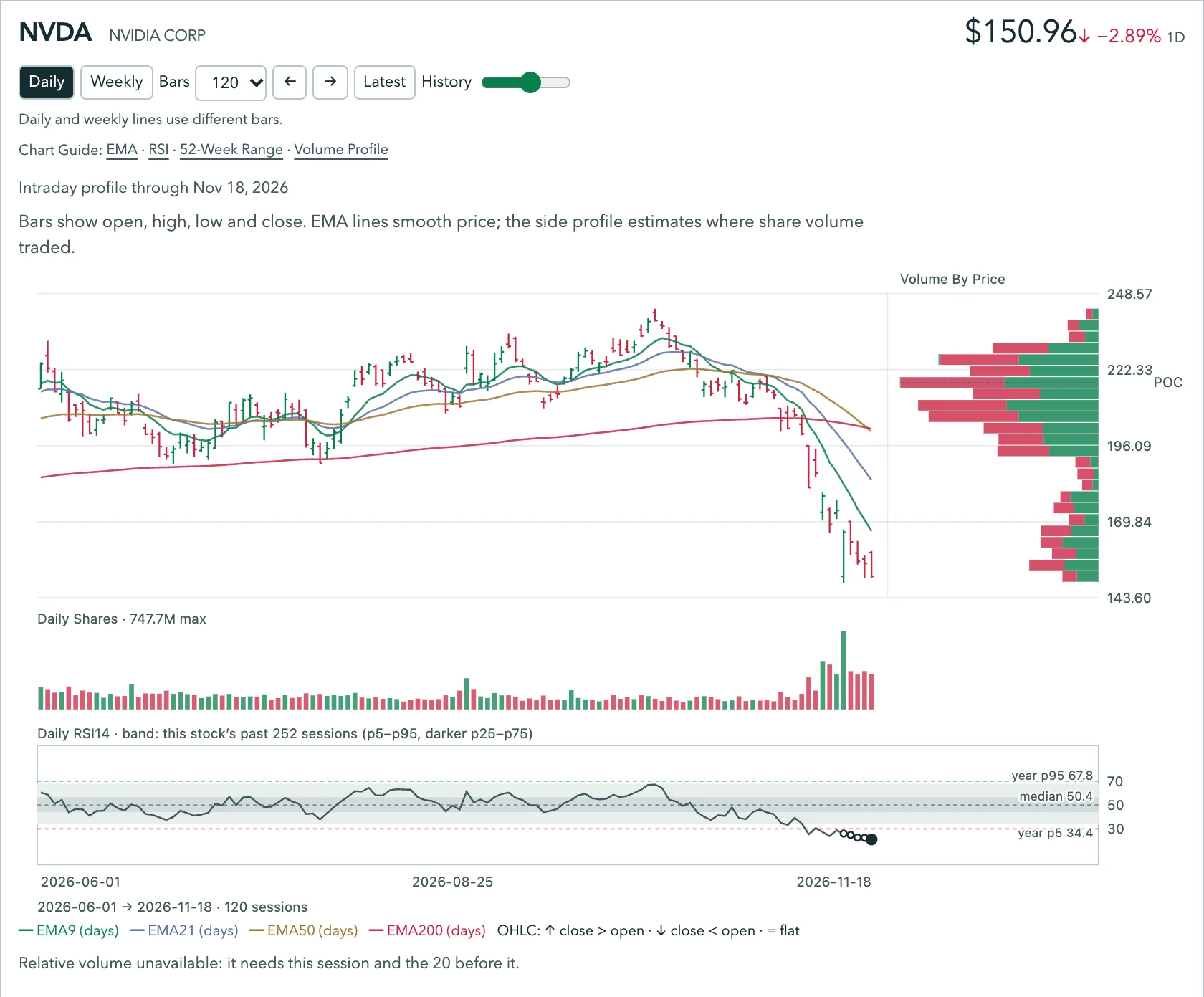
Nvidia the day after its report
Nvidia opened at $159.19, above the level it lost on Monday, reached $159.70, fell to $150.40 and closed 5.24 points under that level. The close stayed above $150, the second level on Tuesday's warning list, by 96 cents. At 21.1, the 14-day RSI is the lowest the stock's chart shows for the past year, and its 50-day exponential average crossed below its 200-day. The SPY, QQQ and AI 30 tabs all open on Nvidia's chart and lenses, which label large-trade share High, from Normal, and options pricing Extreme for a tenth session.
What was reported: CNBC and Yahoo Finance tied the reversal to leadership uncertainty after Jensen Huang's resignation as CEO and board chair Harvey Jones's statement that the board does not intend to reinstate him. Nvidia's results release says it plans to file its quarterly report "in the coming weeks" (company filing).
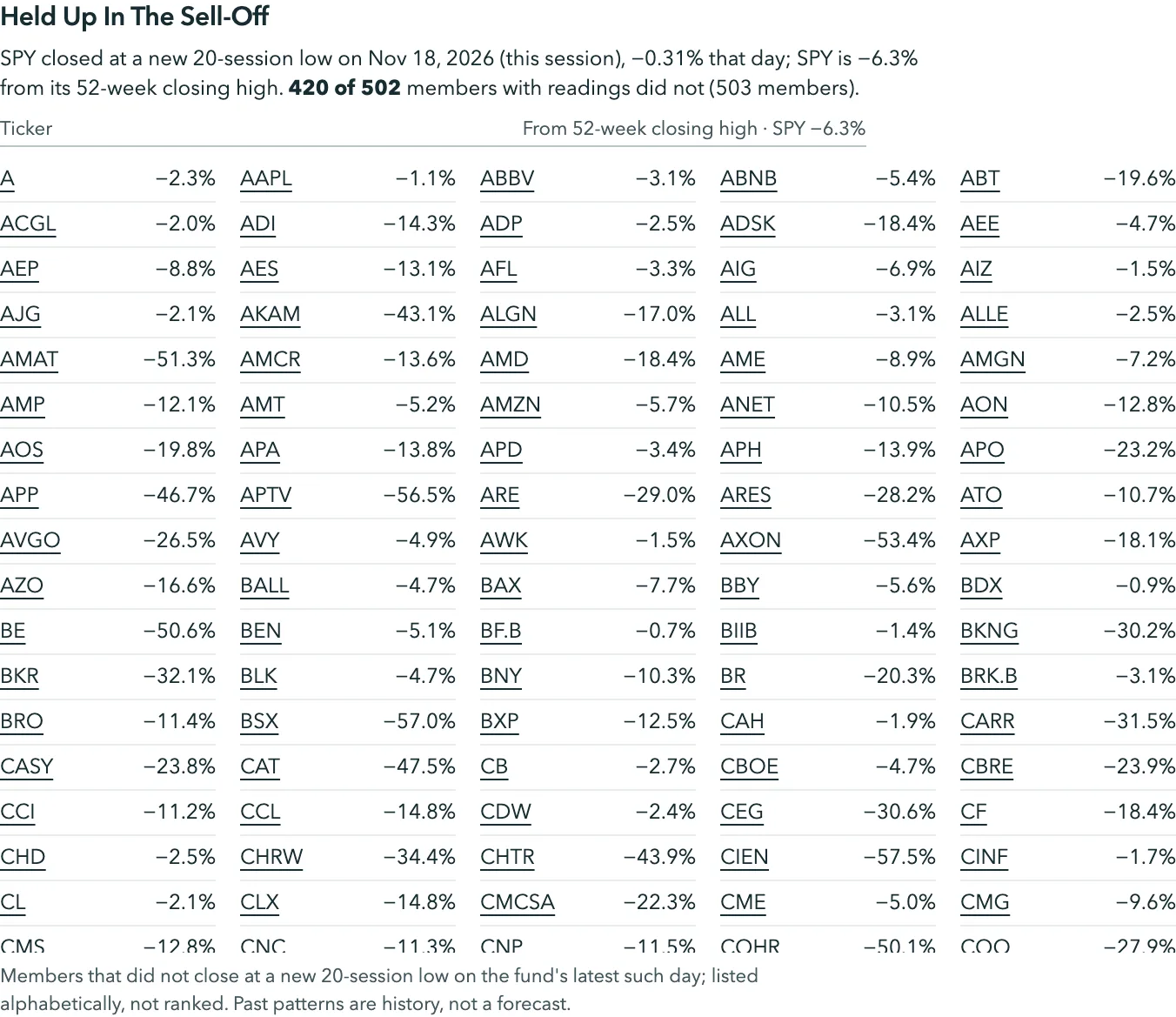
Held up in the sell-off
For SPY the anchor moved from Tuesday to Wednesday, the fund's newest close at a 20-session low: 420 of the 502 members that have readings avoided a 20-session closing low of their own that day, down from 431 on Tuesday's anchor. QQQ's anchor is still November 5, now nine sessions back (59 of 101). The panel lists names alphabetically and does not rank them.
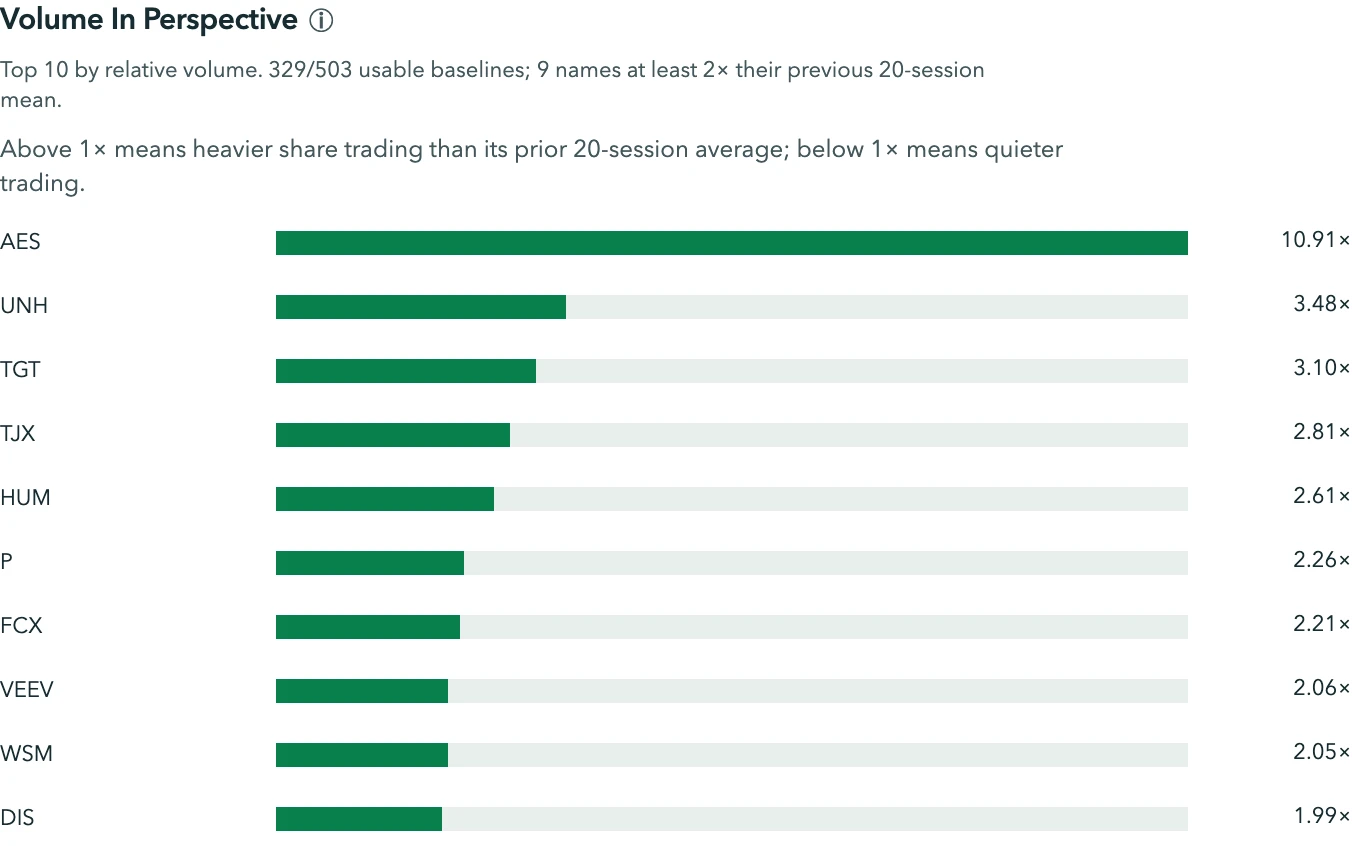
Volume: SPY at its usual volume, and QQQ's rebound check
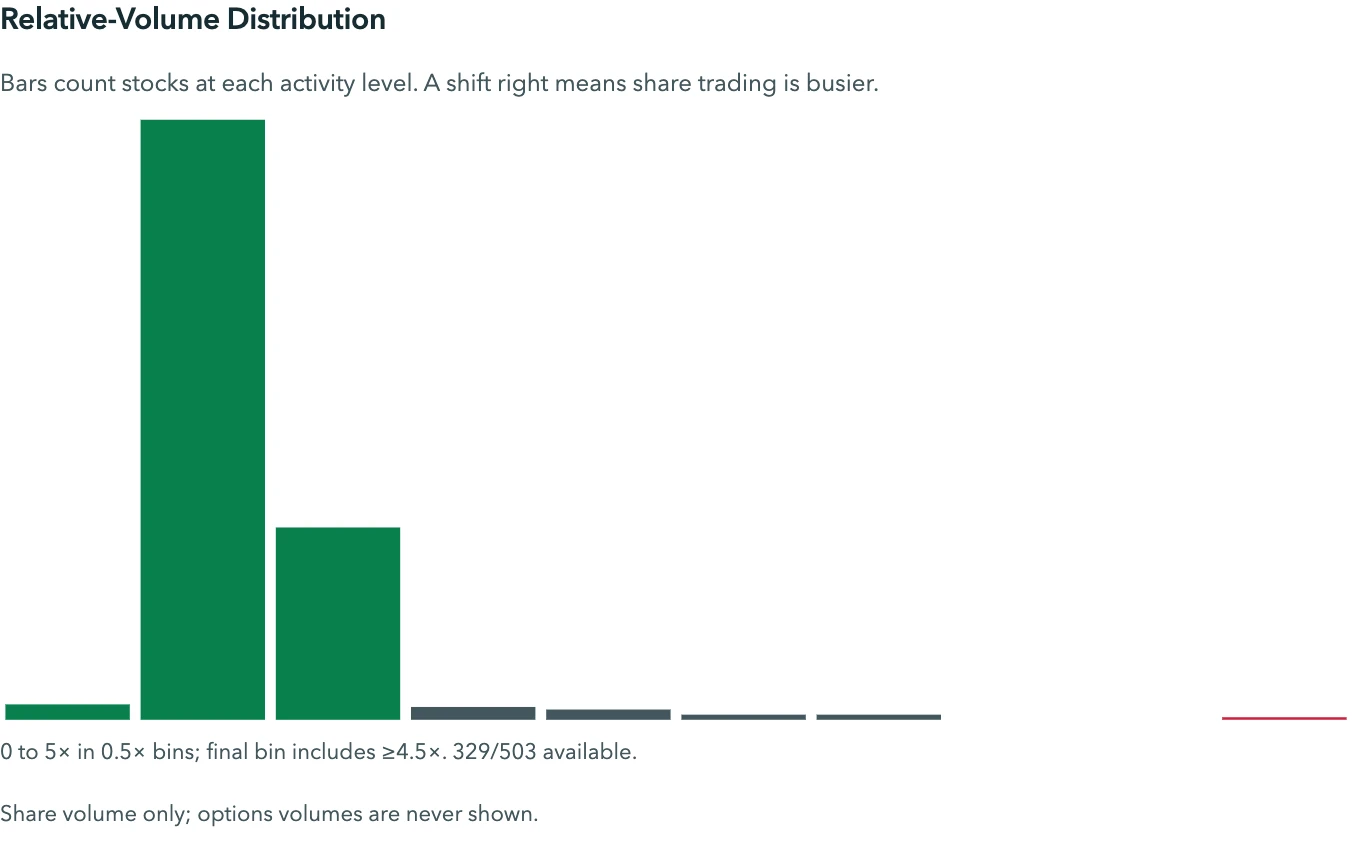
SPY traded 1.00 times its 20-session average share volume, down from 1.43 on Tuesday, so the first close under the 200-day average came on ordinary volume for the fund. Among the 329 of 503 S&P members that have usable baselines, median relative volume was 0.84x, and 234 of them traded between 0.5x and 1x. AES (10.91x) and UnitedHealth (3.48x) led the nine names at 2x or more. Member volume is unavailable for the Nasdaq-100, so that tab's two volume charts are blank.
The rebound volume check appears on the QQQ tab for the first time since November 11. QQQ rose 0.39% two sessions after its 2.67% fall on November 16, on share volume 0.85 times its 20-session average and 0.99 times that of the drop day, and closed 66% of the way up its range. Lower volume than the drop day does not by itself show weak participation. The panel is not shown for SPY on a down day.

Momentum: fifteen S&P names at an RSI of 30 or below
The 14-day RSI slipped to 36.6 from 37.5 for SPY and rose to 37.7 from 36.5 for QQQ. Fifteen S&P members now read 30 or below, up from ten: UnitedHealth, Boeing, Caterpillar, Freeport-McMoRan, First Solar and Archer-Daniels-Midland joined, and F5 left. Eleven read 70 or above, against ten. Oversold is a condition, not a signal.
Fifty-nine S&P members have an RSI in the lowest tenth of their own past year and 26 in the highest tenth; those two filters describe where a reading sits within each stock's year, not a direction. Of the moving-average crosses listed for Wednesday, the one we note is Nvidia's, described above. The Nasdaq-100 list at 30 or below grew to seven names from five, and its filter for 70 or above is empty.
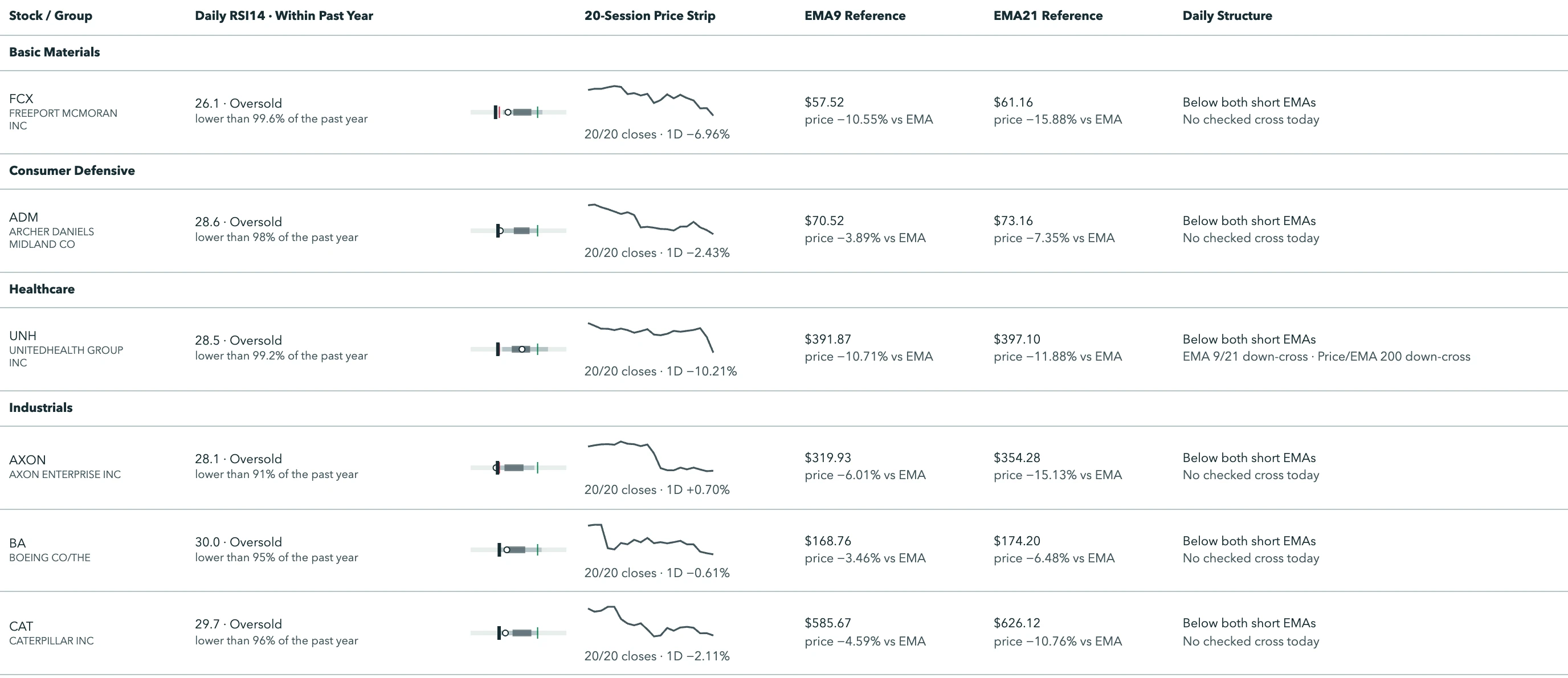
Crypto-related equities: none of seven rose
Six of the seven fell and the Solana staking fund was unchanged, which put the median at −2.63%. Strategy lost most, 6.40% to $90.32, and BTCS closed at another 52-week low. Not one of the seven is above its 20-day or 50-day average, and six read an RSI of 30 or below, up from four. Strategy is last of 7 for the session in the Selected Stock Context table. Strategy is also the stock on the tab's selected chart and lenses: large-trade share Low, options pricing Extreme, from Elevated.
The tab's distribution has no dot above zero. Neither classified sector had a gainer, and every row of the Participation Strip has shown a majority declining for five sessions. Gaps fill most of its Sector × Lens table: five of the seven names carry no reading. Only 3 of the 7 have volume baselines, and Bitmine's 1.04x is the highest. Three of its momentum filters are empty: an RSI of 70 or above, the top 10% of the year, and moving-average crosses.

Macro panel and the Economic Releases table
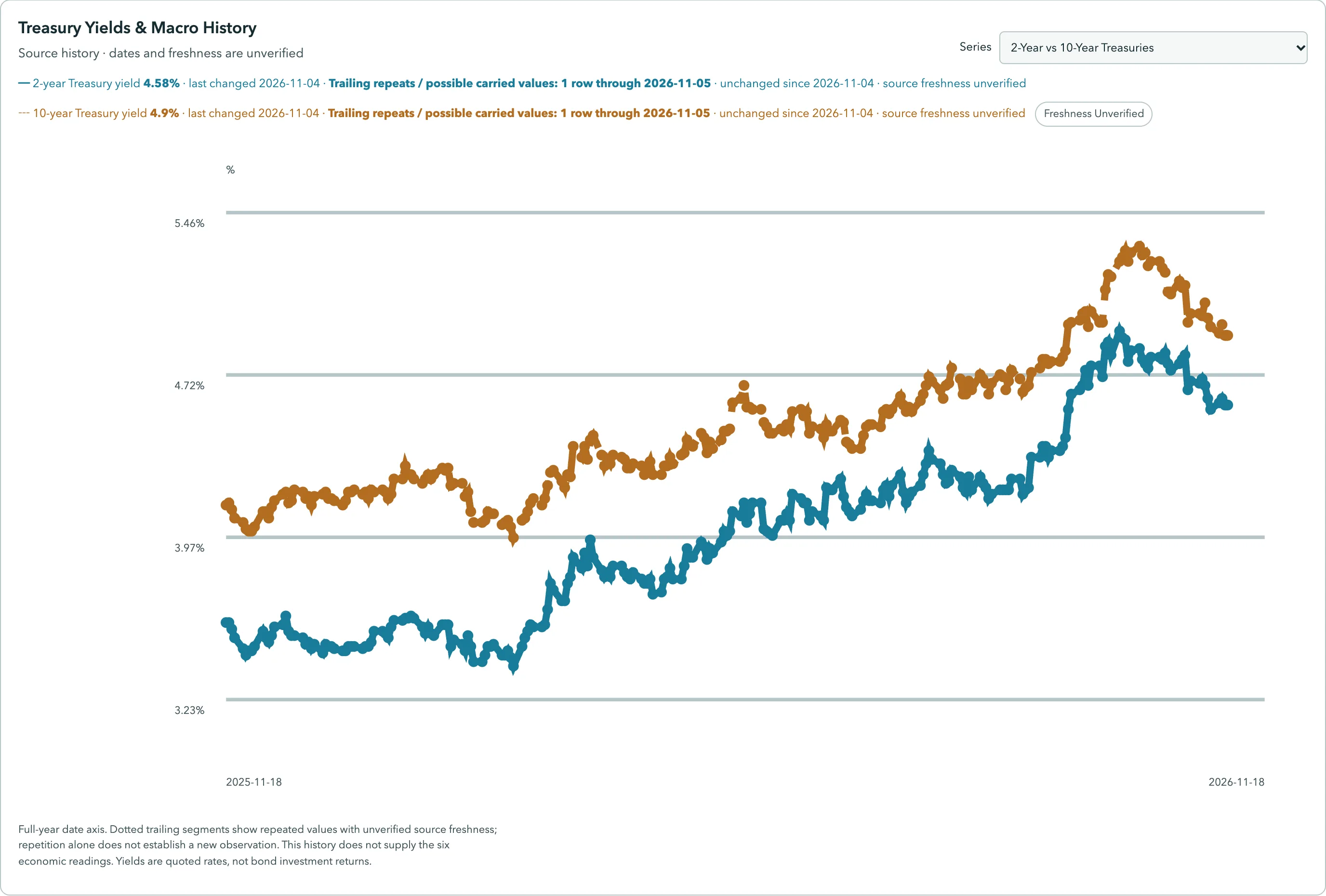
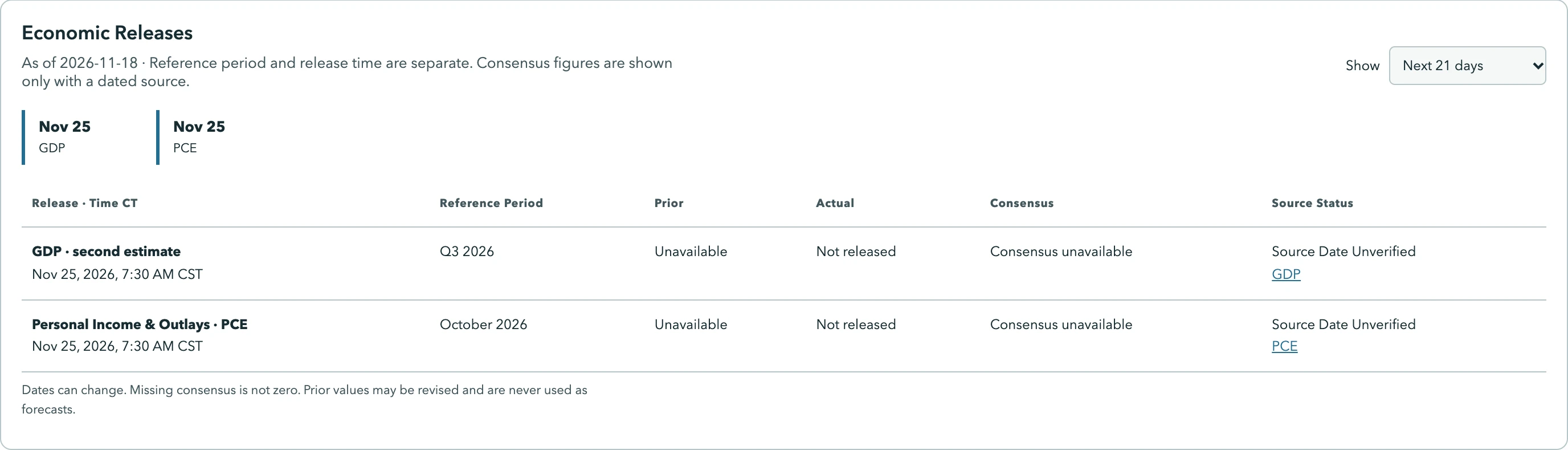
Unchanged: the six macro views and the macro strip are unavailable, and the yield chart still shows its November 4 values (4.58% for the 2-year, 4.9% for the 10-year), marked unverified. The Treasury's own figures are in the Economy section. Ahead, the Economic Releases table lists only two November 25 reports, GDP (second estimate) and personal income and outlays. It has no row for Wednesday's minutes or housing starts, Tuesday's retail sales or Thursday's jobless claims.
Market History, Performance & DCA, Stock History
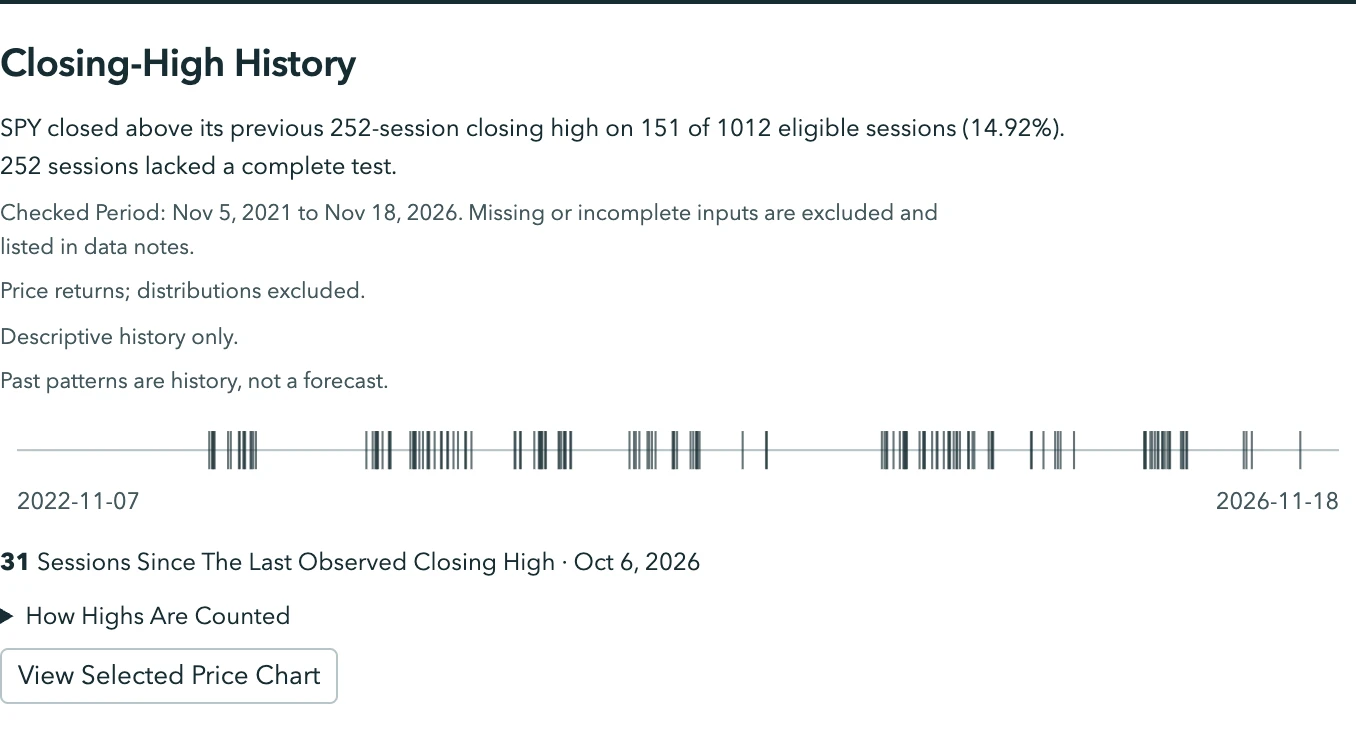
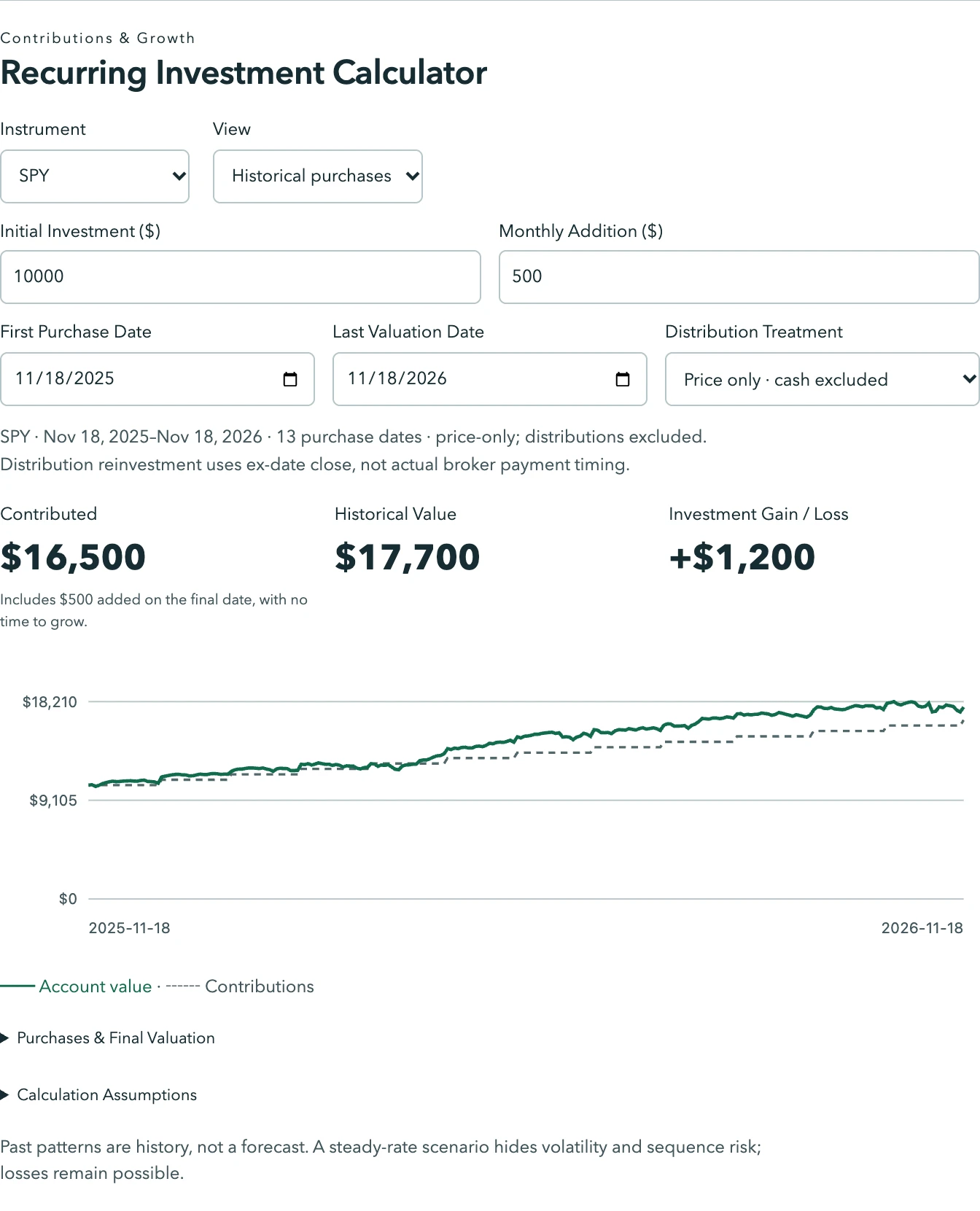
Market History supplies the twelve-month comparison used above; for QQQ the figures are a 10.60% price return against 27.65% for its equal-name basket. Its annual table has SPY up 7.08% in 2026 to date with a maximum drawdown of 9.13% within the year, deeper than the current 6.28%. Stock History puts both funds 31 sessions past their October 6 closing highs. The default case in Performance & DCA, $10,000 at the start and $500 each month into SPY since November 18, 2025, comes to $16,500 paid in and $17,700 of value, price only and an illustration; the growth chart next to it shows axis ticks only.
Quiet and unavailable panels, in one line
No change in the hidden or unavailable modules on any of the four tabs: Fund Bridge with holding contributions, Rotation, Big Moves, Flow Grid, Dividends, and the macro strip with its six views. Text panels, read but not pictured: Metric Guide, The Session In One Paragraph, What Moved The Market Today, Today's News (3 lead items, 19 further stories), Share Previews and Find A Stock. On the AI 30 and crypto tabs the shared modules (How Far, AI 30 Health, Broad Or Narrow, AI Ecosystem, Macro, Performance, Market History, Stock History) match the fund tabs, and each tab's own movers list, volume charts, new highs and lows chart, Breadth Over Time chart and Dated Readings table (AI 30: 43.3% advancing; crypto-related: one new low, no new highs) are read in the sections above. Elsewhere on the site, the Economy page still carries its November 9 date and a September Retail Sales card, and the Journal index, News page, About page and footer dialogs have not changed.
Flows
The numbers in this section are drawn from Wednesday's options tape and from the flow labels on the dashboard. A side is the tape's classification of a print against the quote, not proof that anyone bought or sold; size does not prove intent; and flow is context, not a forecast. All prints are counted at the market level, while the sector ratios and large-print figures use only prints of at least $25,000. About $60.5 million of those larger prints came outside regular hours, so the tape is not purely a regular-session record; every print described below with a clock time is from the regular session. Anthropic has no listed options before its debut.
Market level: premium near its recent median, and the second-highest put share of eight sessions
Total options premium was $46.73 billion, 1.05 times its median over the previous seven sessions and down from Tuesday's $59.97 billion. Puts took 57.2% of premium, against a prior-seven median of 50.4%; among the eight sessions we can compare, only Tuesday's 60.3% was higher. Excluding index options the put share was 52.5%, against a 47.8% median.
SPY's premium was $3.67 billion, or 1.45 times its recent median, and puts were 50.5% of it against a 52.7% median. On the day SPY closed under its 200-day average, then, its options were busier than usual without a higher put share than usual. QQQ's premium ran 1.05 times its median with a 58.3% put share (median 59.1%). Who traded, and why, is not something the tape shows. On the dashboard, SPY's large-trade share label moved to Very high from High, and QQQ's is High.
Sectors: Basic Materials and Healthcare furthest above their recent medians
Basic Materials' large-print premium was 2.59 times its prior-seven median with 75.5% of it in puts, against a 40.3% median. Healthcare's was 1.45 times with a 43.5% put share (median 34.4%), and Technology's 1.09 times. Energy's large-print ratio, 0.31, is distorted, because its baseline includes Tuesday's dividend-pattern prints in Chevron. Measured on all prints, eight energy majors and refiners together drew 1.10 times their recent median, with 49.1% in puts against a 26.3% median.
Single names: UnitedHealth and the cybersecurity group above their medians, AMD below
UnitedHealth drew $191.6 million of premium, 6.65 times its prior-seven median, and 63.6% of it was in puts against a 33.1% median. Seven managed-care names together drew 4.48 times their median with 62.2% in puts (median 37.2%). The mix does not show whether those puts were protection, closing trades or new positions.
Seven cybersecurity names drew $344.1 million, 1.96 times their median, and their put share was 33.7% against a 41.2% median. Palo Alto, before its results, drew 2.57 times its median, and its one-week implied move was 9.9%; that is context from before the event. AMD's premium was 0.62 times its median, so lighter-than-usual options premium accompanied its 5.31% gain.
One artefact: Microsoft's premium was $1.68 billion, 7.16 times its median, but $1.39 billion of it was deep-in-the-money calls the session before its listed November 19 dividend date, a shape that fits dividend arbitrage and carries no direction.
Large and unusual prints: index boxes, and deep-in-the-money puts in the final hour
Sixty-four box-shaped packages in S&P 500 index options carried $1.38 billion of gross premium. The day's largest single print, an S&P 500 November 20 8000-strike put for $167.6 million at 12:17 p.m., was one leg of a same-second 7000/8000 package. A package of that shape fits financing and says nothing about market direction. Deep-in-the-money single-stock puts with little time value totalled $2.79 billion, of which $679.7 million came in the final hour, with Sandisk, Nvidia and Micron the largest; that pattern also fits financing or arbitrage.
Among the rest, one contract stood out. In Palo Alto, 1,949 December 2027 410-strike calls, about 23% above the stock price at the first print, traded for $11.2 million between 10:12 and 11:31 a.m., $10.4 million of it classified at the ask, against prior open interest of 1,797. Whether these were new positions is known only from the next day's open interest.
Nvidia options after the results
Nvidia's option premium was $2.67 billion, 1.02 times its prior-seven median. Puts were 60.7% of it, against a 49.2% median and the highest of the eight sessions, but $0.69 billion of its $1.14 billion in large put prints had the deep-in-the-money shape described above. Thirty-day implied volatility fell to 51.0% from 65.7%, the usual pattern once a scheduled report has passed.
Tying it in
The put share of premium stayed high market-wide on a day the median stock was nearly flat, and much of the largest premium sat in shapes that fit financing. In managed care, where prices fell hardest, premium and put share were both far above their medians. In cybersecurity, where prices rose most, premium was about twice its median with a lower put share. SPY itself showed more activity and no extra put share.
Economy
Released or reported for Wednesday, November 18:
- Housing starts and building permits, October (Census Bureau and HUD, 08:30 ET): starts rose 9.9% to a 1.309 million annual rate from a revised 1.191 million; the bureau's margin of plus or minus 16.8 points includes zero. Permits fell 7.4% to 1.295 million from a revised 1.398 million. Completions rose 6.5%.
- Home-sale contract signings, October (National Association of Realtors, 10:00 ET): the association's index of signed contracts fell 4.7% to 63.0, a second straight record low in data back to 2001.
- Weekly petroleum status (Energy Information Administration, 10:30 ET): crude inventories rose 3.4 million barrels to 417.8 million.
- FOMC minutes, October 27–28 meeting (Federal Reserve, 14:00 ET): almost all participants judged that further increases would likely be appropriate under their baseline outlooks. A couple said more than a quarter point could merit consideration in December if inflation data are unfavourable. Many described the AI buildout as a material source of inflation risk, and most noted that AI-related debt had grown rapidly through complex and opaque financing structures. Staff said off-balance-sheet leasing commitments and circular financing among AI-related firms could amplify losses if returns on AI investment disappoint.
- Treasury par yields (Treasury Department): 2-year 4.80% (unchanged from Tuesday), 10-year 5.07% (from 5.10%), 30-year 5.41% (from 5.46%).
- Fed speakers and pricing: Fed Governor Christopher Waller told CNBC at about 7:20 a.m. that a half-point increase is "probably necessary" in December unless the Fed credibly signals another increase in January. Futures pricing afterwards put the odds of a half-point December increase at 7.3%, from 3.1% a day earlier, as reported. Governor Barr's remark is in Since the close.
Improved since the previous release: housing starts rose to a 1.309 million rate from 1.191 million, inside the margin of error; the 10-year par yield eased to 5.07% from 5.10% and the 30-year to 5.41% from 5.46%.
Deteriorated: building permits fell to 1.295 million from 1.398 million; the reported odds of a half-point increase in December rose to 7.3% from 3.1%.
What it means for SPY and QQQ (our view): the bear evidence is a committee where almost all officials expect to keep raising rates, one governor calling a half point "probably necessary", and minutes that name AI as both an inflation source and a financing risk, the theme QQQ is most exposed to. The bull evidence is that yields fell on a day that carried all of it, with the 10-year under the 5.15% we have used as our measure. Yields fell on a hawkish day, so a rates story is not how we read SPY's close under its 200-day average.
Next release that could change this: Thursday, November 19 brings weekly jobless claims at 08:30 ET (Labor Department). After that, the dashboard's Economic Releases table lists third-quarter GDP (second estimate) and October personal income and outlays, with PCE prices, for Wednesday, November 25 at 08:30 ET (Bureau of Economic Analysis).
Outlook
These are scenarios with conditions and not forecasts; the weights are our subjective leanings, and they sum to 100. The window is three closes: Thursday, November 19, Friday, November 20 and Monday, November 23. Exactly one will have happened; bear is evaluated first, then bull, and base is what remains. Tuesday's scenarios ran through Friday, and their bear condition was met at Wednesday's close. This set starts from that fact, with new lines.
Tuesday's weights were 40% base, 35% bear and 25% bull. Each of the day's main items, and what it does to them:
- The fifth decline and the close under the 200-day average. The bear weight rises to 40% and becomes the largest. It does not rise further because the break was narrow: the median stock fell 0.09%, four sectors had majorities advancing, and SPY's volume was ordinary. The next bear line is Wednesday's low.
- Nvidia's reversal. Tuesday's bull path needed Nvidia back above the level it lost on Monday, and it closed 5.24 points under it. AMD and Broadcom rose while it fell and the AI 30 count went up, so the bull weight stays at 25% with different leaders.
- The Fed's minutes. Hawkish in words, and yields fell. Our rates trigger is unchanged: a 10-year par yield above 5.15% belongs to the bear path.
- Anthropic at $83. The first trade falls inside the window and we make no call on it. It widens both tails: a firm debut with AI names higher fits the bull path, and a weak one with selling in AI hardware and software fits the bear path.
- The evening climb in futures and the funds. SPY's path ended above its 200-day average, which is why the bear weight is 40% and not higher. Neither fund's after-hours range reached a new trigger: SPY stayed above Wednesday's low and under its bull level, and QQQ's high of $668.91 was under its own. The base weight falls to 35% to make room for the bear weight.
- Palo Alto Networks. A 9.08% after-hours gain on top of a 9.90% session makes cybersecurity a leader in the bull and base cases. It is one theme inside Technology and does not move the index weights.
The bull and base cases carry 60% of our weight, short of the 65% that would support a bullish lean, and the base case leaves at least one fund short of its bull level on Monday. So the lean on both funds is cautious, from wait-and-see. What would ease it is a regular-session close that puts SPY back over its 200-day average while half or more of S&P members advance. On concentrated AI our caution is unchanged: Nvidia is under the level it lost, and 3 of 30 AI names are above their 50-day average.
Bear — "a close under Wednesday's low, or under QQQ's line" (about 40%, from 35%).
- Trigger: a SPY close below $726.80, or a QQQ close below $656.10, on any of Thursday, Friday or Monday.
- Path: SPY fails at its 200-day average and closes under Wednesday's low, which leaves $701.18, the level 10% below its October high, as the next reference. QQQ goes through Wednesday's low toward $647.05, the November 5 close that remains this correction's deepest. Nvidia closing under $150 and a 10-year par yield above 5.15% would be the signs alongside.
- Leaders and laggards: Utilities and Consumer Cyclical, which had majorities advancing on Wednesday, would be the relative leaders. Laggards: managed care, Energy, Financial Services, Nvidia and the crypto-related equities.
- Window: each of the three closes counts.
- Invalidation: the window ends on Monday without such a close.
Bull — "both funds above their bull levels at Monday's close" (about 25%, unchanged).
- Trigger: the bear trigger is not hit, and Monday's closes are above $738.07 for SPY, its November 16 low, and above $671.68 for QQQ, its November 13 low. SPY's level is 7.87 points above Wednesday's close; QQQ's is 1.85% above its close.
- Path: SPY closes back above its 200-day average, clears its after-hours high and moves toward $744.13, its 9-day exponential average. QQQ goes through $668.91 and its own 9-day exponential average ($671.42), then clears its bull level. The conditions would be more than half of S&P members advancing, an AI 30 count that rises from 3, and an Anthropic debut that does not coincide with selling in the AI names.
- Leaders and laggards: cybersecurity (Palo Alto, CrowdStrike, Okta), AMD, Broadcom, Amazon, and after-hours leaders such as Arm (+2.73%) and Vertiv (+2.27%). Managed care and Energy can lag.
- Window: Monday's close.
- Invalidation: any close that hits the bear trigger, or a Monday close at or below the bull level for either fund.
Base — "no close under the bear lines, and at least one fund short of its bull level on Monday" (about 35%, from 40%).
- Trigger: the bear trigger is not hit, and on Monday at least one fund closes at or below its bull level.
- Path: SPY closes between Wednesday's low and its bull level, on either side of its 200-day average. QQQ holds its line and stays under its 200-day average. Nvidia closes between $150 and $156.20, and the AI 30 count finishes at 6 or fewer.
- Leaders and laggards: Consumer Cyclical and cybersecurity lead, with AMD and Broadcom ahead of Nvidia; Financial Services and Energy lag.
- Window: through Monday's close.
- Invalidation: any close that hits the bear trigger, or both funds above their bull levels on Monday.
Event previews: what to watch, not forecasts. Anthropic, Thursday: the shares are expected to start trading on Nasdaq under the symbol ANT; the first trade is not something we forecast, and we will record the AI 30's breadth beside it. Fed speakers, Thursday: Vice Chair Philip Jefferson at 9:25 a.m. ET and Governor Barr on artificial intelligence at 2:15 p.m.
Before turning constructive we would want: in the broad market, SPY closing back over its 200-day average ($732.55 on Wednesday) on a day when half or more of S&P members advance, then both bull levels, and a share of members above the 200-day average that holds at 56.0% or better. For concentrated AI, Nvidia closing back above $156.20, the AI 30 count at 7, and QQQ above its bull level and then its 200-day average.
Warning signs that would strengthen the case for caution: a second close for SPY below its 200-day average, then one below Wednesday's low (on: the first close); QQQ closing below its line (off); fewer than 55% of S&P members above their 200-day average (off: 56.0%); more new lows than new highs (on: 6 lows, 3 highs); Nvidia closing under the round level it held on Wednesday (off, by 96 cents).
Dip, wait, or trim? On Tuesday we wrote that a close under either bear line would strengthen the argument for carrying less risk. SPY closed under its line, and that is why the lean changed. Three things temper it: the median stock was nearly flat, yields fell, and the evening's prices recovered the break. The case for adding to broad exposure rests on a close back above the 200-day average with at least half of S&P members advancing; the case for carrying less risk strengthens on a bear trigger.
Key dates (all times ET). Thu Nov 19 — Anthropic's first trade; Walmart; 08:30 jobless claims. Fri Nov 20 — monthly options expiration; Tuesday's scenario window ends. Mon Nov 23 — this scenario window closes. Wed Nov 25 — 08:30 GDP and PCE; 14:00 Beige Book. Dec 8–9 — FOMC.
Final summary
- Thursday's close against SPY's 200-day average. The evening's prices were back above it. A regular-session close above it on a day when half or more of S&P members advance would ease our caution; SPY closing under Wednesday's low, or QQQ under its line, is the bear trigger.
- Anthropic's first trade, and Nvidia after its reversal. The debut is one event we do not try to call. What we will record is whether the AI names that rose after hours keep their gains through it.
- Jobless claims Thursday, options expiration Friday, then Monday's close. The bull case needs both funds above their bull levels by then.
Corrections, Nov 21, 2026: The chart captioned “SPY · Stock chart” shows Nvidia (NVDA), not SPY. The Treasury yields chart in this post shows data through Nov 5, not through the date in its caption.