
Executive summary
After the close, The Wall Street Journal reported that Nvidia's board is preparing to remove Nvidia CEO Jensen Huang and could meet as soon as Wednesday; Semafor said it confirmed the report. It followed a New York Times report, unconfirmed by Nvidia, alleging a second relationship, with Kimberly Powell, Nvidia's vice president of healthcare. NVIDIA fell 8.61% after hours to $158.78 on 33 times its normal after-hours volume, QQQ slipped 0.92% and SPY about 0.49%, and Nasdaq-100 futures were about 1% lower by 7:25 p.m. ET, as reported by Investing.com and CNBC.
That erased, in the leader, a broad AI rebound: SPY rose 1.32% to $759.81, QQQ 2.31% to $690.38 for its first close above its 200-day average in five sessions, 66.0% of S&P 500 members advanced with 17 new 52-week highs and no new lows, the AI 30 median gained 2.73% the day after CoreWeave's results, and NVIDIA itself closed up 2.87% at $173.73. The after-hours read-through was selective: AMD rose 4.32% and Broadcom 2.36% while the AI 30 median fell 1.87%, so the late tape treated this as a single-name event, so far.
Our view: the index lines we set on Monday, $741.95 for SPY and $662.64 for QQQ, are not crossed by the after-hours prices, but the NVIDIA level we named on Tuesday, $168.89, is. We move to neutral at the index level for Thursday and Friday, with the bull and base cases carrying 60% of our weight, short of the two-thirds we would want before leaning bullish: constructive on the broad market beneath the leader, cautious on concentrated AI until Nvidia's leadership question is resolved.
Since the close
Times are Eastern. The two report times are the first live-blog entries we found, not publication times; prices are the final after-hours trades against Wednesday's regular close; futures levels are as reported.
- By about 5:31 p.m. — The New York Times report (an allegation, as reported). The Times reported, citing five people who worked at Nvidia, that Nvidia CEO Jensen Huang had an extramarital relationship with Kimberly Powell, Nvidia's vice president of healthcare, who reports to him. Nvidia declined to comment or did not respond to outlets' requests, Powell did not immediately respond, and NBC News said it had not confirmed the report.
- By about 5:44 p.m. — The Wall Street Journal report (reported board intent, not an announcement). The Journal reported, citing people familiar with the matter, that Nvidia's board is preparing to oust Huang and could meet as soon as Wednesday to decide his future. Semafor said it independently confirmed the preparation and, citing a senior administration official, that the board briefed the White House; NBC News said it had not confirmed a Wednesday-night meeting. No board decision and no Nvidia statement had been reported by 8:20 p.m. Neither Huang's November 8 letter nor the board's statement named the other person; The New York Times reported she was Alice Huang. The espionage and chip-shipment claims remain allegations, and no finding of misconduct has been announced.
- Through 8:00 p.m. — the measured reaction. NVDA began falling in the 4:55 p.m. bar, which closed 3.18% below the regular close, and hit its low of $156.20 (10.09% below) in the 5:25 p.m. bar, so the order of the two reports against the first move is not established. Its last after-hours trade was $158.78, 8.61% below the $173.73 close; Semafor called it a 52-week low. After-hours share volume was 74.2 million, 33.1 times the median of the previous 20 sessions and 34.0% of the regular session's volume. CoreWeave gave back part of its day, $56.90, 6.37% below its close, on 5.63 times its usual after-hours volume; Super Micro fell 5.06%, Dell 3.65%, Micron 2.77%; SMH fell 2.72% and SOXX 1.76%. Against that, AMD rose 4.32% to $576.76 on 7.23 times its usual after-hours volume and Broadcom 2.36% to $353.36. Of 27 AI 30 names with a fresh quote, 4 rose and 23 fell, for a median of −1.87%. QQQ's last trade was $684.00, 0.92% below its close, with a low of $681.98 at 6:15 p.m.; SPY's was $756.10, 0.49% below.
- 7:25 p.m. — index futures, as reported. Nasdaq-100 futures were down about 0.8% at the 6:00 p.m. reopen and about 1% by 7:25 p.m. (28,205.75); S&P 500 futures were down about 0.4% (7,608.75); Dow futures were about unchanged (Investing.com; CNBC reported similar percentage moves).
- Tie to the Outlook. No after-hours price crosses the index bear lines: QQQ's $684.00 is still 2.29 points above the 200-day average of $681.71 it reclaimed on Wednesday, SPY's $756.10 is above $741.95, and moves of 1% and 0.4% from Wednesday's closes would leave QQQ near $683.5 and SPY near $756.8, both above the lines. NVDA's after-hours price is below the $168.89 we asked it to hold into its November 17 report, a call graded at Friday's close; Thursday's close is its first test. The weights below move toward the bear case for this reason, and the bear trigger now includes QQQ losing its 200-day at Friday's close.
Section by section
Pulse: a broad rebound, narrower than Monday's
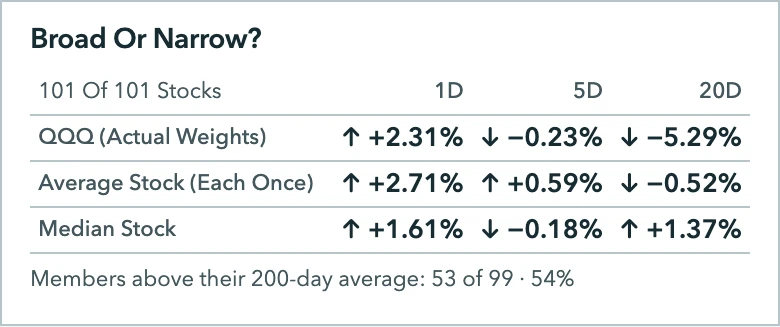
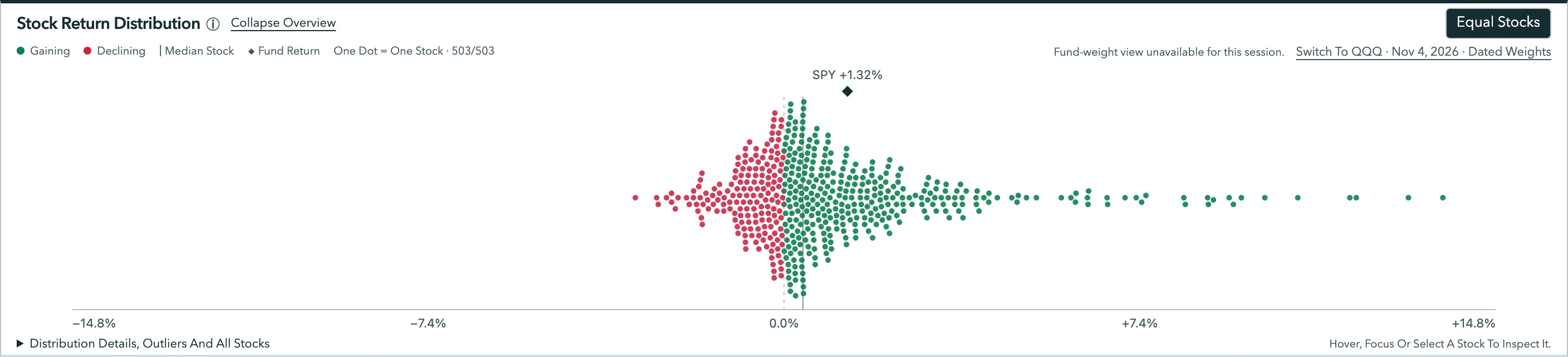
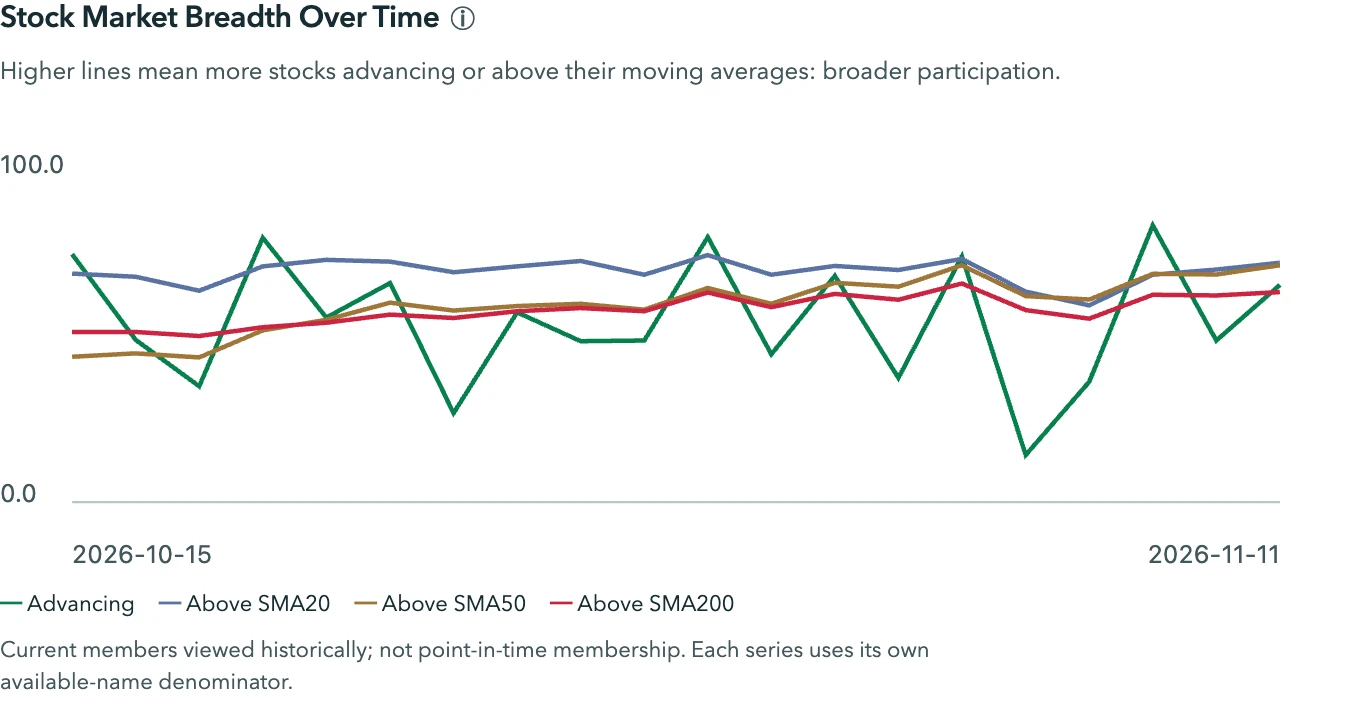
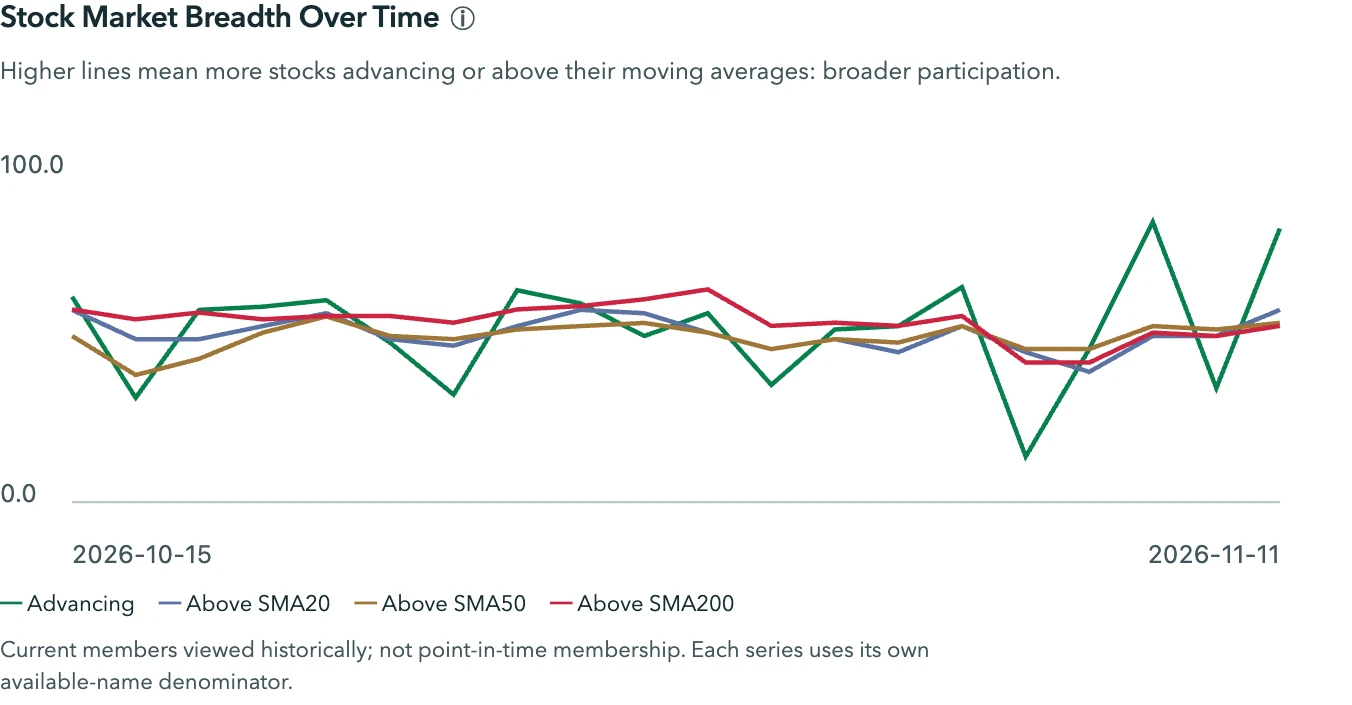
SPY: +1.32%, 66.0% of 503 members advancing (332 up, 168 down, 3 unchanged), 73% / 72% / 64% above the 20-, 50- and 200-day averages, median member RSI 57.4, higher than 96% of the past year's readings. QQQ: +2.31%, 83.2% advancing (84 of 101), 58% / 54% / 54%. AI 30: 26 of 30 up, 33% / 23% / 43%. Monday's rebound had more advancers (84.1% of S&P members) and a higher median; Wednesday had more members above their 200-day (63.8%, from 62.8% on Tuesday and 63.0% on Monday) and no new lows.



The session: a gap that was not filled
SPY opened at $756.80, 0.92% above Tuesday's close, ranged $754.90 to $762.51 and closed at $759.81, 65% of the way up its range; its low stayed above Tuesday's high of $752.14, so the gap is open. QQQ opened at $687.28, ranged $683.56 to $695.57 and closed at $690.38, its low above both its 200-day average and Tuesday's high of $680.95. Both funds crossed above their 9-day exponential averages, and QQQ above its 200-day.
How deep is the correction?
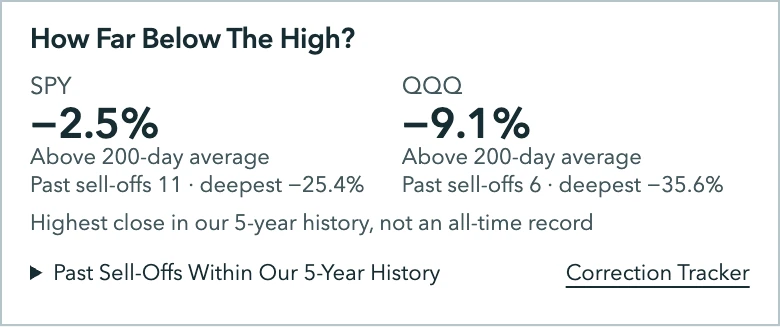
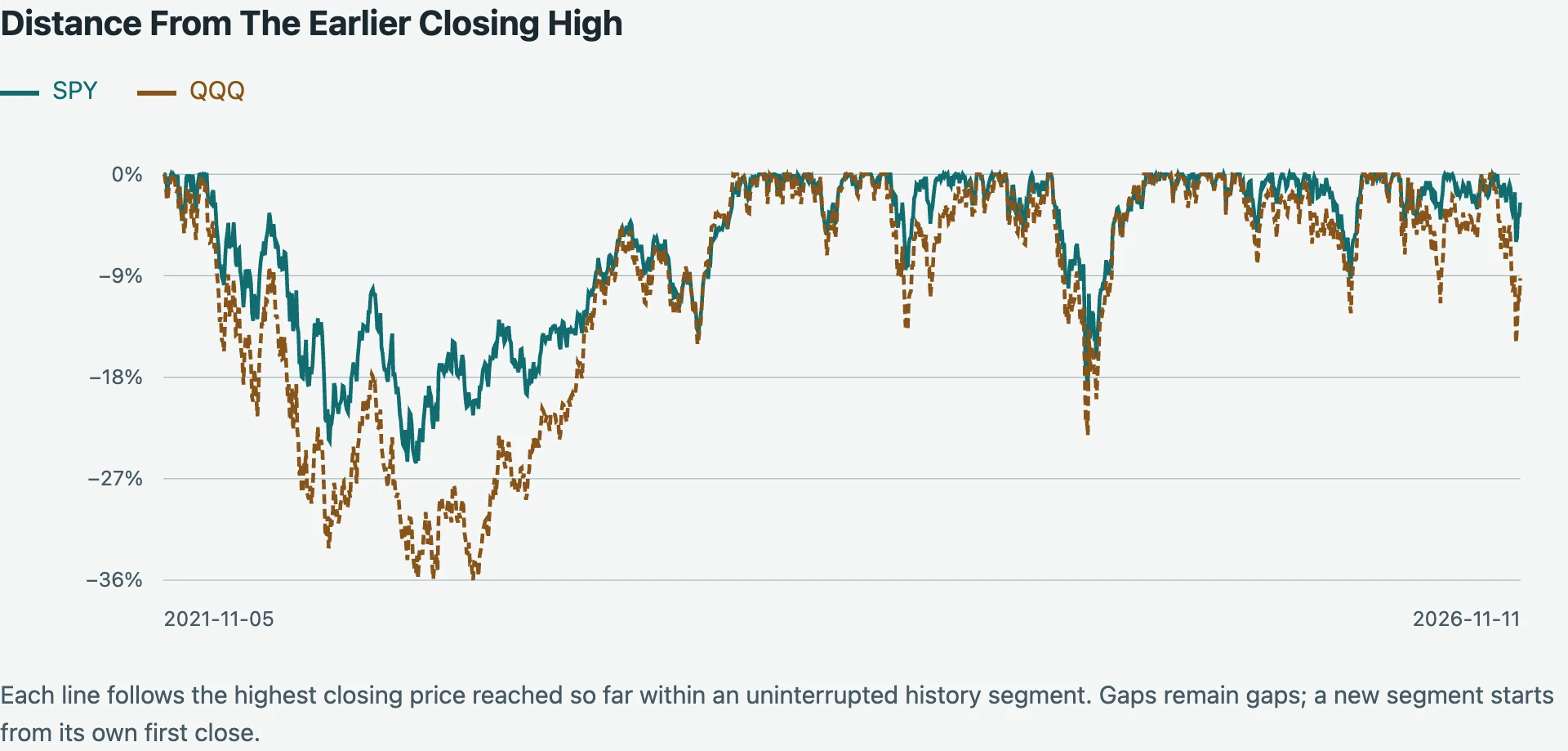
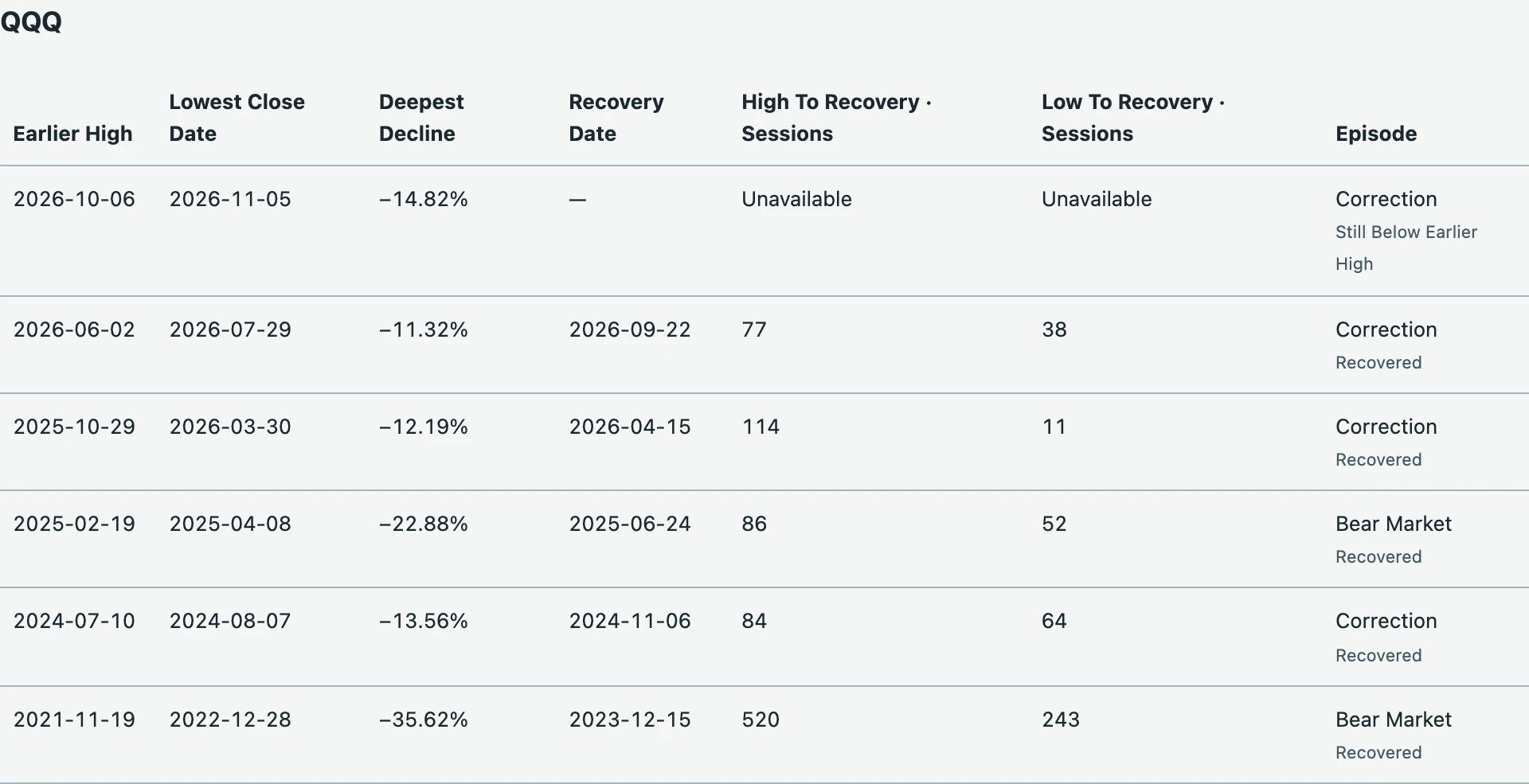
SPY closed 2.47% below its October 6 closing high of $779.09 and QQQ 9.12% below $759.66, from 3.74% and 11.18% on Tuesday. The Correction Tracker keeps QQQ's episode open at a deepest decline of 14.82% on November 5; SPY has no open decline of 10% or more. On Tuesday QQQ sat 4 sessions below its 200-day average; Wednesday's close is above it.
AI 30 Health: the repair count turned up
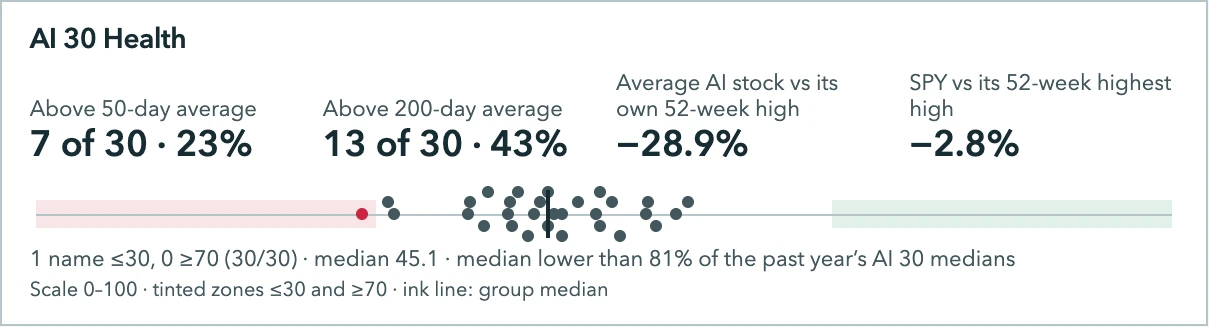
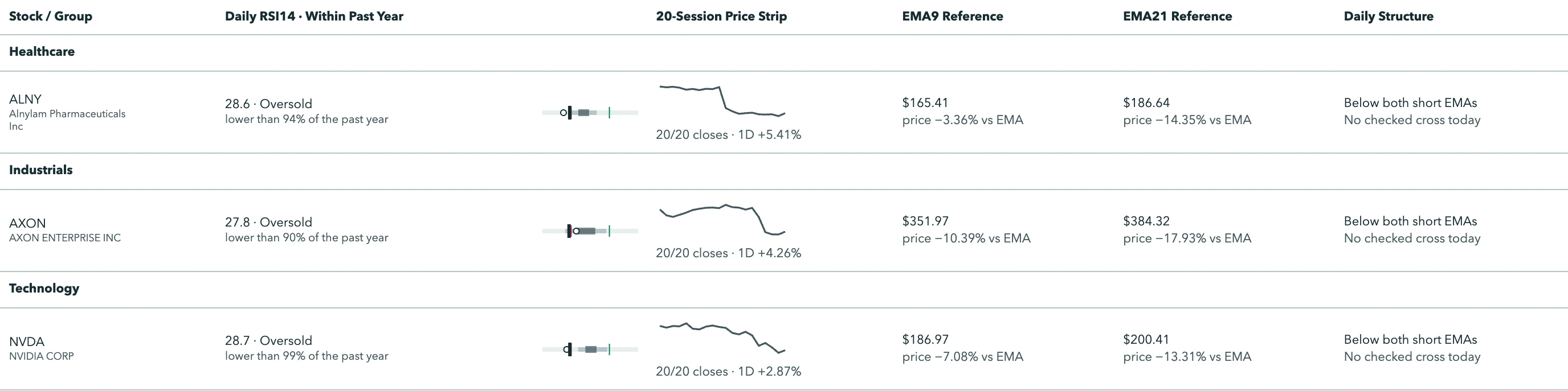
Seven of 30 AI names are above their 50-day average (23%, from 4 on Tuesday; AMD, Arista and Constellation joined), 13 above their 200-day (43%, from 11), and the average AI stock is 28.9% below its 52-week high, from 31.4%, against 2.8% for SPY. On Tuesday we wanted this count rising from four toward a third; it rose to seven. One name is oversold (NVIDIA, RSI 28.7); the group's median RSI of 45.1 is lower than 81% of the past year's AI 30 medians. The count is Wednesday's close.
Broad or narrow? QQQ broad, SPY led by its largest names
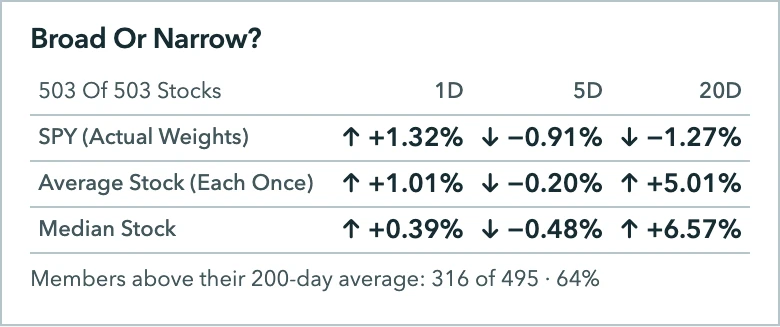
SPY's +1.32% beat its average stock (+1.01%) and its median (+0.39%), so the fund's largest names did more than their share; over 20 sessions the fund is −1.27% while the average stock is +5.01% and the median +6.57%. QQQ's +2.31% sat between its average (+2.71%) and its median (+1.61%), a broad move. Contributions remain unavailable (the Fund Bridge has no checked previous-close weights), so we cannot measure how much came from the chip names.
Distribution and breadth history: dispersion returned
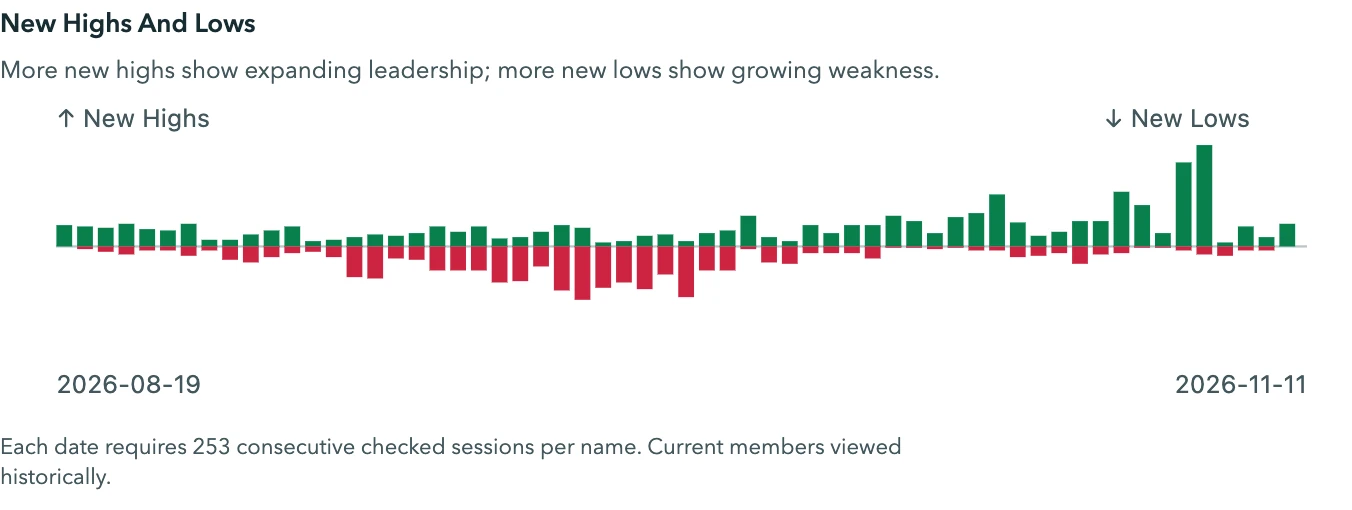
S&P member dispersion rose to 2.30 percentage points, the 59th percentile of the past year, from 1.71 (17th) on Tuesday; the Nasdaq-100's rose to 4.14 from 2.00, the 87th percentile. On Monday we flagged 55% of S&P members above their 200-day and new lows exceeding new highs as warning lines; Wednesday read 63.8% (316 of 495) with 17 new 52-week highs, among them Apple, Coca-Cola and Intercontinental Exchange, against no new lows. The Nasdaq-100 had three new highs and one new low (MercadoLibre); the AI 30 and crypto breadth charts show 26 of 30 and 7 of 7 advancing with no new highs or lows, and 33% and 0% of their names above the 20-day average. The dated readings table repeats these values.
Leaders and laggards: memory, servers and optics led; Microsoft lagged again
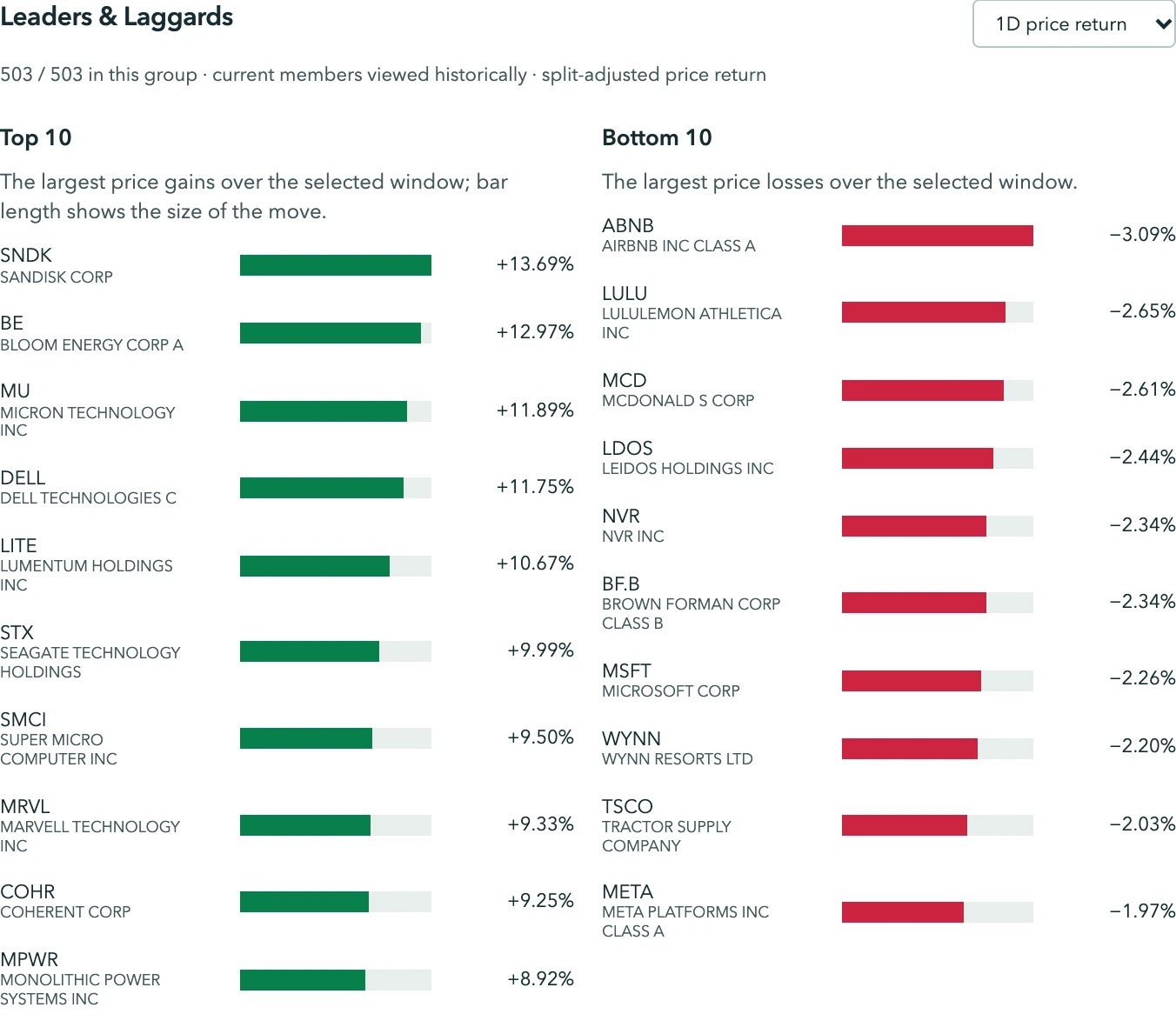
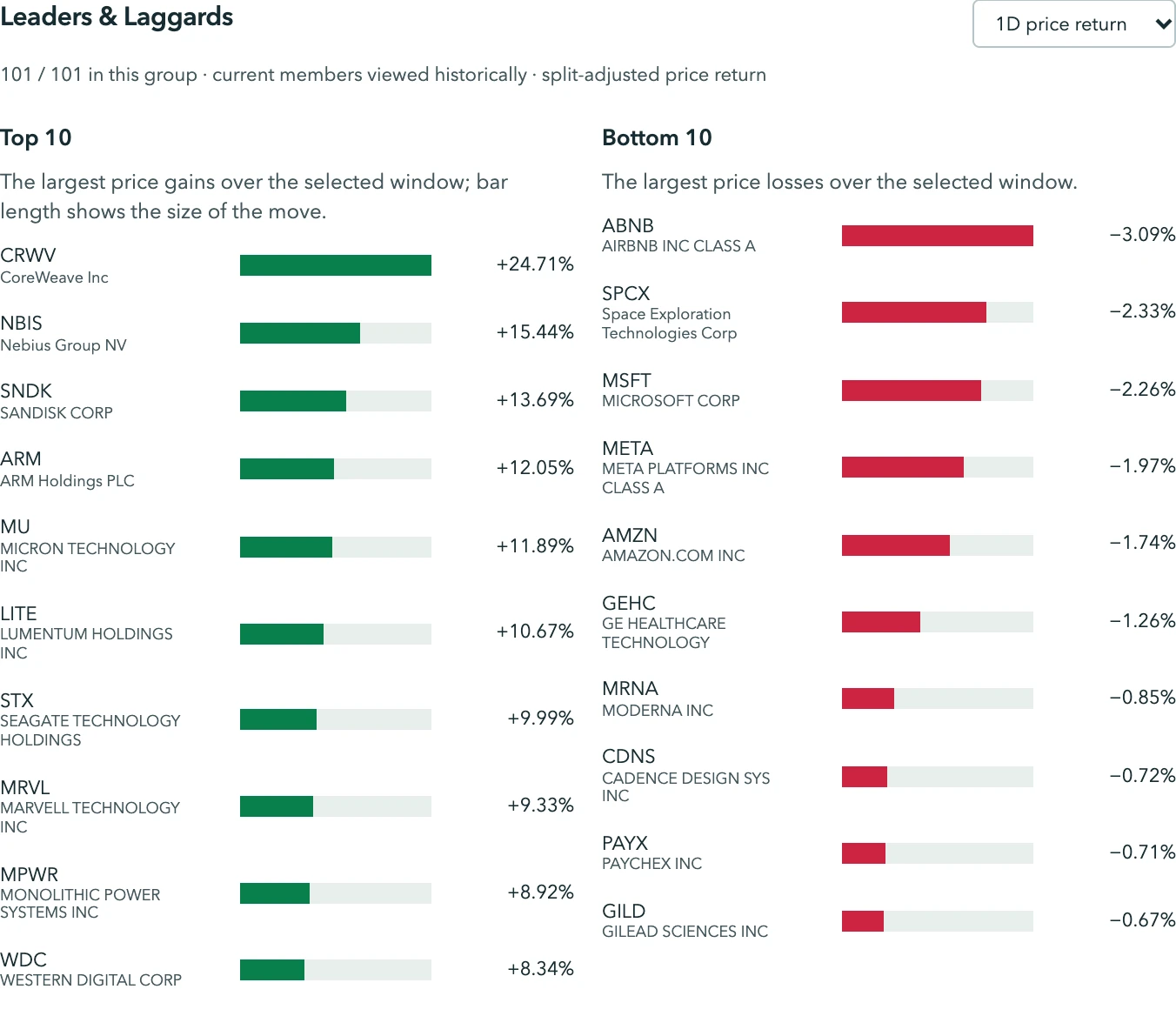
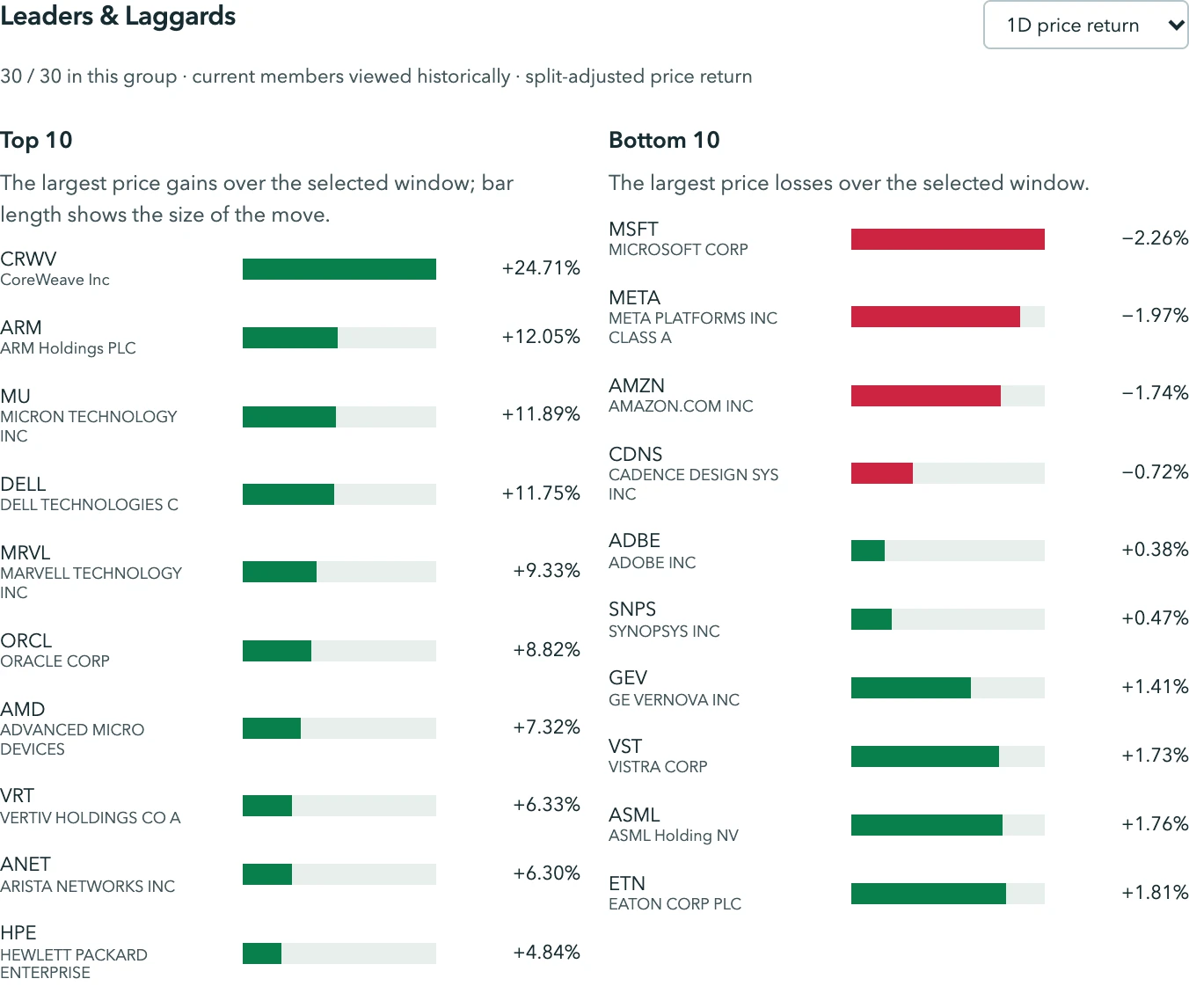
S&P leaders: Sandisk +13.69%, Bloom Energy +12.97%, Micron +11.89%, Dell +11.75%, Lumentum +10.67%. Laggards: Airbnb −3.09%, Lululemon −2.65%, McDonald's −2.61%, Leidos −2.44%, NVR −2.34%. Nasdaq-100 leaders: CoreWeave +24.71% the day after its report, Nebius +15.44%, Sandisk, Arm +12.05%, Micron; laggards Airbnb, SpaceX −2.33%, Microsoft −2.26%, Meta −1.97%, Amazon −1.74%. In the AI 30, CoreWeave, Arm, Micron and Dell led, then Marvell +9.33% and Oracle +8.82%; Microsoft, Meta and Amazon trailed, Cadence −0.72% the only other decline. Microsoft's fall was its second straight (−6.24% over five sessions). The Big Moves module flags CoreWeave's move, and Skyworks +5.96%, with the ex-dividend context unchecked.
What about Nvidia?
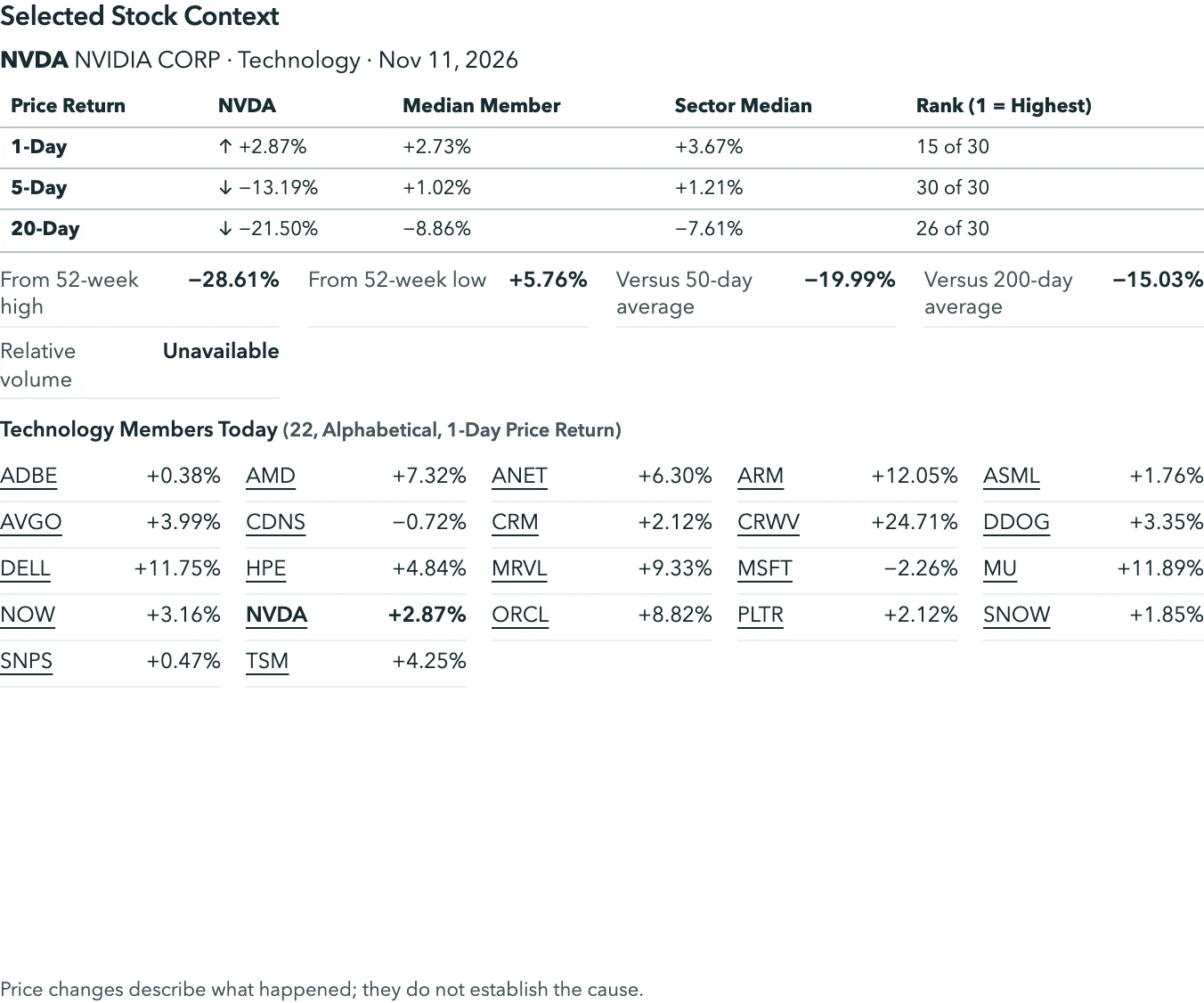
In the regular session NVIDIA closed at $173.73, up 2.87%, its first gain since the November 8 disclosure; Baird downgraded the stock to Neutral, citing the investigations and uncertainty over the CEO's tenure (analyst opinion). The close was 4.84 points above the $168.89 we asked it to hold on Tuesday and 2.76% below Monday's $178.67; the stock is still 13.19% lower over five sessions, with an RSI of 28.7 and an options-pricing label of Extreme. The after-hours price of $158.78 is 5.99% below $168.89. The company facts are unchanged: the independent directors' investigation, with Joon H. Kim and Wachtell, Lipton, Rosen & Katz, is under way, no findings have been published, and no leadership change has been announced. The board report and the relationship allegations are reported, not confirmed; the company's leadership is the open question into Thursday's open, six days before its results.
Held up in the sell-off
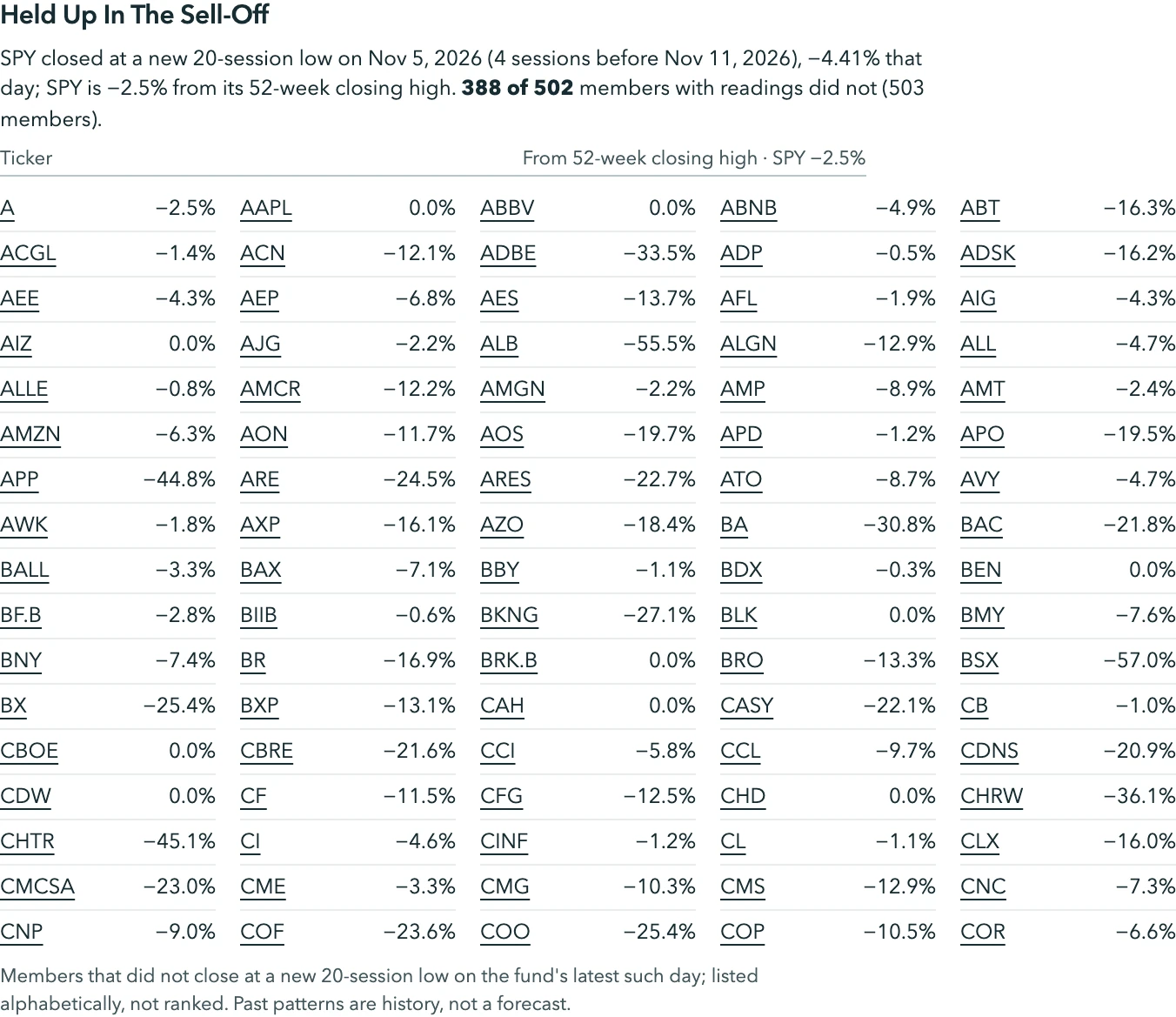
Unchanged anchor: 388 of 502 S&P members with readings and 59 of 101 Nasdaq-100 members did not close at a new 20-session low on November 5, the funds' worst day, 4 sessions ago. On the AI 30 and crypto tabs this slot is the Selected Stock Context table.
Sectors: Energy unanimous, Technology best by median
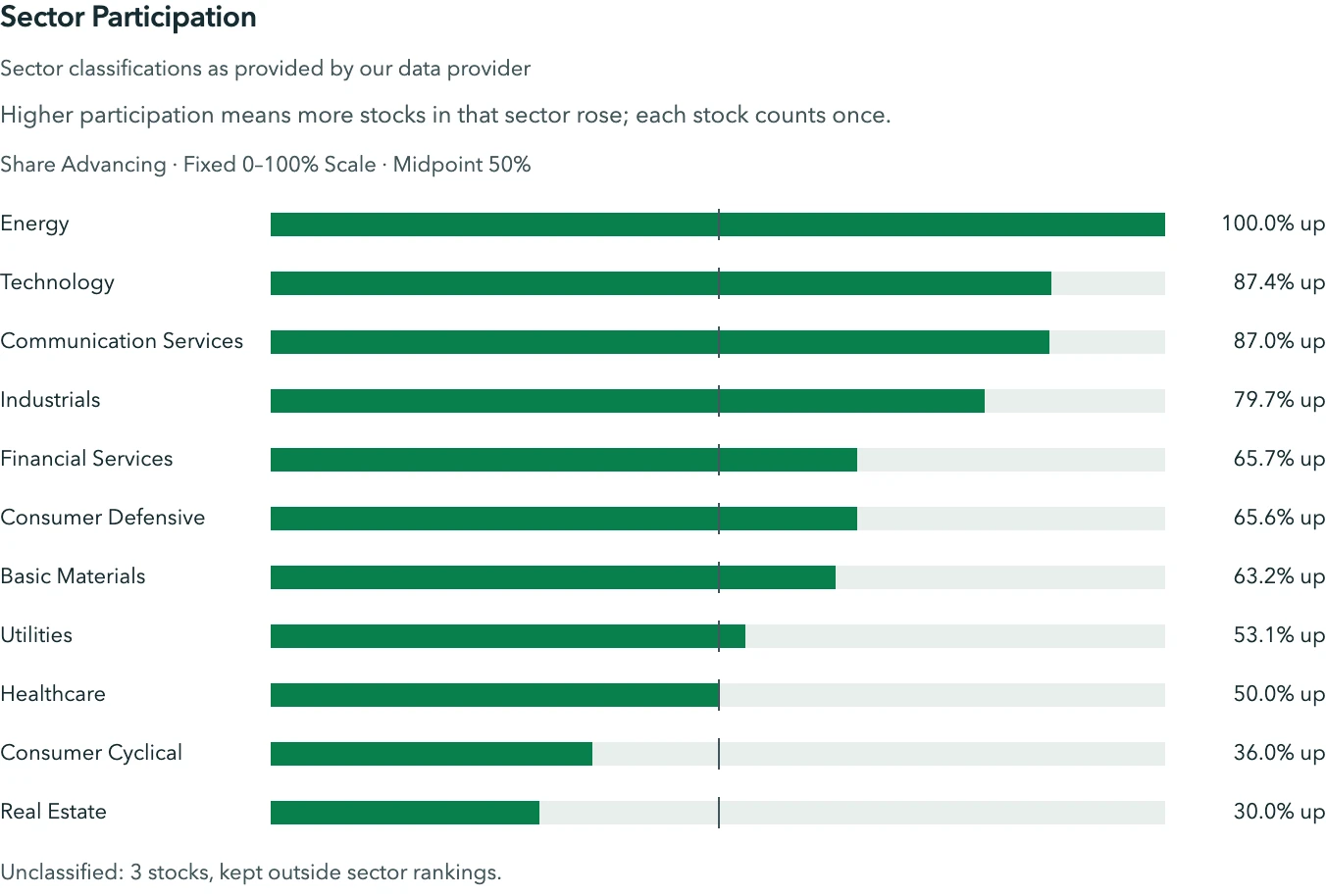
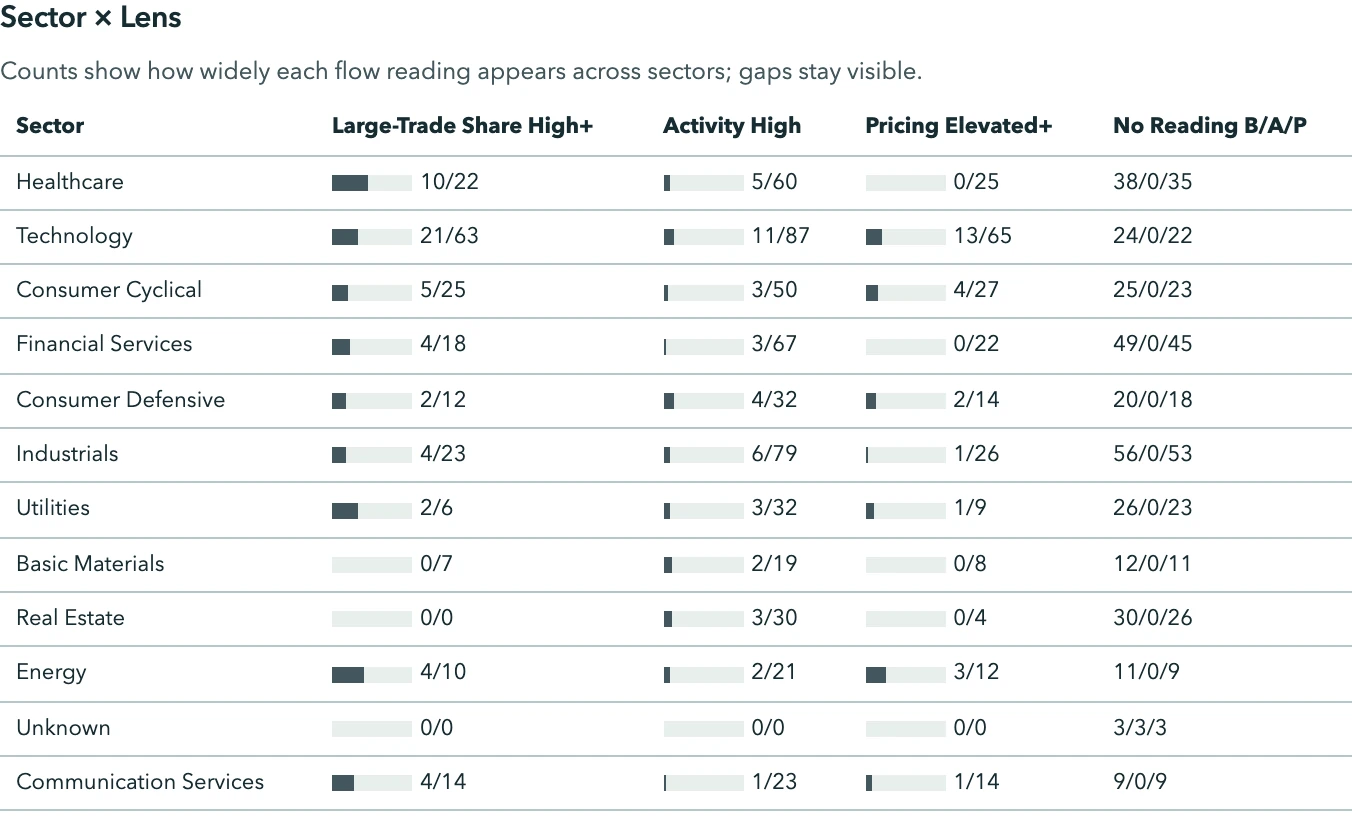
Eight of eleven S&P sectors had a majority advancing. Energy was unanimous (21 of 21, median +2.12%); Technology had the best median (+2.48%, 87.4% of 87 members advancing), then Communication Services (+0.91%, 87.0%) and Industrials (+0.80%, 79.7%). Real Estate (30.0% advancing, −0.16%) and Consumer Cyclical (36.0%, −0.39%) trailed; Healthcare split 50-50 with a flat median. In the Nasdaq-100, 92.7% of Technology members rose (median +3.09%), against 24.4% on Tuesday. On the AI 30 tab, Technology (22 names) was 90.9% up with a +3.67% median, Industrials and Utilities were unanimous, Communication Services split one up and one down, and Consumer Cyclical (Amazon) was the only group with no gainer; on the crypto tab all three groups were fully up. The Sector × Lens tables count 56 high-or-above large-trade-share readings among 200 S&P members with readings, 17 of 73 in the Nasdaq-100, 10 of 30 in the AI 30 and 0 of 2 on the crypto tab; the Participation Strips and Full Sector Tables repeat the majorities.
Volume: the rebound came on light share volume
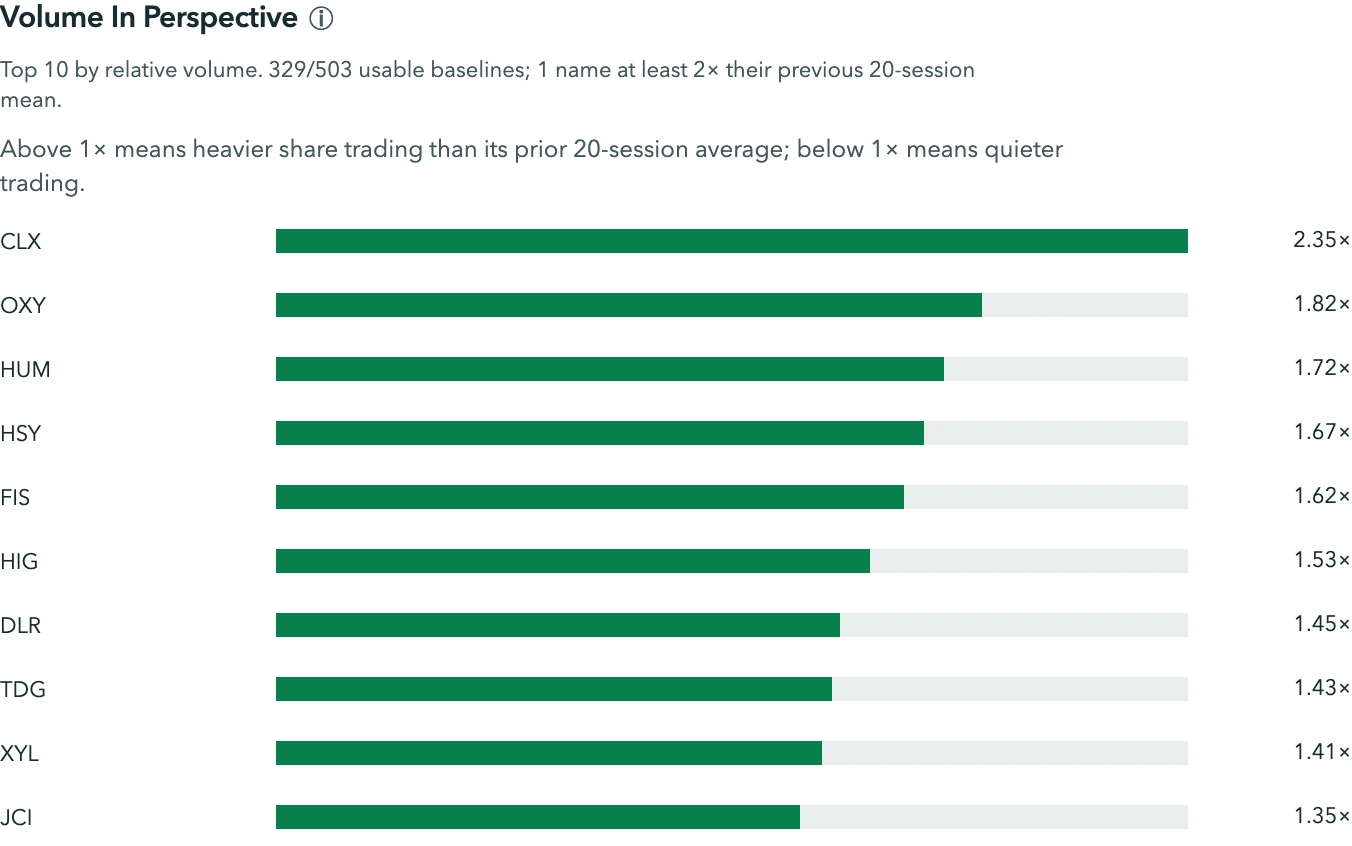
SPY's own relative volume was 0.76x and the median member's 0.72x (329 of 503 with baselines); the relative-volume histogram has one name, Clorox at 2.35x, at twice its 20-session mean. A new panel in the Volume module, "Was The Bounce Real?", puts SPY's share volume at 0.76 times its 20-session average and 0.30 times the November 5 drop day, with the close 65% of the way up the range; QQQ's reads 0.82x, 0.32x and 57%. The panel's own caveat applies: lower volume than the drop day does not by itself show weak participation. Volume remains unavailable for QQQ members; it is available for 9 of 30 AI names (median 0.86x, Dell 1.18x the busiest) and 3 of 7 crypto names (median 0.47x).


Momentum: oversold names fell from 12 to 3
SPY's 14-day RSI rose to 49.9 from 44.6 and QQQ's to 46.1 from 40.1. S&P oversold names fell to 3 from 12 and overbought rose to 44 from 42; the Nasdaq-100 has 3 oversold and 9 overbought; the AI 30 one oversold (NVIDIA) and no overbought; the crypto tab neither. The bottom-10%, top-10% and EMA-cross filters list the names behind these counts.
The AI Ecosystem tab: chips 90% up
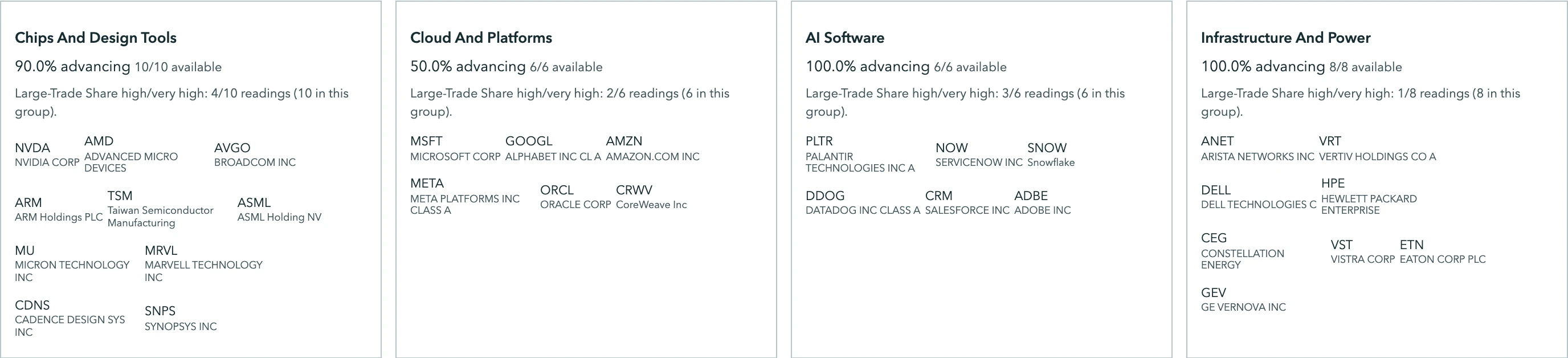
Chips And Design Tools: 90.0% advancing (9 of 10), from 30.0% on Tuesday; the other three groups ran 50.0%, 100% and 100%. On the AI 30 tab the return distribution ran 26 up and 4 down around a +2.73% median, 10 of 30 names were above their 20-day (from 7), and there were no new 52-week highs or lows. The day's AI-financing news cut both ways: TSMC's board approved up to $500 million of Anthropic shares at the IPO price (SEC filing), while SoftBank reported a fiscal second-quarter net loss of about $7 billion after a $3.7 billion writedown on US datacenter equipment payments (Reuters).
Crypto-related equities: all seven up, none above a 20-day average
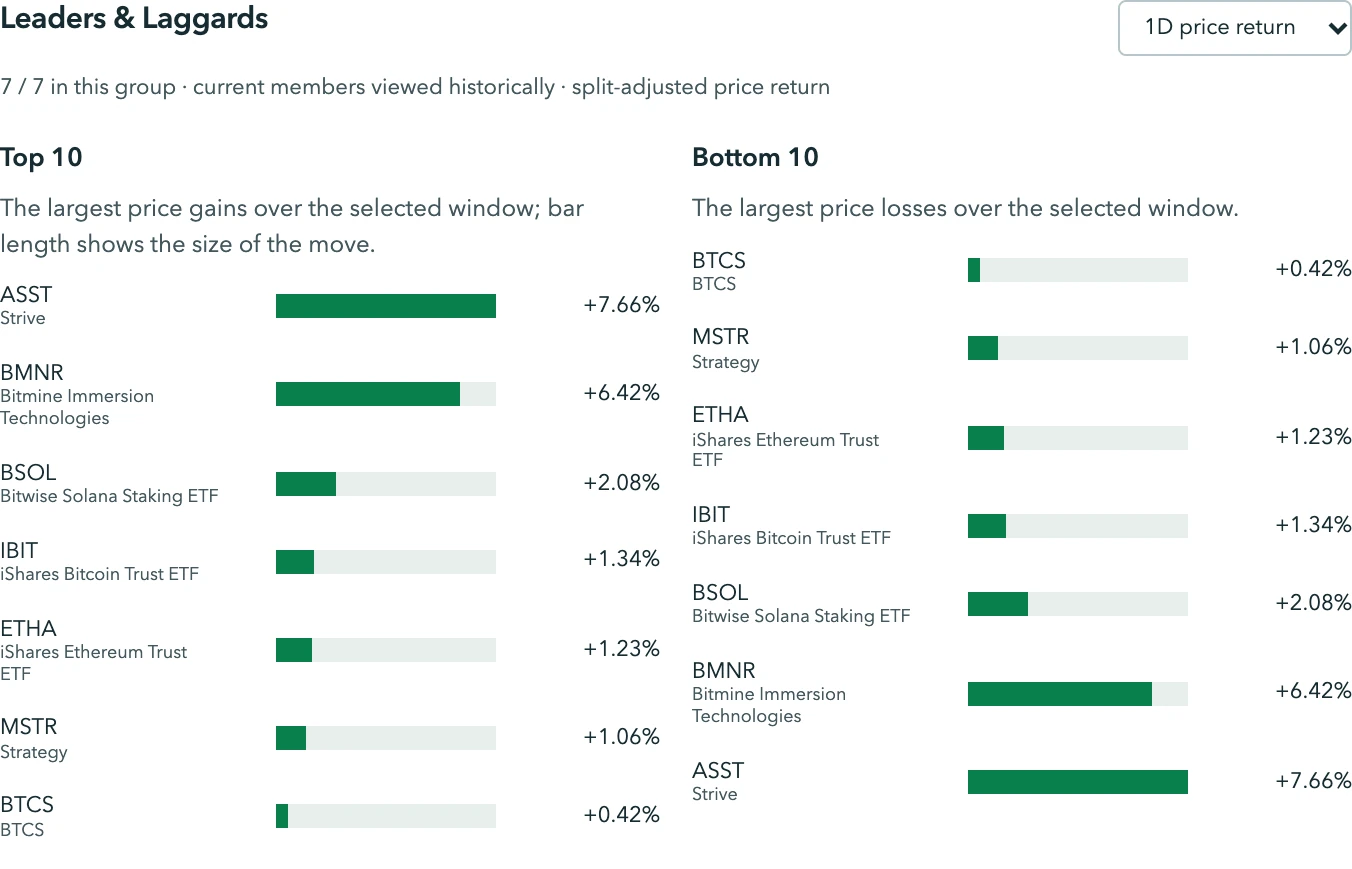
All seven rose: Strive +7.66%, Bitmine +6.42%, the Solana trust +2.08%, the bitcoin trust +1.34%, the Ethereum trust +1.23%, Strategy +1.06%, BTCS +0.42%, for a +1.34% median. None is above its 20- or 50-day average, two are above the 200-day, and the median 20-session return is −14.26%.
Quiet and unavailable panels, in one line
The Metric Guide, Session In One Paragraph, Today's News (10 of 15 verified stories at 7:20 p.m. CT; we cite its sources, not the panel), What Moved The Market Today (price moves only; contributions unavailable), the stock chart, Lenses rail, Find A Stock and Share Previews are populated; the Fund Bridge, Rotation, Big Moves event history, Flow Grid sentiment lens, Dividends and the Macro six views are unavailable, and the sentiment and position lenses carry no labels. The Correction Tracker page is covered above; the Economy page carries no new release; the Journal index, the About page and the footer dialogs are static text.
Macro panel: carried yields, no Veterans Day row
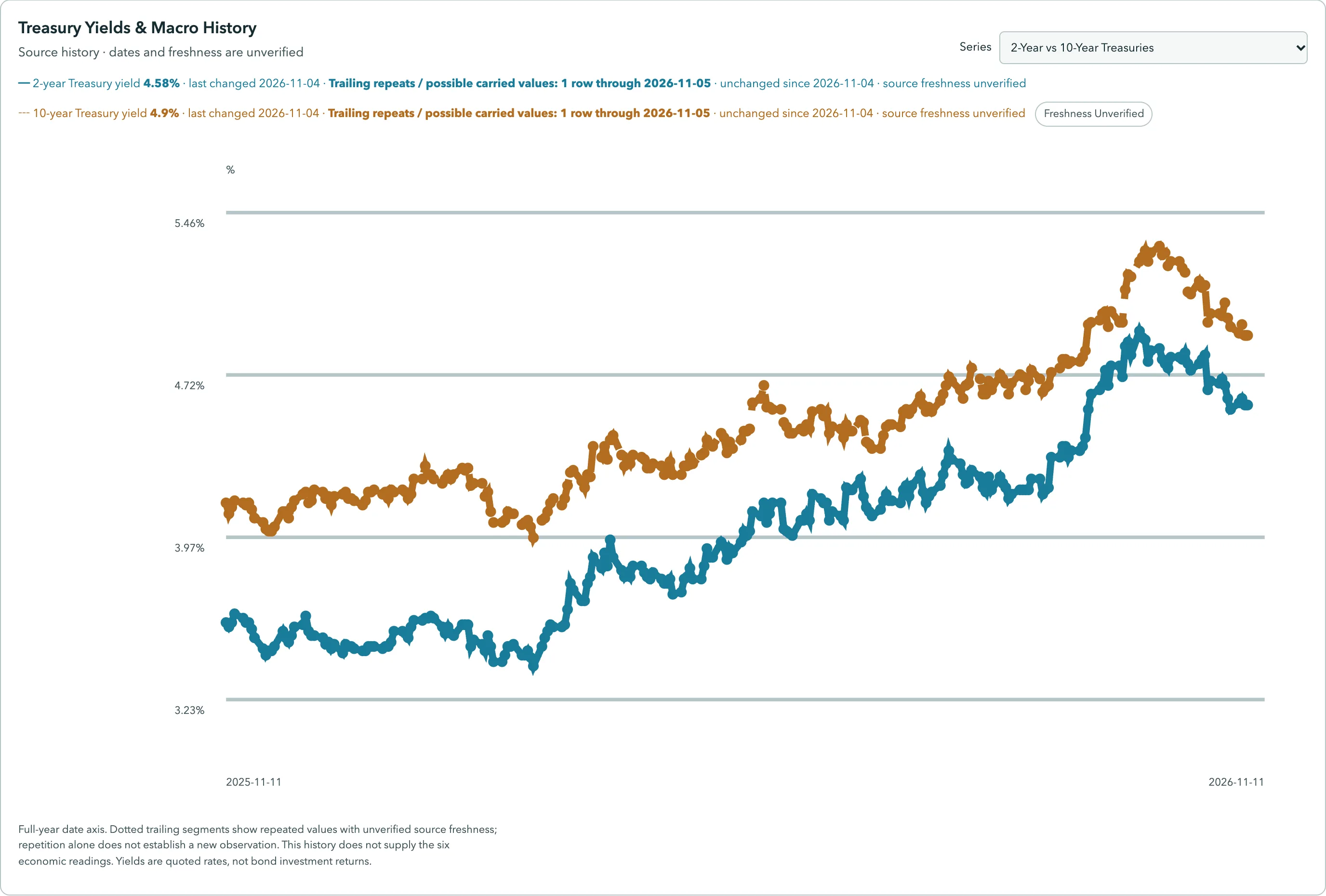
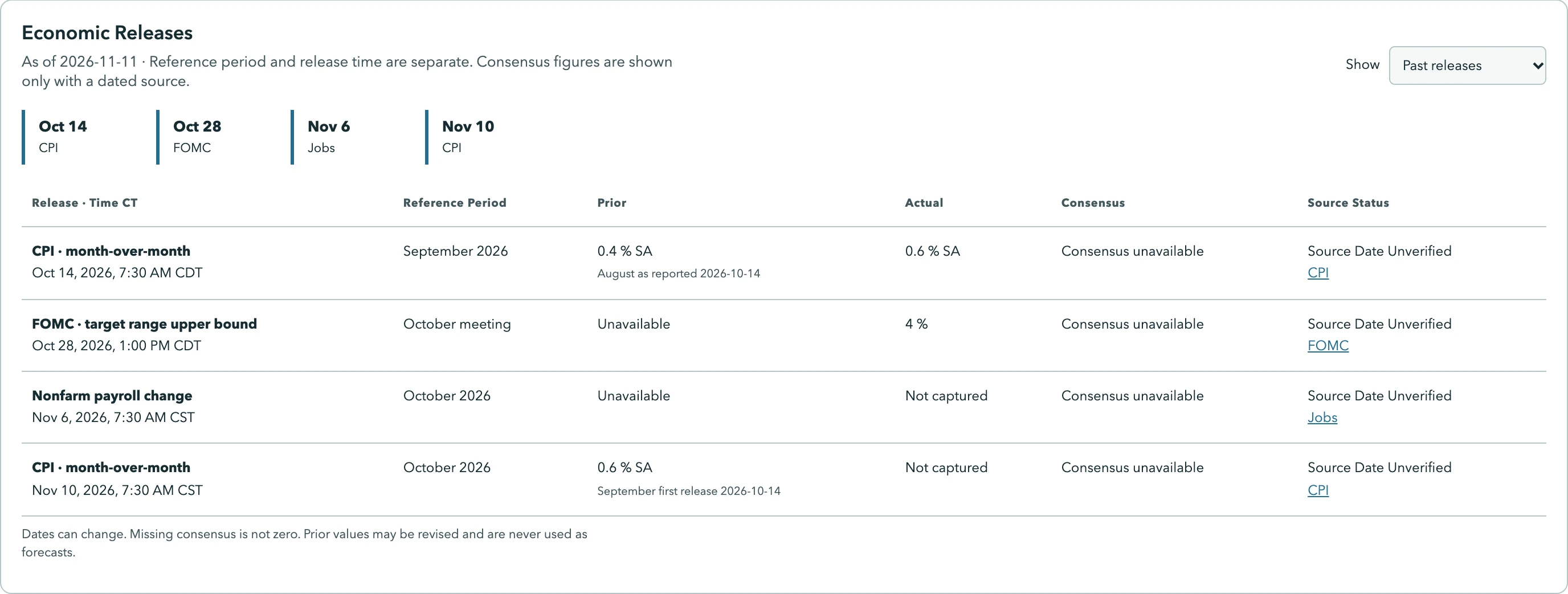
The panel's yield history still shows a 2-year at 4.58% and a 10-year at 4.9%, last changed November 4 and marked unverified; the cash Treasury market was closed on Wednesday, so there is no new par-yield curve. The Economic Releases table lists no release for November 11 and still shows Tuesday's CPI with the actual "Not captured".
Market History, Performance & DCA, Stock History
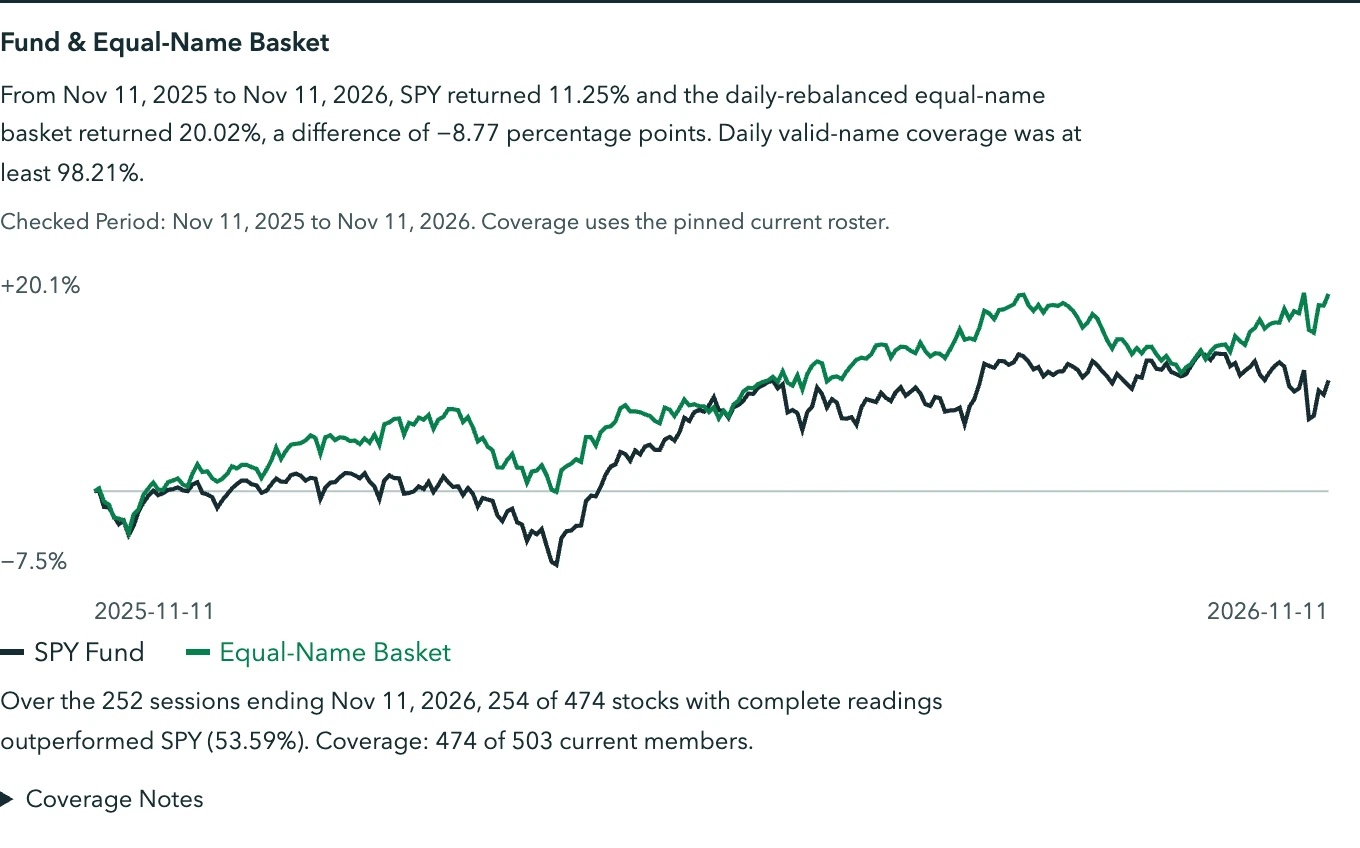
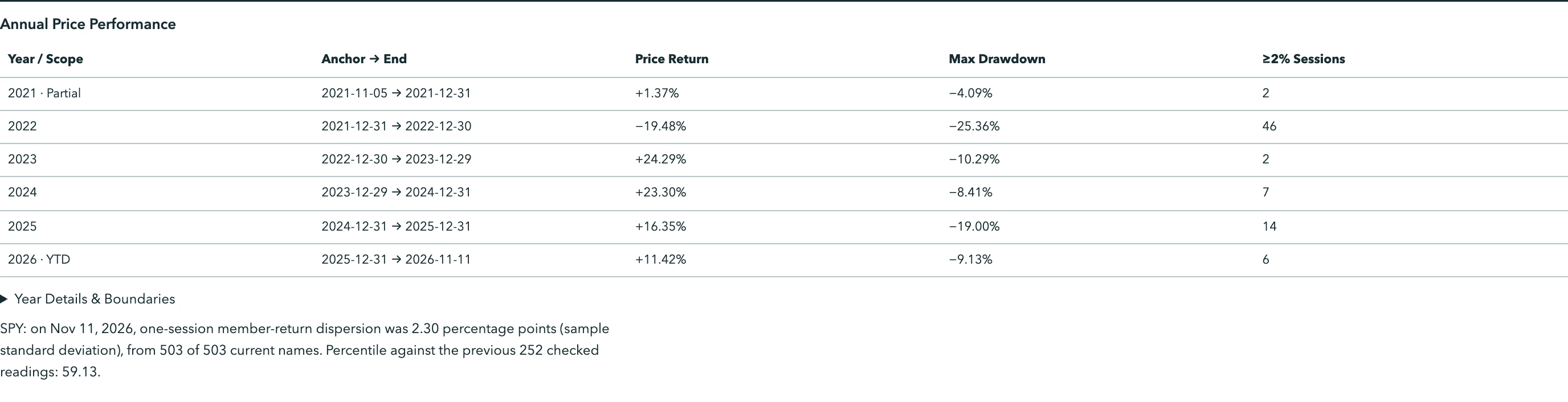
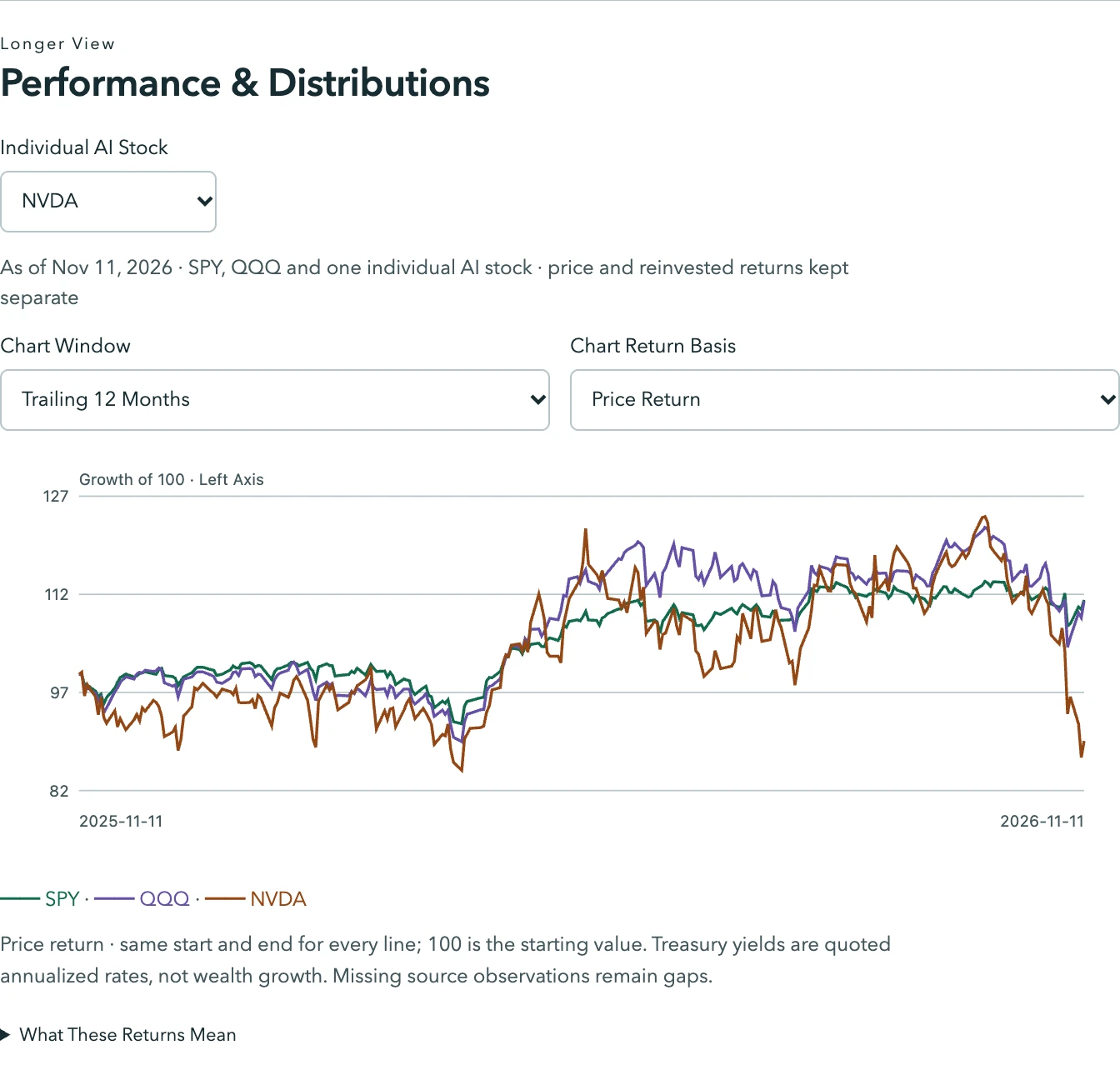
Over twelve months SPY returned 11.25% against 20.02% for an equal-name basket of its members, QQQ 11.07% against 29.28%; for 2026 to date, +11.42% and +12.38%, with maximum drawdowns of 9.13% and 14.82%. The Recurring Investment Calculator's default SPY case shows $16,500 contributed and $17,957 of value. The Performance chart shows NVIDIA behind both funds over twelve months; Stock History's After Drawdowns card has insufficient checked data.
Flows
Figures come from the day's options tape and the dashboard's flow labels; sides are the tape's classifications, not confirmed purchases or sales; size and side do not prove intent; flow is context, not a forecast. The tape ends at 4:59 p.m. ET, before the Nvidia reports, so none of the after-hours reaction is in these figures.
Market level: calls took the larger share
Options prints of $25,000 or more added up to $25.51 billion in premium on Wednesday, up from $23.19 billion on Tuesday but below Monday's $34.93 billion, and 0.90 times the median of the previous 20 sessions. Puts took 42.8% of that premium, down from 52.8% on Tuesday; only 4 of the previous 20 sessions had a lower put share. Across the dashboard's stocks and funds, put volume was 0.73 times call volume, down from 0.93, with call volume at 1.12 times its 30-day average and put volume at 0.94 times. In SPY, big-print call premium of $554.6 million outweighed put premium of $313.1 million, and in QQQ calls came to $644.2 million against $491.1 million in puts; on Tuesday puts had been the larger side in both. In SMH the two sides were close ($113.0 million of calls, $117.3 million of puts), and IWM kept its put tilt ($83.6 million of puts, $23.4 million of calls). SPY's big-money label rose from Normal to Very high, QQQ's from Low to Normal with its pricing label easing to Normal from Elevated, and the activity lens rated 247 of 528 names Low, from 269.
Sectors: arithmetic artefacts
Technology option volume ran busiest against its 30-day average (1.20x; 1.27x for calls), Energy quietest (0.71x). Consumer Cyclical's +31.8% premium change was Tesla (61% of the sector; −4.8% without it), and Utilities' −2.3% hides a dividend-arbitrage package in American Water Works ($44.25 million of deep in-the-money calls the session before its dividend date); $259.8 million of Apple's $446.3 million in big-print premium was the same pattern ahead of its November 12 dividend date.
Single names: NVIDIA near even, AMD and CoreWeave busy
NVDA rose 2.9% in the regular session with call volume at 1.7 times its 30-day average and put volume at 1.4 times; premium classified as bullish ($933.6 million) and as bearish ($901.4 million) were close to even after Tuesday's $126.1 million bearish excess, and its 30-day implied volatility fell 4.1 points to 55.2%. AMD rose 7.3% with call volume at 2.2 times its average; CoreWeave's 30-day implied volatility fell 33.0 points to 87.9% after its results. Microsoft fell 2.3% for a second day with put volume at 1.76 times and call volume at 1.53 times their averages and a classified net near zero; its big-money label is Very high. Across the AI 30 basket, call volume ran 1.40 times and put volume 1.23 times their summed 30-day averages on a median move of +2.73%, and put volume fell to 0.60 times call volume from 0.77.
Large and unusual prints: structures, not one-way bets
Most of the largest prints were again SPX call-and-put packages, mostly at strikes from 7000 to 8000 across expiries from November 20 into late 2027; the biggest, a nine-leg package at 3:03 p.m. worth $504.9 million gross, pairs a box-spread shape in its March 2027 legs with a collar-or-condor shape in its December legs, financing and range structures with no stated market direction. The largest NVDA order was one leg of a 5,000-contract June 2027 175/200 call spread at 10:45 a.m., coded as a single multi-leg trade, so it is a structure rather than a one-way position; AMD's largest package was a 12,498-contract February 2027 590/650 call spread worth about $119.5 million gross at 11:58 a.m. The largest single-leg stock print was a 32,000-contract Meta January 2027 750 call ($31.0 million, classified at the ask, a floor print). Spreads define a range rather than a direction, and even a single-leg call carries no stated intent.
Tying it in
The premium mix moved with price: the put share fell to 42.8% on a day 66.0% of S&P members and 92.7% of Nasdaq-100 Technology members rose, and AI 30 call volume ran well above its average while the basket's median gained 2.73%. Put premium stayed relatively heavy in IWM and level with call premium in SMH, and Microsoft's put volume ran 1.76 times its average as it fell a second day. In our view the regular-session tape read as a rebound with the usual financing structures on top; what it could not see was the after-hours Nvidia news, which arrived after the last print.
Economy
No US economic indicator was released on Wednesday, November 11 (Veterans Day); the Bureau of Labor Statistics schedule lists nothing for the day, and the cash Treasury market was closed, so Tuesday's par yields stand: 2-year 4.73%, 10-year 4.98%, 30-year 5.35%. The latest inflation release remains Tuesday's October CPI, +0.4% on the month with core at +0.3% for a third month; the agency published no October 12-month headline or core rate because October 2025 data were not collected.
Chicago Fed President Austan Goolsbee, a 2027 voter, called the October CPI "another distressing report — borderline disturbing" and declined to commit to a December move, in an interview aired Tuesday and reported by CNBC on Wednesday. CNBC, citing futures pricing, said a December increase is fully priced and a 50-basis-point move about 15%. Goldman Sachs economist David Mericle and UBS's Ulrike Hoffmann-Burchardi both now see hikes in December and March (analyst opinion, as reported by CNBC). Mortgage News Daily's 30-year fixed rate rose 12 basis points to 7.30%, ending four weeks of declines (CNBC).
Improved since the previous release: nothing new; no indicator was released. Tuesday's improvements (headline CPI 0.6% to 0.4% m/m; shelter, gasoline and energy cooling) stand.
Deteriorated: nothing new in the data. In our view the tone deteriorated: a voter called the print "borderline disturbing", two banks moved their forecasts toward more hikes, and mortgage rates rose.
What it means for SPY and QQQ (our view): bull evidence: the market absorbed a hot CPI and a hawkish chorus with a 1.32% gain, 66.0% of S&P members advancing, 17 new highs against no new lows and 63.8% of members above their 200-day; energy inflation cooled in October. Bear evidence: core at 0.3% for a third month with a December hike fully priced and a 50-basis-point move still live, the 2-year at 4.73% and the 10-year at 4.98% into Friday's PPI, and a Nvidia leadership shock on top. In our view the rate path remains the main risk to valuations beneath the Nvidia headline; a hot PPI on Friday would harden it.
Next release that could change this: weekly jobless claims, Thursday, November 12, 08:30 ET (Labor Department); then October PPI, Friday, November 13, 08:30 ET; FOMC minutes November 18; November CPI December 10†.
Outlook
Scenarios with conditions, not forecasts; the weights are our subjective leanings and sum to 100. They cover Thursday, November 12 and Friday, November 13, so exactly one happens; evaluate bear first, then bull, else base. The after-hours reaction changes the weights, not the Monday lines: NVDA already sits below the $168.89 we asked it to hold, so the bear case rises to 40% from Tuesday's 30% and the bull case falls to 15% from 20%. Our lean is neutral at the index level: the bull and base cases carry 60% of our weight, below the two-thirds we would want before leaning bullish, the base case is a hold, and the deciding fact, Nvidia's board, is binary and unresolved; the gap between the tails (40 against 15) reflects the after-hours loss already in hand, not a directional call. Beneath the leader the broad market's evidence is constructive; concentrated AI is where the caution sits.
Bear — "the leader drags the index" (about 40%, from 30%).
- Trigger: any SPY close below Monday's opening price of $741.95 or any QQQ close below $662.64 on Thursday or Friday, or a QQQ close on Friday below its 200-day average of $681.71, the level it reclaimed on Wednesday.
- Path: QQQ back through $681.71 toward Tuesday's close of $674.76, with $662.64 beneath; SPY through its 9-day exponential average at $753.52 toward Tuesday's $749.92, with $741.95 beneath. The accompanying sign would be SMH and the AI 30 median falling as far as NVIDIA at Thursday's open rather than diverging from it as they did after hours (SMH −2.72% against NVDA −8.61%), and a 2-year par yield above 4.73% after Friday's PPI.
- Leaders and laggards: relative leaders would be Wednesday's unanimous Energy sector (21 of 21 up), the 17 new-high names, Consumer Defensive (65.6% advancing) and, within chips, AMD and Broadcom, which rose after hours. Laggards: NVIDIA, CoreWeave (−6.37% after hours), Super Micro (−5.06%), Dell (−3.65%), Micron (−2.77%) and the neoclouds (Nebius −4.02%, IREN −4.27%).
- Window: any close Thursday or Friday for the Monday lines; Friday's close for the 200-day test.
- Invalidation: both Monday lines intact and QQQ at or above $681.71 at Friday's close.
Bull — "the rebound extends through the news" (about 15%, from 20%).
- Trigger: no bear trigger, and on Friday, November 13 SPY closes above its 20-day average of $760.20 (0.39 points above Wednesday's close) and QQQ closes above Wednesday's close of $690.38, so that the after-hours loss is recovered and the rally extended.
- Path: SPY through $760.20 toward its 50-day at $764.96, QQQ above $690.38 toward its 20-day at $698.94, on a board outcome or company statement that settles the leadership question and a PPI no hotter than the reported consensus published Friday.
- Leaders and laggards: Wednesday's leadership continues: Technology broadly (87.4% of S&P Technology members advancing), AMD, Broadcom, TSMC, the memory names Micron and Sandisk, and Industrials (79.7%). NVIDIA can lag here too; the bull case does not need it, but it needs the AI 30 repair count holding at or above 7 of 30.
- Window: Friday's close.
- Invalidation: a bear trigger at any close, or Friday closes below either level.
Base — "the broad market holds, the leader is repriced" (about 45%, from 50%).
- Trigger: no bear trigger, and Friday's closes do not clear both bull levels.
- Path: QQQ holds between its 200-day at $681.71 and Wednesday's close of $690.38, around its after-hours $684.00; SPY holds between its 9-day exponential average at $753.52 and its 20-day at $760.20, around its after-hours $756.10. NVIDIA trades below $168.89 while the rest of the AI 30 holds most of Wednesday's gains, as the after-hours divergence showed.
- Leaders and laggards: the median stock and Wednesday's majorities, Energy, Technology outside NVIDIA, Communication Services (87.0% advancing) and Industrials; laggards NVIDIA and the names that moved with it after hours (CoreWeave, Super Micro, Dell). The AI 30 above-50-day count holds near 7.
- Window: through Friday's close.
- Invalidation: a bear trigger, or Friday closes above both $760.20 and $690.38.
Before turning constructive on concentrated AI we would want: a board decision or company statement that settles Nvidia's leadership question, as reported; NVIDIA closing back above $168.89; the AI 30 count above its 50-day holding at 7 or more and rising toward a third; QQQ holding $681.71 on closes; the 2-year par yield no higher than 4.73% after PPI.
Warning signs that would strengthen the case for caution: a QQQ close below $681.71 or SPY below $753.52, then the Monday lines at $741.95 and $662.64; NVIDIA below its after-hours low of $156.20; SMH and the AI 30 median falling as far as NVIDIA at Thursday's open; S&P members above the 200-day under 55% (Wednesday: 63.8%); new lows exceeding new highs (Wednesday: 17 to 0); the AI 30 above-50-day count back to 4; a 10-year par yield closing above 5.00% after PPI.
Dip, wait, or trim? In our view the regular session answered Tuesday's question about the broad market: Monday's lines held with room to spare, QQQ reclaimed its 200-day, and the advance reached 66.0% of S&P members with no new lows. The after-hours news did not undo that beneath the surface, where AMD and Broadcom rose while NVIDIA fell, but it put the largest index weight into an open leadership question six days before its results and left QQQ's after-hours price 2.29 points above the average it had just reclaimed. That is why our lean is neutral rather than bullish: 60% of our weight sits on the cases in which the lines hold, but the deciding event is binary. In our view the broad market and Wednesday's majorities are where a case for adding on weakness rests, not Nvidia or the names that fell with it, and that case waits for Thursday's open and the board's outcome; a case for trimming concentrated AI would strengthen on a QQQ close below $681.71 or NVIDIA below $156.20, and a case for trimming broad exposure on either Monday line or a 10-year close above 5%. Net: neutral at the index level with a named bear trigger; constructive on the broad market beneath the leader; cautious on concentrated AI until the leadership question is resolved.
Key dates (times ET; dates can change; † = unverified): Thu Nov 12, 08:30 — jobless claims (Labor Department); before the open — Nebius results, as reported; 13:00 — 30-year auction†; after the close — Cisco results, as reported by Earnings Whispers and Yahoo Finance; any time — Nvidia's board, as reported. Fri Nov 13, 08:30 — October PPI (Bureau of Labor Statistics). Tue Nov 17 — retail sales; NVIDIA after the close. Wed Nov 18, 14:00 — FOMC minutes; Anthropic IPO pricing, as reported by CNBC. Thu Nov 19 — Anthropic's first trade, as reported. Wed Nov 25† — GDP and PCE. Fri Dec 4† — jobs report. Thu Dec 10† — CPI.
Final summary
- Nvidia's board and Thursday's open. The Journal's report is reported intent, not a decision, and the relationship claims are allegations; what the market can measure is a $158.78 after-hours price on 33 times normal after-hours volume against a $173.73 close. The $168.89 we named on Tuesday is now the level to reclaim at a close; $156.20 is the after-hours low.
- QQQ's 200-day at $681.71 and the Monday lines. The reclaim held in after-hours trading by 2.29 points; a Friday close back below it is the new bear trigger alongside $741.95 and $662.64. Our weights: bear 40, base 45, bull 15; neutral at the index level, constructive on the broad market beneath the leader.
- Claims Thursday, Cisco after Thursday's close, PPI Friday at 08:30 ET. A 2-year above 4.73% or a 10-year close above 5% after PPI would, in our view, say the rate pressure on growth valuations is growing even if the Nvidia question is settled.
Correction, Nov 21, 2026: The Treasury yields chart in this post shows data through Nov 5, not through the date in its caption.